
Tanzania at the T-Junction
Chambi Chachage
The protagonists
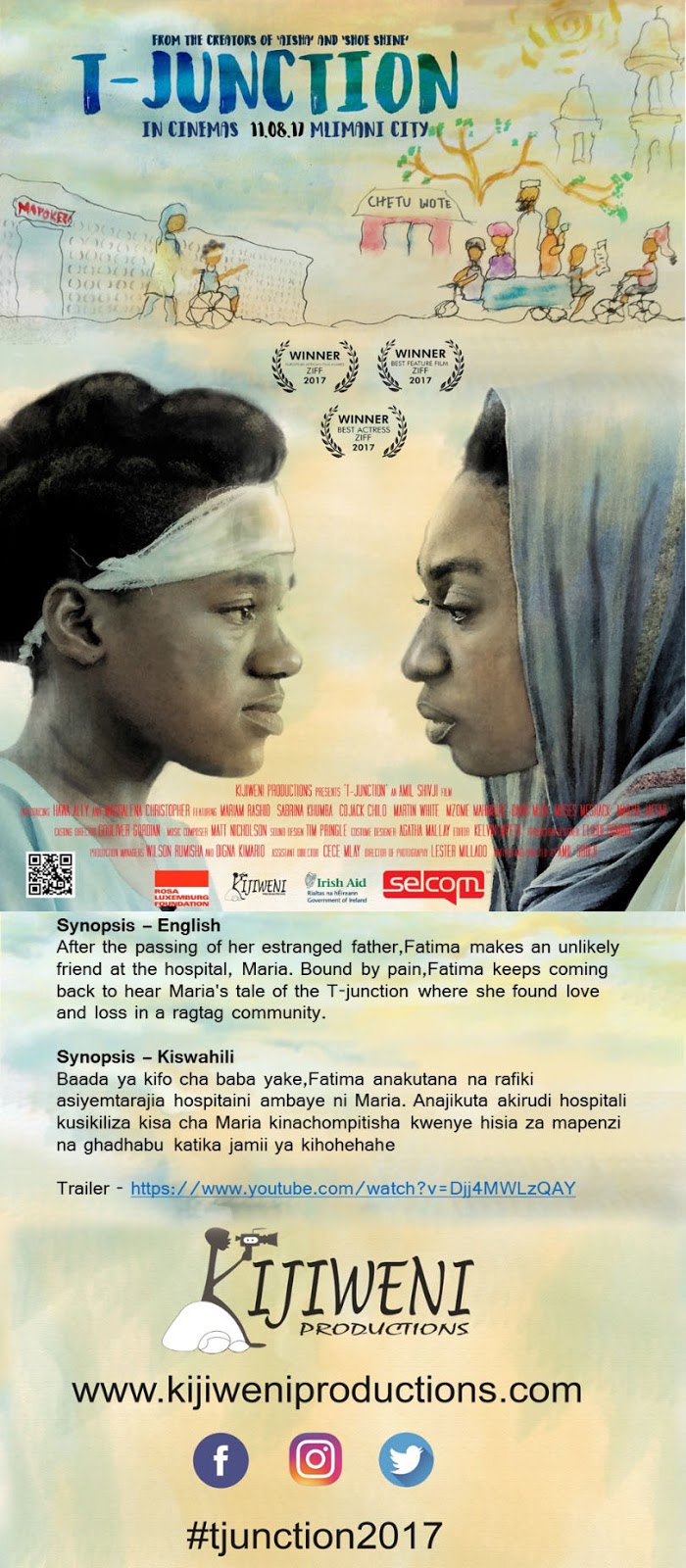
of the recently premiered film, T-Junction,
are a marvel to watch.
Although dubbed “An
Amil Shivji’s film”, it is a collaborative work that brings Tanzanian
talents as they attempt to make sense of our society. What is particularly
impressive is the way the scriptwriter who also happens to be the director has
juxtaposed the role of the starring.
There is the
young Fatima (Hawa Ally) who seems to be the starring. But this
feeling does not last long when Maria (Magdalena Christopher) enters the scene. One then gets a sense that Maria could be the ‘alter
ego’ of Fatima as she struggles to come to terms with the contradictions of her
society. As such, her experience embodies Tanzania’s crossroads.
These crossroads
include the questions of race, state power and economic (dis)empowerment. As a
daughter of the later Iqbal Hirji, whom we never get to see in the film, Fatima
has what one may call ‘Indian heritage.’ But Mama Fatima (Mariam Rashid) was
his African domestic worker prior to their marriage. Whereas the widow deeply mourns
the loss of someone whom she believes loved and accepted her irrespective of ‘class
and color lines’, the orphan hardly finds solace in a memory of an “estranged father”
who probably drunk himself to death.
That is as far as
we can get in unpacking the mystery of why T-Junction opted to start with the
funeral of Fatima’s father. What we can surmise is that the film is attempting
to tell those of us, who tend to view the ‘Indian Community’ in Tanzania as
generally wealthy, that not all is rosy. The ‘Iqbals’ lived in a modest house
though the funeral services took place in a prominent mosque. Yet ‘their house’
does not seem accessible to Africans probably because it appears to be in the
areas that were historically – i.e. ‘racially’ – designated for Indians.
Thus, the only
people who came to comfort Fatima and her mother were from Tanzania’s ‘Indian
Community’. To buttress this point, the film ensures that Fatima is asked if
she does not have any friends who will come. We thus encounter Fatima making
her first friend in the film when she goes to the hospital to seek treatment
and enquire about a death certificate.
This is when she
encounters Maria who narrates to her about the story of the T-Junction. In a
nutshell, it is a ‘surreal’ narration of how the state apparatuses bulldozes those
who attempt to eke out a living through ‘street vending’ in what some
theorists refers to as the ‘informal sector.’ It is also an account of what
a young African girl, i.e. Maria, can encounter when she works for an Indian
woman who seems to be related to Fatima’s father. To add nuances, the film indicates that even a seemingly exploitative Indian businesswoman who hires an
African domestic worker can also be subjected to the gendered violence that
emanates from patriarchy.
Though it may
seem coincidental, it is interesting to note that there is a real Fatima
Bapumia who has published her research on Rationalizing violence Domesticizing Abuse: South Asian Experience in Tanzania. Therein she unpacks how what happens in
the ‘private sphere’ of Tanzania’s ‘Indian Community’ is hardly noticed in the ‘African
community.’ T-Junction thus gives us a rare chance to peek into that sphere in
relation to what transpires in the public.
Then there is what
is hardly coincidental. As the film premiered, we witnessed another round of
demolition of houses and business premises in Dar es Salaam. This time it is not only the downtrodden
in the informal sector who are bearing the brunt, but also the ‘middle class’
in the ‘formal sector.’ In this sense, T-Junction is not a corner out there where
‘the poor’ struggle for a ‘right
to the city.’ Rather, it is at the very heart and soul of a society in
search of solace.
They “came for
the Jews, and I did not speak out—Because I was not a Jew.” When
they come for the Marias, do we ‘speak
truth to power’? Or we are not yet at
the T-Junction?


To be honest, I haven't watched Bongo Movies for awhile now. But this one looks really good, the sound quality, resolution, and the acting seems to be on point and professional. I am happy that it shows a different side of Tanzania that many people don't know (me included). Congrats to the Director and the whole team for the wins at ZIFF. Thank you for sharing.