
Tanzania’s General Election and Prospect for Change
Chambi Chachage
“Tanzanians Need Change” – Mwalimu Julius Nyerere
Change
has become the buzzword in Tanzania. Defining it, however, remains elusive.
Bringing it about even more challenging. Yet everyone seems to want change.
Now.
As
the General Election slated for October 25 approaches, both activists and
politicians are selling their versions of the buzzword: ‘Change Tanzania’,
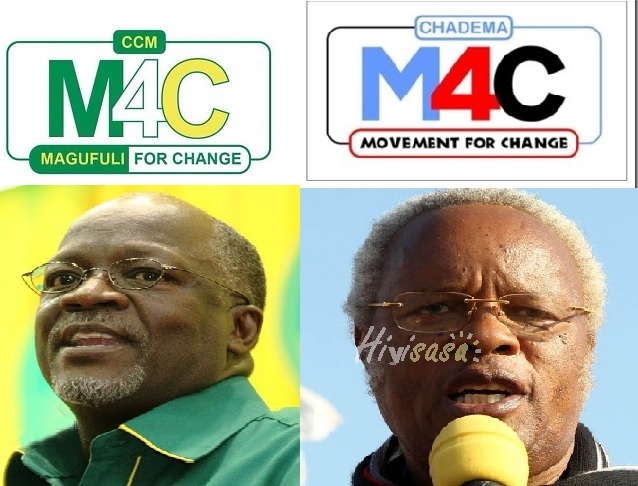
‘Alliance for Change and Transparency (ACT)’, ‘Movement for Change (M4C)’ and, lately,
‘Magufuli for Change.’ One wonders what ‘Theory
of Change (ToC)’ informs them.
Put
simply, ToCs are well-thought explanations of the ‘what’, ‘who’, ‘when’, ‘why’
and ‘how’ in regard to a certain change, practically. They are not ‘shopping
lists’ of ‘electorate promises’ that masquerades as ‘election manifestos.’ Let
us illustrate this.
Grand
corruption is one of the ‘what’ that needs changing. Many corrupt activities of
the ‘who’ seems to be what one whistleblower
refers to as an “open secret throughout Tanzania.” The
same applies to the when, why and how many such dealings occurred.
Hence
voters ought to know who/what will change the dire situation, when and how will
he/she/it do so and why can it be done now? Tellingly, the ruling party’s
lengthy election manifesto appears to address some of these questions while
evading others.
First,
its manifesto acknowledges that corruption is a public enemy. CCM’s manifesto
goes on to admit that its top organ criticized public servants who use their
position to amass wealth. Hence it promises to continue to take action against its
leaders who do so. It also asserts that it will direct its government to fast
track the enactment of a law to ensure that during that public servants are not
businesspersons during their tenure.
Yet
a number of businesspersons are running as CCM’s candidates to be Members of
Parliament. A number of those under scrutiny for alleged involvement in
corruption as also vying for public office. This begs the question: How will it
now be possible to pass a bill to separate business and politics i.e. years
after the President promised
so?
Do
opposition parties fair well on this? The main opposition party, CHADEMA, and
its coalition known as UKAWA are already under fire for embracing tarnished
leaders who have defected from CCM. In this regard even their statement of
intent is wanting.
The
third force/way, ACT-Wazalendo, are celebrated as being more focused in regard
to changing the state of corruption in the country not least because the
inspiration behind their election manifesto is the then CCM’s Arusha
Declaration that, on paper, was clear about ensuring that business is not mixed
with politics. Yet what remained to be seen is how it is translated, first, at
its own party level in terms of its source of finances and those of its leaders
who are also required to publicly declare their wealth.
So
far only CCM has had the chance to be tested in terms of bringing about change
as a ruling party. And, in the case of corruption, they seems to have failed
miserably as the scandals such as Richmond, Escrow and EPA, to only name a few,
attest hence the call for change from virtually all quarters. But are voters
ready to change guards?
Understandably,
the cautious are afraid of merely changing a ruling party. They are scared
partly because the then apparent face of corruption in CCM is now running as a
presidential candidate of CHADEMA/UKAWA. What they want is ‘clean change.’
For
them the ‘transition’ from one seemingly corrupt party to another is not ‘real change’.
It is not ‘regime change’ because, as they see it, the order of the day will
continue. Hence, paradoxically, they are cornered to opt for ‘better the devil
you know’ given that the third way seems to be way too ‘small’ to stop a
‘two-horse race.’
It
seems Aikande Kwayu has thus
aptly captured their state of apprehension in this
deadlock: “Is desiring ‘change’ enough? Change from what? CCM is saying ‘change’
from things as usual while UKAWA/CHADEMA ‘change from CCM.’” But Azaveli
Lwaitama sees
it differently. So do many who have decided to cast
their lots with the ‘other devil’. For them UKAWA/CHADEMA is but a
stepping-stone towards change.
Desperately,
they will step on this stone no matter how rough it is and ‘cross the bridge
when they get there’. To them it can’t get any worse. They are too tired of
being overly cautious like their fellows who are scared of ‘rough change’ and
hence ready to wait and wait for ‘smooth change’ even if it means preserving
the status quo.
Hence
their ‘Theory of Change’ is ‘rudimentary’ but it makes a lot of sense: ‘Change
the ruling party and everything else will follow (later)’. They will rather
fight to hold accountable a new, inexperienced ruling party than the one that
has been at the helm for decades. One can but sympathize with them given the
arrogance of leaders who could go as far as saying the ‘questionable money’
they got were ‘peanuts/petty cash.’
But
the fact that even CCM cannot avoid embracing the language of ‘change’ as
evidenced in its invoking of January Makamba’s ‘New Tanzania’ chant in its
recent public statement is a sign that it cannot afford to continue with
‘business as usual’ even if it wins the elections. Gone are the days of apathy.
Change is indeed constant.
Just
before he passed away the founding leader of CCM wrote
these words: “Decades ago, as President of my
country, I told Tanzanians that the choice before them was to change or be
changed. I was wrong. There was no choice. They had to change, and would still
BE changed.” It seems the coming election is ‘forcing’ all of us to change.
Whatever
happens one thing is clear. Tanzania(ns) will not be the same again. Never.
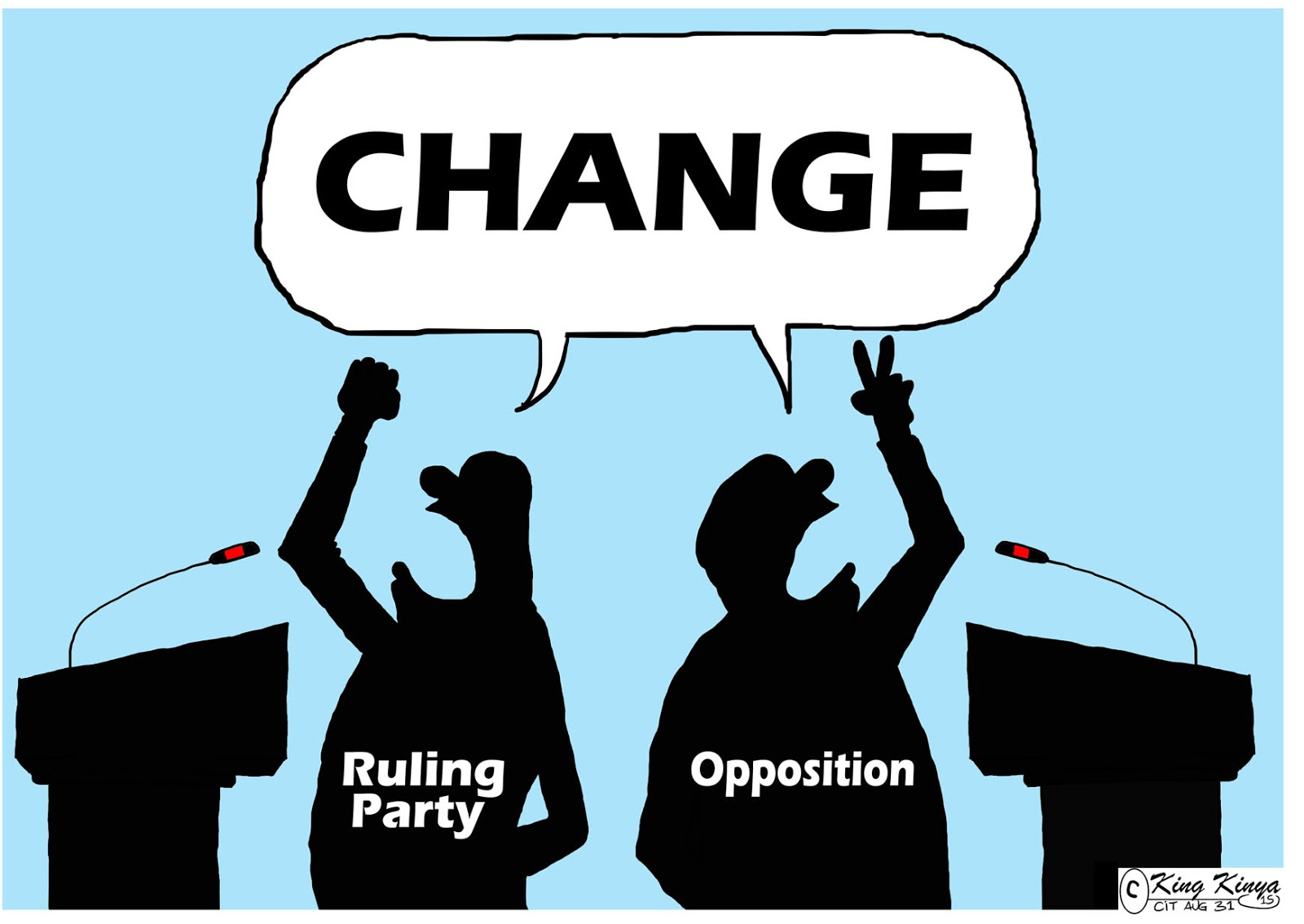

The same point in cartoon form, from The Citizen, 31/8/15
Asante Ben, I have added it!
Thanks for a comprehensive report