
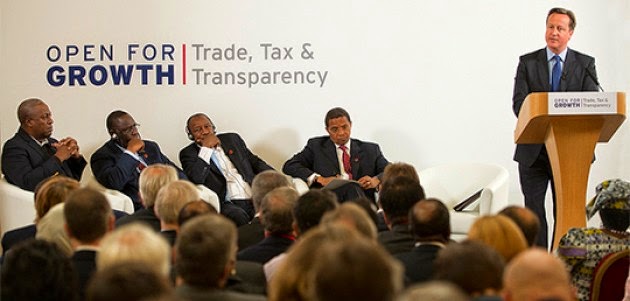
Is the UK retreating from Africa?
Chambi Chachage
An “African youth who has been educated and done
research in the UK” is
“disturbed with the apparent diminishing influence of the UK in the global
sphere and specifically in Africa.” Even if it were true why is it so
disturbing? Why is the UK so important to us?
To Aikande Kwayu, it is important because it is “a
historical “parent” to most African countries.” For her, Africa is “the
continent that has so much in common with” the UK. Hence “due to its history
and geographical proximity, the UK needs to be at the forefront of anything
that has to do with Africa starting with the increasing terrorism threats in
the continent from Boko Haram in the West to Al Shabaab in the East of the
continent.”
But do the numbers add up when we look at particular
cases in Africa? Let us start with Kwayu’s own country, Tanzania. What does the
UK’s face of foreign place therein say?
In her Q&A
with ‘The Report Company’ in 25 November 2014, Dianna Melrose – British High
Commissioner to Tanzania, had
this to say: “The UK is the second largest bilateral donor in Tanzania.
Increasingly the focus is on economic development. We give £71 million a year
in budget support, but this is the last year that the UK will give general
budget support. We’re moving now to sectoral support in energy and education
where you can really measure results.” Of course energy include oil and gas,
not just electricity.
No wonder Melrose also had
this to say: “We agreed last year a high-level prosperity partnership with
Tanzania. The idea is to increase trade and investment across three priority
sectors and fourthly to improve the business environment. The first is oil and
gas with companies right the way down the supply chain. The second is renewable
energy. The third sector is agriculture which is the biggest priority for
Tanzania in terms of livelihood opportunities for its people and then the
fourth is the ease of doing business. We are encouraging companies to come but
we are not even having to encourage them very hard because we can’t keep up
with the demand. The biggest sector of interest is gas and [British Gas] BG
[Group] have already invested over US$1 billion. In the future BG could invest
$10-15 billion in a $30-40 billion [Liquefied Natural Gas] LNG plant.”
Quite revealing is Melrose’s response to the following
question: “Tanzania is one of five African countries chosen by the UK for its
high-level prosperity partnerships. Why Tanzania?” Said she: “You’d have to say
the gas discoveries because if you look at the countries chosen, including
Mozambique, Ghana and Angola, there’s a thread of energy there. That’s the
game-changer potentially because of the opportunities down the value chain and
that’s where [UK Trade & Investments] UKTI are going to direct most of
their energy. The prosperity partnership isn’t just about bringing in investors
and promoting trade; it’s also about the development goal. We describe it as
mutual prosperity and win-win and so it’s in terms of our desire to tackle
poverty and seek growth as well as finding opportunities to increase trade and
investment.” Is this a country retreating from Africa?
UKTI would answer with a resounding no. This is how
it proudly describes its global function in its official website – a
government site, of course: “UK Trade & Investment (UKTI) offers expertise
and contacts through its extensive network of specialists in the UK and in
British Embassies and other diplomatic offices around the world. It provides
companies with the tools they require to be competitive on the world stage.”
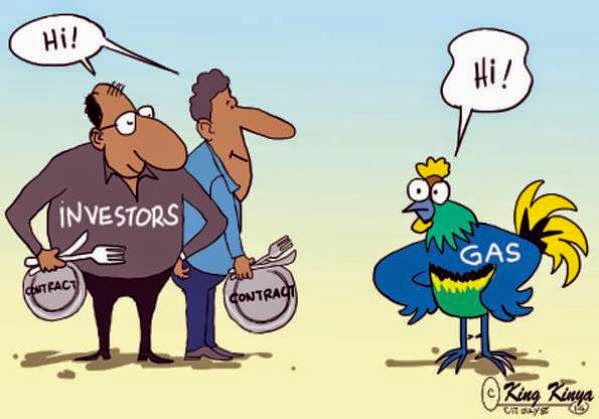
policy’, let us revisit its own “Case Study” accordingly entitled “UKTI helps ASCO prepare winning bid for
contract in Tanzania.” Before “bidding for the contract”, its section on “building
relationships” aptly points out, “UKTI introduced ASCO to the
Managing Director of the Tanzania Ports Authority (TPA), the Minister for
Transport and other key decision makers. UKTI also provided market
information and advised on cultural issues.” Why did they to do this?
Probably because in 2010
when “ASCO became aware of a business opportunity to tender for services to
support BG’s offshore exploration programme in Tanzania” they “had no business
relationships in the country and contacted UKTI to find out about the
support that was available.” Little wonder in “late 2013, ASCO Group was
awarded a 3 year £60 million contract at the port of Mtwara in Tanzania.” The
story did not end there.
We are thus also told: “UKTI continued to help
ASCO develop its relationships in Tanzania after they won the
contract. UKTI arranged a meeting between the company and Jakaya
Mrisho Kikwete, the President of Tanzania and his delegation during his visit
to the UK in April 2014.” If this is what Kwayu is longing for, it is already
happening.
Melrose must be quite aware of the importance of
foreign policy in oiling business deals that is why she also said this: “More
and more companies are coming. We are doubling the size of UKTI in Tanzania and
we launched a new British Chamber of Commerce in July. In terms of trade
delegations, we haven’t been able to keep up with demand. The locally run
British Business Group already has over 200 members and rising.”
Yet Kwayu is wondering whether the UK’s purported withdrawal from Africa “is based on calculated rational national interests or what?” She even query, rhetorically; “when was the last time a sitting British Prime Minister visited Sub-Saharan Africa?” Do they really have to come to achieve their goals? Unclassified UK-Tanzania Communiqué on the “Visit to the UK by His Excellency Jakaya Mrisho Kikwete, President of the United Republic of Tanzania, at the invitation of the Right Honourable David CameronMP, Prime Minister of the United Kingdom of Great Britain and Northern Ireland” sums it all.
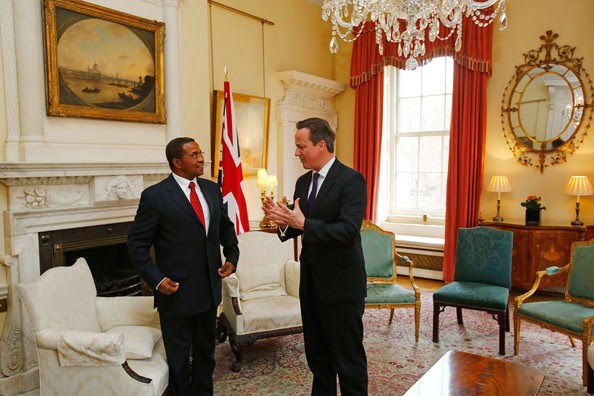
Goal number one is thus presented in the Communiqué: “In this regard, BG Group, Ophir Energy and their joint venture partners have agreed a Memorandum of Understanding with the Tanzanian Energy Ministry on potential construction of a multi-billion dollar onshore Liquefied Natural Gas plant, which would bring vital investment to Tanzania.”
Our political scientists and experts of International Relations (IR) should always bear in mind that the UK’s foreign policy in Africa,
like that of other key players in the continent, is primarily based on a
Corporate-State-Civil Society (CSC) Tripartite Foreign Direct Investment (FDI)
Setup. I haveloosely defined this setup elsewhere “asthe interplay of
international power relations in a given land between entities emanating from a
foreign country with the overall aim of benefitting it.” In the case of the UK
in Tanzania, UKTI is a component of the Setup. So is the Department for
International Development (DFID).
DFID was the
major financier of “a £31” million Accountability in Tanzania Programme (AcT)
“to increase the responsiveness and accountability of Government in Tanzania,
through a strengthened civil society.” This is the same DFID that engaged
with BG “on the establishment of an East African umbrella organisation to
provide technical and vocational training related to the emerging oil and gas
sector in Kenya, Mozambique, Tanzania, and Uganda.” It is the same BG that is
(apparently) funding a key civil society organisation in Mtwara. In terms of ‘interlocking
directories’, it is the same BG that has/had
a “Non-Executive Director”, Vivienne Cox, who also sits in the
DFID Board among other Boardrooms.
Here it is important to recall this argument that Kwayu also makes: “The UK’s continuing soft power in the global sphere is mostly through English, which is an international language. In the words of Lee Kuan Yew, English is “ the language of business, science, diplomacy, and academia”. The fact that English is a universal language gives the UK leverage in influencing the global masses.” It is an assertion that also helps to make sense of how the UK utilizes its CSC Setup when engaging with us.
From the Communiqué cited above we thus get a glimpse
of its CSC Setup: “The two governments agreed to promote partnerships between UK and
Tanzanian companies to maximize local job creation and develop local skills.
They also concurred on the value of giving Tanzanian students access to the
best educational opportunities in the UK, building on initiatives like the
joint BG
Group/British Council International Scholarship Programme. Both leaders
welcomed the strong partnership between the Tanzanian Ministry of Education and
the British Council, underpinned by DFID funding, in developing the English
language and teacher training skills of teachers across Tanzania.”
Coincidentally, one may
disclaim to avoid ‘Conspiracy Theory’, this is the same British Council
that recently hosted the ‘Commonwealth Alumni Meeting’ whereby Professor Kitila
Mkumbo gave a keynote on the New
Education Policy in Tanzania, reiterating
his critique of the decision to introduce Kiswahili as the Language of
Instruction at all levels. With such vigorous promotion of English,
distribution of Scholarships, formation of Commonwealth
Alumni Association of Tanzania (CAAT) and consolidation of the UK Alumni in Tanzania Network’s (UKAT)
link with its alumni’s alma maters, Kwayu’s lamentation, that it is “unfortunate that
Britain is no more the first place young Africans are thinking of pursuing
their university studies despite its world-class universities,” is attended to.
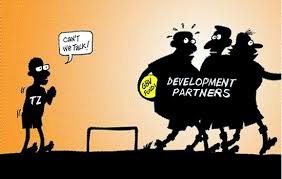
Standard Chartered Bank (SCB) is also part of UK’s CSC
Setup in Tanzania that is why the UK played
a significant role in fighting the companies involved in the Tegeta Escrow
scandal. It would be naïve to expect anything else from the UK. After all isn’t
foreign policy about
persuading other countries to do what your country wants them to do?
Kwayu’s question “Why is [the] UK retreating?” is most
likely misguided. She may wish to ask: Why is it treating Africa to UK Aid?
Is it to resolve the UK’s century-long
crisis?
