

Acting on Regionalism and Factionalism in
Tanzania’s Multiparty Politics
Chambi Chachage
She hails from one of the regions in the northern part
of Tanzania. Her revolutionary sympathy seems to lay with a political party that
is accused to be primarily ‘north-based’. When I asked her about what is
increasingly referred in Swahili as siasa
za ukanda (politics of regionalism) within the country in relation to party
formation, she remarked: “hakuna chama
kisicho cha kikanda” (there is no political party that is not regional).
In a country that has been celebrated for containing
the politics of ethnicity especially during the ‘single party’ reign of its
first President, Mwalimu Julius Kambarage Nyerere, it is ironic that ‘tribalism’
is rearing its ugly head under the guise of regionalism. For sure the
conditions for starting a new party after the return to multiparty politics in
1992 have attempted to ensure that we don’t end up having a party that is based
on a region. But it appears this has not been sufficient enough since the law
stipulates that a party only has to have at least 200 members from at least
10 regions to be eligible for registration.
Little did we know that regionalism in Tanzania
will come to mean something more than mkoa
(region). Currently, the country has 30 regions. But when people talk about
the politics of regionalism, they are talking about the politics of an area
that constitutes more than one region. In other words, they are talking about
an area in which one or a couple of ethnic group dominates. This area can be
outside of the ethnic group’s region of origin.
CHADEMA, the leading opposition party in Tanzania, is
a case study as its detractors claim its main ukanda is the area that constitutes the northern regions of
Kilimanjaro and Arusha. Since, ‘commercially’, the Chagga are the ‘predominant’
group in both regions, they easily become the allegedly face of this party. This
is almost convincing given that its founding chair is a Chagga based in Arusha and
its current chair is a Chagga who also happens to be the Member of Parliament (MP)
of the Hai constituent in Kilimanjaro.
Probably not knowing that he was feeding into the
discourse – if not propaganda – that the party’s accusers were continuing to
propagate, its then member, Zitto Kabwe, penned
these words in 2012 after campaigning in a by-election somewhere between downtown
Arusha and Kilimanjaro: “Jambo moja la dhahiri baada ya uchaguzi wa Arumeru ni
kwamba ukipanda basi kutoka Moshi kwenda Arusha, utakuwa ukipita katika ngome
ya CHADEMA. Ni ngome ya CHADEMA kuanzia Moshi mjini, Hai, Arumeru Mashariki na
Arusha Mjini…eneo hili sasa ni Liberated Zone, yaani ukanda uliokombolewa.”
At the risk of misquoting the quotable quote, one can
thus directly translate those words: “One things is clear now following the
by-election in Arumeru, that is, if you board a bus from Moshi to Arusha, you
will be passing in CHADEMA’s stronghold. It is CHADEMA’s base from Moshi town,
Hai, East Arumeru and Arusha Town…this area now is the Liberated Zone, that is,
a region that has been liberated.” In other words, since then the MPs of all
those constituents across the legendary highway are from CHADEMA.
Yet, like his ex-fellow members who did not hail from
the north, he
thus defended the party resolutely in a lengthy online interview in the
social media in 2012: “Chadema ni chama cha kitaifa. Kingekuwa chama cha kidini
au kikabila kingefutwa. Katika uongozi wa Chadema unapata watu toka mikoa na
kabila mbali mbali, pia watu toka dini mbali mbali. Diversity hii haipatikani
katika vyama vingi humu nchini. Nadhani mtazamo huu unapandikizwa na watu ambao
hawakipendi chama chetu na wanaoona chama kama threat kwa maslahi yao binafsi. Pia sisi kama chama tunapaswa kuwa makini
sana, hasa viongozi tunapofanya kazi zetu ili kutothibitisha taswira hii mbaya
dhidi ya chama chetu. Baadhi ya wanachama wa CHADEMA ndio mabingwa wa kueneza
jambo hili…Chama chetu kimesambaa nchi nzima na viongozi wake ni wa dini zote
na makabila yote.”
Risking misinterpretation, one can thus paraphrase
those words by way of translating: “Chadema is a national party. If it was a
religious or ethnic party it would have been deregistered. In Chadema’s
leadership you get people from various regions and ethnic groups, as well as
people from varying religions. This diversity is not present in many a party in
the country. I think this perception is propagated by those who do not like our
party and who view it as a threat to their personal interests. As a party we
also need to be very careful, especially when we do our work as leaders so that we
do not affirm this bad perception about our party. Some member of CHADEMA are
the champions of propagating this perception…. Our party is spread throughout
the country and its leaders are from all religions and ethnicities.”
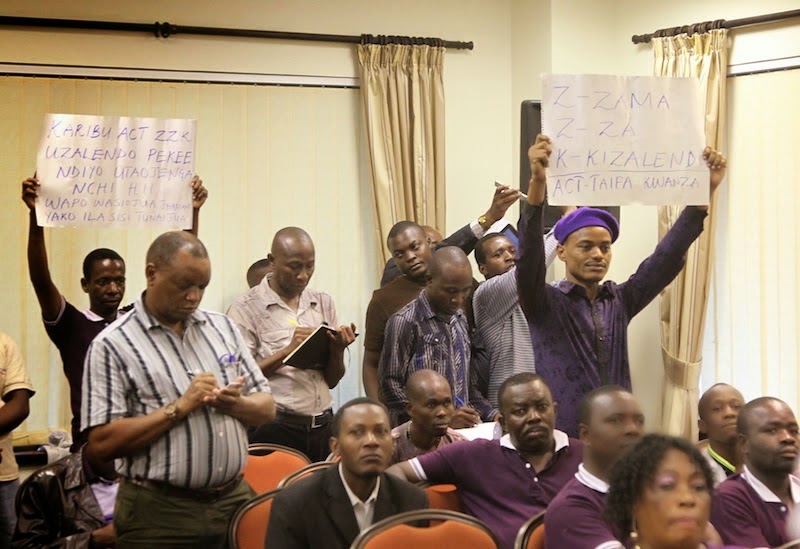
Now, having fallen from the grace of his (former)
party, the tables have been turned on him. His new party, Alliance for Change
and Transparency (ACT), is now on the receiving end of accusations about being
primarily ‘west-based’. By this they mean the regions of Kigoma, where he hails
from, and Tabora, that is connected to it.
Maybe also unaware,he fed thisdiscourse-cum-propaganda when heheld ralliesin downtown Kigoma and Kasulu soon after
CHADEMA stripped him of his appointed leadership positions in the party in
2013. Tellingly, before Zitto joined ACT officially in 2015,it won majority of the seats in Kigoma’s Mwandiga, in 2014’s local governments elections.
For conspiracy
theorists, even the choice of Tegeta in Dar es Salaam as the place he was
officially issued with ACT’s membership card capitalized on the apparent
presence of an ethnic enclave from Kigoma. They extrapolate this from the fact
that in 2013 Zitto was vocal by questioning
– and intervened
successfully against – the arresting of Tanzanians from Kigoma residing Tegeta
who were wrongly accused of being illegal immigrant.
Dar es Salaam, the de facto political headquarters and
de jure commercial capital of Tanzania, is a melting pot of ethnicities in the
country. So, it is quite disturbing when its areas are associated with
particular ethnic groups. Maybe it is understandable in relation to the
dynamics of migration. The problem, as we have observed in neighboring countries, starts
when such ethnic associations are politicized especially in the context of
elections.
Gathering solid data on ethnic composition,
particularly in cosmopolitan areas, has not been our preoccupation. “The Tanzanian
government has not gathered any census data on ethnic affiliations since 1967”,
aptly noted Matthew
Collin in 2013, “considering the
matter to be taboo”. But like many other researchers, especially those from
abroad, for him it is an interesting matter as his
study on ethnic enclaves in Dar es Salaam attests.
Yet it is an open secret, for those of us who cling to
the taboo, that such and such an area is this or that ethnic enclave. I, for
one, resided in a street where CHADEMA won in the 2010 general elections and now,
in 2015, I have moved too a street that is not very far from that one and where CHADEMA won the local government elections in 2014. People hardly talk openly
about it but it seems almost everyone knows why this is a ‘liberated zone’.
We can opt to dialogue openly and honestly about these
politics of regionalism-cum-ethnicity that are slowly but probably surely
extending beyond the regions where those ethnicity originates from. Or, as Professor Samuel Wangwe has recently cautioned us, keep
taking our nation for granted as if our ‘unity in diversity’ has and will always be there as if the task of building the nation is done.
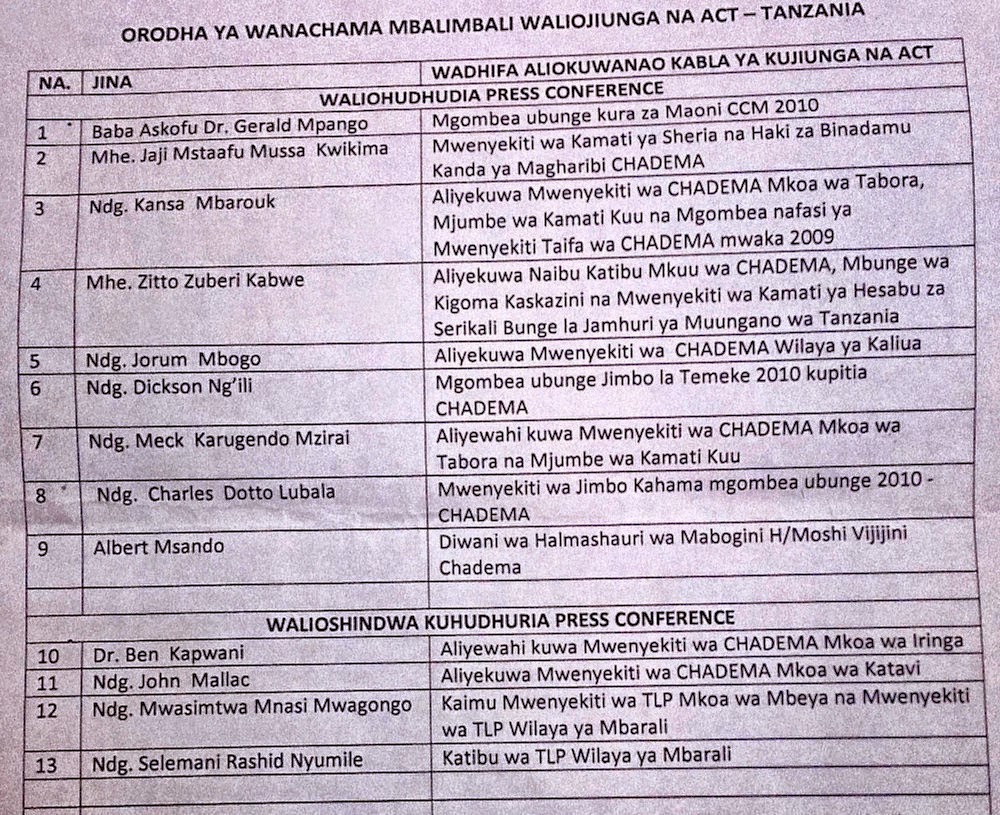
Zitto’s close ally, Professor Kitila Mkumbo, may be utterly
right bythus
decryingthe ‘conspiracy theory’ against their new party vis-à-vis CHADEMA
and the coalition of leading opposition parties known as UKAWA: “This theory
that ACT has been founded for the purpose of ‘divide’ and ‘rule’ remains a
theory.” They may even be both right in insisting that they are building a party that is not only patriotic and democratic, but also nationalist and
socialist. What remains to be seen is whether they will act against and move
beyond the legacy of regionalism that is an Achilles heel of many a political
party.
Here it would be instructive for the de facto – and
probably soon to be the de jure – face of the ACT party to recall and reapply
this personal
clarion call from back in his heydays of (political) activism: “I must
graduate from being a divisive figure to a uniting figure.”

