
Zitto Kabwe’s Political Act and the Future of Multiparty Parliamentary Democracy in Tanzania
Chambi Chachage
The (political) game of ‘hide and seek’ between
Tanzania’s (current) leading opposition party and arguably its (then) most
popular member is over. The official twitter profile of the former shadow Minister
of Finance and former deputy Secretary General of the self-proclaimed party of
Democracy and Development (CHADEMA) now reads: “Zitto is a former MP for Kigoma
North (2005-2010 & 2010-2015) & former Chairman of Public Accounts
Committee (PAC)”. Hehas
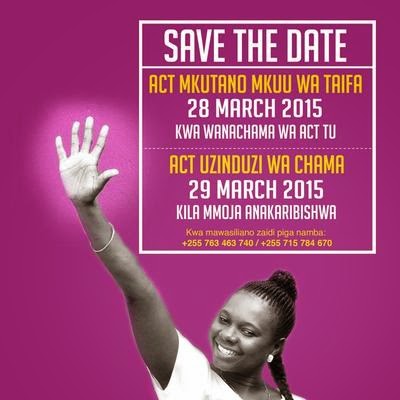
just completed his moveto one of the new political parties that both claim(ed)
the (core) nameAlliance for Change and Transparency (ACT).
What “is happening” between “@ChademaTz & @zittokabwe”,
laments Erick Kabendera,
“is an impediment to growth of a viable multiparty democracy & a
disappointment to believers.” As “Chadema edged closer to making unprecedented
political gains”, the sympathetic journalist also notes, “it’s biggest
challenge was always going to be its members remaining united.” The
disappointed believers should have seen the signs of the times way back or
maybe they saw but they continued to believe anyway.
Kabendera would indeed recall the following prophetic
words that were published in Africa
Confidential (AC Vol 51 No 7) on 2 April 2010: “The opposition parties
are still too weak to matter much, and the CCM controls wealth, most media and
the oversight bodies. Chama cha Demokrasia na Maendeleo has made an
impression, in Parliament and beyond, on mining and corruption, but internal
tensions have robbed it of its bite and the mining bill may weaken it further.
Chadema’s lustre has been dimmed by the marginalisation of Zitto Kabwe (AC
Vol 50 No 1), the young MP who challenged party leader Freeman Mbowe in
internal elections last year but was persuaded to withdraw.”

Yet the party and the politician did not part ways for
the next five years. In a way the politician’s role in PAC boosted the party’s
bite. REPOA’s Brief Number 44 on Public Accounts
Committees in Eastern Africa: A Comparative Analysis with a Focus on Tanzania states: “Data were collected on two
main PAC activities: the average number of days per year devoted to PAC
meetings and, more importantly, the number of hearings held. The data indicate
that the Tanzanian PAC is the second most active in terms of meetings held and
is the most active in terms of hearings held. Viewed in conjunction with the
capacity of Tanzania’s PAC to summon a broad range of witnesses to testify
(thereby holding the executive to account), this implies that the Tanzanian PAC
is the most effective committee among the six countries of Eastern Africa
examined.”
Despite all these achievements the party and the
politician have reached a point of no return. To some of us, when and how – let
alone why – they (really) crossed the Rubicon remains – and may always be – a
mystery. What is clear is that it is a bittersweet irony.
One only has to read comments from his supporters and
detractors to get a glimpse of this ironic move. It is even more telling when
one hears from the horse’s mouth. But before we delve into his farewell speech to
the parliament that he had planned to give let us revisit his lengthy interview
with Jamii Forum members that took place on 22 November 2012.
Little did he know that his political career might end
up with him moving to – or even becoming a founder of – a new political party. Zitto
stated: “Siamini katika kuhama vyama ili kutimiza malengo ya kisiasa na
ndio maana mimi sijawahi kuwa [na] chama kingine chochote zaidi ya CHADEMA maisha
yangu yote. Mwanasiasa anayehama vyama ili kupata uteuzi anafuata vyeo na sio
muumini wa sera ya chama husika.” This can be translated as: “I don’t believe
in moving from political parties in order to achieve political ambitions/goals
and that is why I have never had any other party apart from CHADEMA in my whole
life. A politician who move across political parties so as to get elected is
going after positions and is not an adherent of the policy of the given political
party.”
Ironically, this
is how he envisioned the future of multiparty democracy in the country
when responding to a question about mushrooming of political parties: “Ndio
Demokrasia. Tusiminye kabisa watu kuwa
huru kuanzisha vyama vya siasa. Baada ya muda ni vyama vyenye uwezo wa kukonga
nyoyo za wananchi ndio vitabakia. Wala hatuna haja ya kuweka sheria. Huko mbele
ninaona Tanzania yenye vyama sio zaidi ya 4. Vyama vikubwa 2, CCM and CHADEMA.
[N]a CUF watakuwa a balancing party kama ilivyo LibDems UK au Greens and
Liberals Ujerumani. Kwa hali ya sasa ya muungano ninaona kuwa CUF yaweza kuwa
kama The Bloc Québécois ya kule Canada. Sioni NCCR ikidumu. [Sioni]
future ya UDP bila Cheyo na TLP bila Mrema. Lakini pia kuna uwezekano mkubwa sana
wa Kundi moja la CCM kuunda chama kingine cha siasa ambacho kinaweza kuwa na
nguvu hata zaidi ya CHADEMA. Baada ya uchaguzi wa mwaka 2015 tutaona hi[z]i new
configurations. Tuache watu wawe huru kuunda vyama. Vyenye nguvu vitabakia.”
He thus saw a country that would end up having at
least four parties, two of them – CCM and CHADEMA – being the strong/big ones and CUF
being a balancing party like some parties in the UK and Germany or, in the
context of the Tanzanian Union, like one of the parties in Canada. Moreover, he anticipated
a splinter group from CCM forming another party that could be stronger even
than CHADEMA, predicting that we will see the new configurations after the 2015 General Elections. All in all he supported the founding of new parties instead of limiting their numbers legally, arguing
that is democracy whereby ultimately the bigger/stronger parties are the ones that would
survive/remain.

Now – on 20 March 2015 – he penned the following words
in his last parliamentary speech as CHADEMA’s MP: “Mheshimiwa Spika, vyama vya
siasa ni jukwaa muhimu katika ujenzi wa demokrasia lakini havipaswi kamwe kuwa
juu ya wananchi. Kwa hiyo ni maoni yangu kwamba wakati sasa umefika wa kukomesha udola na ufalme wa vyama vya siasa hapa nchini. Mfumo wa siasa ambao unavipa vyama vya siasa mamlaka ya kisheria ya kukanyaga mamlaka ya wananchi haupaswi kuendelea katika Karne ya 21 na katika nchi ambayo inaendeshwa kwa misingi ya demokrasia ya kuheshimu wananchi. Mimi ninaondoka bungeni sio kwa sababu wananchi wangu wa
Kigoma Kaskazini walionichagua wametaka niondoke. Siondoki kwa sababu
nimeshindwa kufanya kazi zangu za ubunge. Na kwa kweli siondoki kwa sababu
wanachama wenzangu katika CHADEMA wametaka niondoke. Ninaondoka kwa sababu
mfumo wetu wa kisheria unavipa vyama vya siasa mamlaka juu ya wananchi na
wapiga kura. Ni matumaini yangu kwamba Bunge lako tukufu halitaruhusu mfumo huu
unaoruhusu vyama vya siasa kupora mamlaka ya wananchi uendelee. Ni Bunge lako
pekee lenye uwezo wa kukomesha mfumo ambao unatukuza Parties’ Power, badala ya
People’s Power.”
Zitto was/is thus strongly asserting that it is neither
through the will of his voters in Kigoma nor his fellow members of CHADEMA let
alone his capability of functioning as an MP that he is vacating the
parliamentary seat. Rather, it is through the legal system that grants
political parties the authority over citizens. Decrying what he dubs a
system that usurp authority from the people, he goes as far as arguing that it is only the parliament that is capable of ending that system that glorifies
“Parties’ Power” instead of “People’s Power.”
By invoking CHADEMA’s Movement For Change (M4C) slogan
of “People’s Power” sarcastically, Zitto is reiterating the stance he took when
he filed a case against the party. It appears that all that he wanted was a fair/just and safe space/chance for the members of the “Baraza Kuu” (General Assembly) of CHADEMA to
hear him before “Kamati Kuu” (Central Committee) deliberate and decide on the status/fate of his membership.
Apparently, although the Kamati Kuu was nearly split in half in November 2013
yet it went ahead and stripped him of all his (appointed) positions in the party hence it
was clear that what would eventually follow if he doesn’t get an opportunity to
state his case at the Baraza Kuu would be to kick him out of the party,
something that actually happened to his fellow accused, Professor Kitila Mkumbo
and Samson Mwigamba, who, tellingly, are also members – indeed co-founders – of ACT.

Put simply, Zitto was/is basically saying that it was/is only
a handful of leaders, rather than the majority of members, who wanted to take
away his CHADEMA membership. Having won the first case, he continued to survive
as a member of the party at the mercy of the court. No sooner had CHADEMA won
their appeal on 10 March 2015 than the lawyer of the party, Tundu Lissu, announced publicly that
his membership has been automatically annulled not least because of a provision
in the party’s constitution that allegedly effect that when a member files a
case against the party in a court of law. Why couldn’t he/they wait? Probably because of the then hide and seek game of preempting each other in regard to who would actually initiate the sacking and the switching.
Jamii Forum’s anonymous member, The Boss, puts it this way in the (Swanglish) language of Tanzania’s social media: “The Road ahead for Zitto…. kuna kitu ambacho naona Zitto anakiweza sana kuliko yoyote ndani ya CHADEMA nacho ni ku court attention all the time….. naamini hiki ni moja ya vitu ambavyo wapo watu ndani ya CHADEMA vina wa irritate sana waliamini wakimfukuza watamfukuza kama mbwa and its done badala yake kawachezesha ngoma halafu anaondoka in style… maradona wa siasa za Tanzania for sure…. now October kuna ‘world cup’ lets wait and see.”
Constitutionally, however, this is what Zitto expected
if the party leadership was not simply interested in getting rid of him through
some sort of an internal ‘kangaroo court’: “Mheshimiwa Spika, katika hali ya
kawaida na kwa mujibu wa katiba ya chama chetu, ilitarajiwa kwamba baada ya
maamuzi ya Mahakama Kuu, Kamati Kuu ingekaa na kunipa rasmi mashtaka yangu
yanayohusu uanachama wangu, mimi kuitwa kujieleza na hatimaye Kamati Kuu kutoa
uamuzi wake.” To paraphrase by way of translation, here Zitto is interpreting
the High Court ruling in relation to the Constitution of CHADEMA, arguing that the
Central Committee was expected to officially convene to deliberate on the
accusations in regard to his membership and give him a chance to defend
himself before coming to a decision. This is a correct interpretation given
that it could not do so because of Judge Utamwa’s initial ruling that was in
favor of Zitto but now it was/is free to do so after Judge Mziray dismissed
Zitto’s case on some ‘technical grounds’.

Gosh, the disappointed believers may exclaim, ‘how did
we get here?’ The answer should be simple. A powerful clique in CHADEMA and its
faithful supporters lost faith in Zitto. But it takes two to tango. Zitto let
alone his diehard believers also failed to mend fences with the so-called ‘wahafidhina’ i.e. conservatives.
Alas, what really happened to the CHADEMA that Zitto could
thus describe in 2012 after claiming it has its own brand of democracy and
members accept that: “The Party deploys
for or against your wishes and every member must oblige a JUST deployment. I
will”?
Whatever happened to the Zitto who could
thus state this in 2011 after proclaiming that politicians grow and so does he in a heated debate on his then seemingly compromise with African Barrick Gold (ABG):
“I must graduate from being a divisive figure to a uniting figure”?
So, what’s next? The ending of the “single party
dominance” that Zitto has proclaimed
over and over again as his mission? Or the beginning of the splitting of a
leading opposition party that has become a recurring trend in Tanzania? In any
case, would the future of our multiparty parliamentary democracy be secured? Time will tell
and when it does, will people act?