
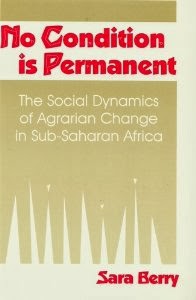
Sara Berry (1993) historicizes
what she refers to as the “inconclusive encounter” between farmers and states
in the era of planned development. She aptly critiques a then substantial
literature of the time for failing to fully explain the general failure of
rural development programs initiated by “international agencies and African
government to accelerate agricultural growth and/or raise rural living
standards” (43). For her, this inadequacy in their explanatory power stems from
an ‘either or’ approach between the actors and structures, that is, explaining
‘what went wrong’ in Africa as “a logical consequence of either rationality of
a particular class of actors (politicians, bureaucrats, or peasants) or the
structure of particular institutions (traditional communities, contemporary
states)” (45).
Variants of (1) Goran Hyden’s notion of the ‘uncaptured
peasantry’ that evades government control; (2) Robert Bates’ attribution to
members of the political apparatus as concerned with maintaining power rather
than promoting development and; (3) Richard Sandbrook’s argument on the colonial
legacy of neopatrimonial rule are particularly singled out.
Taking an approach that is similar
to Frederick Cooper in his attempt to ensure that the nuances and open-ended
possibilities created by the encounter between the state and subjects is not
lost while explaining the ‘bigger picture’ of structures, Berry attempts to
write a corrective history that moves beyond interpretations that “tend to
ignore the interplay between individual action and institutional structure” and
“imply that rural development programs have definitive consequences which can
be clearly labeled successes of failures” (45). However, she is careful enough
not too lose the bigger picture. Publishing around the same time as Mahmood Mamdani was finalizing his Citizen and Subject: Contemporary Africa and the Legacy of Late Colonialism, it is interesting to note how
she also invokes the centrality of indirect rule in shaping, albeit in nuanced
ways, the structures and strictures of rural setups. The “contradictions of
indirect rule…[reflected] in the inability of colonial regimes to solve the
Kikuyu land problem, create stable rural settlements in northeastern Zambia, or
settle disputed claims to tribute or rent in northeastern Zambia”, Berry notes,
“led officials to argue for more comprehensive and centrally controlled
approaches to these problems”(47).
What is particularly significant
in Berry’s approach is that it does not look at indirect rule, which continued
to provide the ideological framework for state interventionism, as being
entirely deterministic as far as outcomes and responses from actors are
concerned. Instead, she describes ‘inconclusive
encounters’ between the state and those it sought to control. If there was any
continuity between the colonial and post-colonial state, then one of them is
that of restructuring local jurisdictions and administrative systems, a
situation that increased rapidly after independence in the quest for expanding
the economy. However, the inconclusive (development/underdevelopment)
encounters persisted whereby “the proliferation of state institutions in rural
areas multiplied the potential channels through which bureaucrats and farmers
sought access to each other’s resources” (57).
Another important, albeit controversial, contribution is her argument
that the presence of the state, both during the ‘second colonial occupation and
after independence, was intrusive rather
than hegemonic with regard to rural
economies. But if she is right, how was
this intrusion achieved without
forceful coercion or hegemonic consent?
—
Sarah Berry (1993). No Condition is Permanent: The Social Dynamics of Agrarian Change in Sub-Saharan Africa. Madison, US: University of Wisconsin Press.
