
Urbanization, Prostitution and the (Re)Making of African Labor
“…African labor power was only for
sale in small units” – Frederick Cooper
“Thus, prostitution exists in a direct
relationship to wage labor…” – Luise White
Jade Luo & Chambi Chachage
How
did the colonial encounter lead to the emergence of industrial urban spaces? To
what extent did labor shape these centers in relation to agrarian rural spaces?
And how did the state and the society shape each each other within the context
of resistance?
These
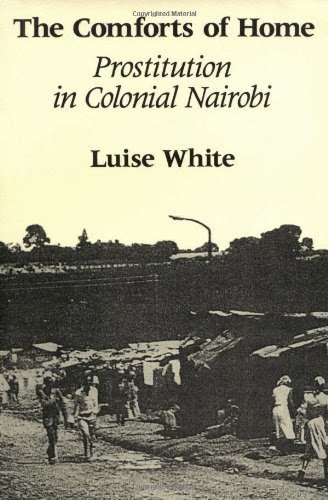
are some of the questions that Frederick Cooper’s (1987) seminal book On the African Waterfront: Urban Disorder and the Transformation of Work in Colonial Mombasa and Luise White’s (1990) book on The Comforts of Home: Prostitution in Colonial Nairobi address. Work, writes
Cooper, has been the most central element in the relationship between Europeans
and Africans since the 15th century. He acknowledges that the former
constructed a stereotype of the latter as being lazy in the context of slavery
and colonialism. However, he shifts the emphasis on this stereotype as a
legitimizing myth used to justify coercive labor extraction by taking it as a
clue that Europe did not totally dominate labor in Africa. From this he builds
his central argument that both domination and resistance shaped the working
relationship between employers and workers in relation to the state. As he puts
it, his book “concerns the efforts of a colonial state and of a group of
employers to reasserts control over a workplace, faced with an orchestrated
challenge from African workers” (1).
Cooper
correctly observed that the preoccupation with the study of labor market and
patterns of labor migration overshadowed that of the nature of work itself. As
a result African labor history tended to appear in a linear form. Among
neoclassical economic historians it was more of a history of the “development
of wage labor as a self-propelled movement of people from an area of low
productivity to one of high” (6). In the case of their radical critics it was
primarily about proletarization. However, he rightly observes that the case of
Mombasa suggests that the story was hardly linear. Rather, change appeared to
proceed in bursts or cracks on long-standing forms of organization and ideology
through critical moments. These moments that led to new departures, however,
“came about not only under the pressure of titanic clashes, but through an
accumulation of minute and subtle struggles in the workplace, as both capital
and labor tried to bend their relationship with each other” (7).
Such
critical moments that Cooper address includes the urbanization of the labor force, transformation of casual labor
and the organization of labor strikes. In the final analysis, however, he
departs from his main argument on the articulation of domination and resistance
by privileging the role of the state and capital over that of workers in
redefining labor and urban spaces.
In
analyzing the origins and trajectories of trade unions and workers strikes that
rocked Mombasa and other African cities during and in the immediate aftermath
of World War II, Cooper relies on the history by analogy with the making of the English respectable working class. For him what happened in Mombasa at that
time echoed what happened in England a half-century earlier, albeit with one
main difference – the nature of casual labor. The problem of casualism in England,
he points out, occurred within the structural context of advanced capitalism
thus making it easy to solve it by isolating it from the general problem of
labor. He means that workers there no longer had, as an alternative, access to
precapitalist forms of production that those in rural Africa had. Since
Africans in Mombasa were crisscrossing the city and the countryside with
relative ease they had too many alternatives to be at the mercy of employers as
far as their livelihoods were concerned. For them casualism was only one
alternative hence decasualizing was a daunting task. Thus “only by forcing regular
work and regular habits of life upon them could they be tamed; and the infant
African working class that showed signs of emerging had to be protected against
contamination” (21).
Ironically, this move
toward regulation was earlier seen as potentially dangerous in terms of
providing a space for organized resistance among the workers. However, as
Cooper rightly points out, the way migrant and casual laborers managed to unite
and agitate through strikes among other measures in the 1930s/1940s shattered
this perception. As a result the state and employers opted for decasualization
as a way of venting and fragmenting resistance. Interestingly, casual “labor in
the port disappeared with remarkable rapidity, far faster than it did in Great
Britain itself” (3).
The conventional
city-countryside divide, as Cooper observes, was seriously challenged in the
wake of the Mau Mau insurgency that was primarily rural. It thus made the
problem of stabilizing urban spaces acquire a particular urgency. Moreover, it
“shattered any remaining illusions that rural tranquility might be preferable
to urban ferment” (128). Casual and migrant laborers who were traditionally
seen as contaminating the city with their rural infection were now cast as
casual laborers who could easily be induced to mob and participate in urban
disturbances. What all these discourses implied was that “both rural and urban
Africa had to be remade” (129). Shifting back to his analogy with England,
Cooper attempts to show how the colonial state tried to do achieve the remaking
by severing the African laborer from his rural life. At a practical level this
involved, with relative success, “the restructuring of time, authority, and
space” (142).
In the case of time, Cooper put more emphasis on colonial and economic structure. Even though he
acknowledges that by 1960 casual labor was no longer the pattern of working
desired by workers, he goes on to conclude that “the initiative in
decasualization had come from the state and eventually capital, not from the
workers” (162). But in line with his central argument, these workers whom he
claims their working lives had been profoundly altered to the extent that they
opted for weekly labor are the same workers who were part and parcel of the
strikes aimed to better their living and working condition. The fact that they
did not find it any more desirable to combine casual labor and their farming or
other activities explains their resistance and relative autonomy shaped the
protracted ways by which the state and capital went about to proletarianized
them.
While Cooper’s
historical analysis is convincing what we find puzzling is his conclusion that
the impetus for the complex of changes that happened in Kenya “lay in the
conflicts that arose inside the city, not in a dynamic originating in
agricultural change or colony-wide process of economic transformation” (176).
We find this particularly surprising because throughout his text he has
effectively managed to show the interaction between the rural and urban spaces
within the context of the transformation of slave labor on land to relatively
free labor. Moreover, he has done so without ignoring the land, labor and
agrarian questions. “Indeed”, he affirms, “mounting land pressure, the
rationalization and mechanization of estate agriculture, and more intense —
and more conflictual — land accumulation in several African areas were pushing
more and more people out of rural areas” (175).
Echoing
Cooper’s emphasis on labor, White is trying to bring the study of prostitution
back to the study of labor–to focus on the nature of the work itself. White
takes issue with the fact that the reformist moral agenda has obscured the
study of prostitution, such that oftentimes it is overlooked that prostitution
is an economically driven form of labor, not unlike labor in other sectors of
society. White notes the unique position of prostitution as a form of labor: it
“exists in a direct relationship to wage labor and is domestic labor,” offering
a link between casual and wage labor (11). By examining the content of the
labor itself and the use of the earnings, White aims to tell this story of
labor, where “a prostitute’s conduct is determined by strategies of
reproduction, not personality” (20).
The
labor story that White tells is one of kinship and “rational economic choice.”
The different forms of prostitution and the prostitute’s choice to engage in
one over the other reflected deeper kinship linkages as well as economic
situation, such as access to housing. The malaya form of prostitution, which
comes closest to domestic labor with its nonsexual services, arose out of a
desire to establish independence and break off ties with their family. This
prostitution was characterized by secrecy, awareness of the community, and a
keen capitalist mindset. The prostitution was a “long-term investment,” and
with its “slow and steady accumulation,” many prostitutes were able to
establish themselves as property owners, eventually even forging new kinship
lines as an independent head of household. The accumulation was for oneself.
In
contrast, the much more aggressive wazi-wazi form of prostitution reveals
strong kinship ties, usually to the cash-crop production farmers in rural
areas. These prostitutes cared little about conforming to the community and
developing secrecy and dignity around their work; instead, they aggressively
sought customers, to the horror of the malaya. Money was the sole goal of their
work, and they were not secretive about it. This money was sent back to support
the prostitute’s family back in the rural areas. The wazi-wazi prostitute had
no real investment in the urban communities, and their failure (and perhaps
unwillingness) to integrate paints a picture of the rural-urban divide.
The
wazi-wazi and malaya forms of prostitution also highlight the relationship
between strong kinship ties and the acceptance of this new urban spatial
framework. The malaya prostitutes, who oftentimes intentionally cut off kinship
relations, went to great length to be part of a “good neighbor” to the community,
even if that meant not being paid. They not only understood capitalism in the
urban context, but they adopted it and for the most part, thrived. Meanwhile,
the wazi-wazi prostitutes, though they operated in an urban context, refused to
identify themselves with the urban centers. With more traditional strong
kinship ties, these prostitutes tended to opt out of re-accumulation of
capital.
Like
Cooper, White also makes a point to bring in the state into the story,
particularly where urban housing comes in. Before World War I, the state had
attempted to redefine the African urban-rural divide, identifying certain
groups as “urban, detribalized Africans” and others as “mobile, rural migrant
laborers” (128). These identifications and the policies that resulted were
based on “constructions of African social life, rural and urban” (129). The
colonial regime was keenly aware of economic interests in the degree to which
they attempted to control prostitution and housing for the urbanized Africans.
In the 1920s, “prostitution was essential to the smooth running of a migrant
labor economy on the scale Nairobi required,” and thus the regime did not
actively evict prostitutes (77). Similarly, landlords and their accumulation
“served the state in ideological and practical ways; the high rents they
charged…sent more men to their rural homes or into urban homelessness than the
pass laws did” (131). Under such policies, certain groups of urban Kenyans
thrived.
As
time passed, however, the thriving of malaya prostitutes began “founding
lineages that, taken in the aggregate, comprised a class” (121). Landlords and
their effectiveness in controlling tenants and their behaviors meant growing
class differences. Without the control over urbanization that the state
desired, by 1938, the regime began their attempts “to create a respectable
working class in words and memoranda” (121). What White highlights here is a
narrative similar to that of Cooper’s: the state attempted to “remake” the
urban-rural divide once again by severing these newly developed urban classes
and lineages, without much success. By getting rid of landlords and existing
urban communities, the state attempted to use housing units as a way to
construct new gender and family-based relationships to maintain control of the
urban center. White notes that it was largely unsuccessfully: “[landlords] did
not see housing as a way to structure gender and family
relationships…[prostitutes] had their own ideas about the meaning of gender and
the role of men and women in their lives” (146).
Both
Cooper and White’s texts highlight the main themes that have been dominant
throughout the emergence of industrial society in urban centers. They both show
how by focusing on productivity the state attempted to control the gendered
production and reproduction of labor across time and space. However, despite
the structural constraints African men and women challenged authority with
varying successes and thus created spaces for class mobility and capital
accumulation.
