
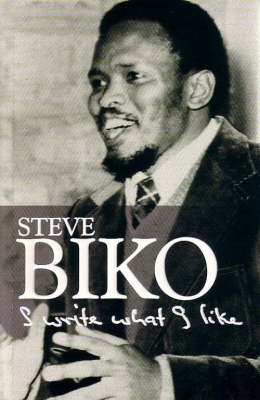
“Without doubt, Steve Biko (18 December 1964 – 12 September 1977), the father of Black
Consciousness Movement in South Africa, read ‘The Fact of Blackness.’ The title
of his fifth chapter of his book ‘I write what I Like’ echoes the terms
employed by Frantz Fanon i.e. “Black Souls in White Skin”? It seems that Biko (1996), like Fanon,
reached that point that forced a black person, out of the quest for
self-identity and self-determination to make himself known. That is it to
affirm his blackness. He agreed with Fanon that blacks were suffering from an
inferiority complex. It seems that he agreed with Fanon that a black man was
not a man: “To a large extent the evil-doers have succeeded in producing at the
output end of their machine a kind of Black man who is man only in form. This
is the extent the process of dehumanization has advanced. Black people under
the Smuts government were oppressed but they were still men…. All in all the
black man has become a shell, a shadow or man” (Biko, 1996, pp. 28-29). But
while Fanon (1986) advocated the liberation of the black man from himself, Biko
(1996) decided to advocate black pride: “ the first step is to make the black
man come to himself; to pump back life into his empty shell; to infuse him with
pride and dignity…. This is what we mean by an inward-looking process. This is
the definition of black consciousness” (Biko, 1996, p. 29). However, a close
examination of the conditions that necessitates the emergence of black
consciousness as well as the difficulty Biko had in defining who was black in
South Africa reveals that Biko (1996) was aware of the same dilemma of black
essentialism that faced Fanon. Now wonder his 7th chapter of ‘I
write what I like’ is entitled ‘Fragmentation of the Black Resistance’” – ‘
“THE FACT OF BLACKNESS”‘
—
Biko, S. (1996). I write What I Like; a selection of his
writings. Randburg, SA: Ravan
Fanon, F. (1986). Black Skin, White Mask. London, UK:
Pluto Press.
