
In Praise of Authenticity? Reflections on ‘The Task
of African Traditional Religion in the Church’s Dilemma in South Africa’
“Africa is in search of viable political institutions, but also of indigenous-oriented church institutions
” – G.C. Oosthuizen (2000: 280) in Jacob K. Olupona (Ed.), African Spirituality: Forms, Meanings and Expressions, (pp. 277-283).
Chambi Chachage
G.C.
Oosthuizen’s (2010) brief, 7-page chapter on ‘The Task of African Traditional Religion in the Church’s Dilemma in South Africa’ is a sermonic call to practitioners of Christianity in Africa. Published 6 years after the end of Apartheid in South Africa, and in the context of a dramatic growth of the African Independent Churches (AICs) by an anti-Apartheid activist, it naturally gravitates towards a radical discourse of decolonization and indigenization. In a way it is a summary of a personal
journey of the late founding director of the Research Unit for New Religious
Movements and the Independent Churches (NERMIC) who, as minister, had to resign
from the Dutch Reformed church that was the main Christian face of Apartheid’s
institutional racism.
The chapter is divided into three interdependent sections: ‘Western Theology and
African Alienation’; ‘Mission Christianity and Identity Crisis’; ‘African
Challenge and Indigenous Christianity’. Throughout these sections the author,
finding it hard to totally abandon Christianity for the sake of Africanity,
vacillates between a radical, African-centered critique of Western practice of,
and scholarship on, religion in Africa and a moderate, Christian-centered
defense of African religion. It is within this context, of hanging between the
radical Okot p’Bitek and moderate John. S Mbiti, that this reading report locates
Oosthuizen as it summarizes and explicates his text.
Section one opens with a sweeping claim that even though the meaningfulness “of any
theology rests on its relevance to the life of the members of the communities
where it is applied” many “of the theologies that spun out from and were
nourished in the Western intellectualist context have no roots in the life of
the communities in Africa and thus ‘became useless verbiage’” (p. 277). For him
this “is because Western theology has in many respects been indifferent to the
church getting rooted in Africa, its longing for Africanization”. Convincing as
it may be to an African-centered reader, this assertion does not explain why the
Christian churches, at least in the places where they were planted by missionaries
before and during colonialism, were widely and stably embraced in Africa even
though “Western theology”, as he correctly puts it, “has been the intellectual
foundation of the Western-oriented churches” (p. 277). If indeed “these
disposition blindfolded theology to the issue at the gut level of Africa’s authentic
existence” and “smothered what is positive in the traditional African context”
(Ibid.) what then attracted many Africans to the theologies and structures of
the Western-oriented churches? Coercion? Services? Materiality? If they were of no theological and cultural relevance to Africans why did they continue, statistically, to grow rapidly in Africa after
1960, the celebrated year of Africa’s independence?
What Oosthuizen does is to conflate the post-colonial and post-Apartheid histories
of the ‘Christian church’ in Africa. This is very problematic as it results in
an ahistorical analysis of more than 40 years of post-colonial history of the
church. When he writes during 2000, that not “only is the theology of
Western-oriented churches in Africa becoming progressively more suspect but
also the structures of the Western-oriented churches” and that the “imposition
of Western values and institutions on indigenous African systems is seen as a
major cause of the retrogression of the so-called mainline church” (Ibid.), he
is addressing a specific case that may even be peculiar enough to feed into the
contentious claims about South Africa’s ‘exceptionalism’. His otherwise strong
argument about the AICs becoming more attractive to Africans in post-Apartheid South
Africa because it is meeting their social, cultural and spiritual needs end up
being superimposed on Africa in a way that essentializes culture and religion.
This discourse of ‘authenticity’ and ‘purity’ is evident in claims such as these:
“The organization of the church as institution became more important to
missioners than the traditional inborn sense of African religion” (p. 278). It
is very surprising for such a claim to come from a former minister of a
Christian church in a country where Afrikaner nationalism was almost synonymous
to Dutch Reform Christian fellowship and who knows that the central message of
the Bible is ‘Christian fellowship’ as thus summed up in this call in the first
epistle of John chapter one and verse three: “That which we have seen and heard
declare we unto you, that ye also may have fellowship with us: and truly our
fellowship is with the Father, and with his Son Jesus Christ”. It is particularly
difficult to understand why Oosthuizen is sidestepping the question of race and
racism in the church in explaining why there was a dramatic decline in the
membership of the so-called mainline churches and a dramatic increase in the
AICs.
But even statistics that informed his analysis do not paint a simplistic picture.
He is using figures from 1981 to 1991 and contrasts them with those of 1950.
But in the latter case Apartheid as an official system was only two years old
whilst in the former period it was crumbling and the struggle against it was
increasingly becoming identified with churches whose members were not
predominantly ‘white’. When one consults the South African Census conducted in 1996
and 2001 s/he will observe that even though there was a dramatic increase of ‘black
African’ membership in the AICs there were non-AICs that had a significant
increase of ‘black African’ membership in that period. For instance, their
membership in “Pentecostal/Charismatic churches” increased from 1 652 829 in
1996 to 2 589 886 in 2001. Their membership in what are classified as “Other
Christian churches” increased from 883 377 to 2 189 663 at the same time (See http://www.statssa.gov.za/census01/html/default.asp).
Does this mean they have also resolved the “crisis of African alienation” and “new
dualism”?
I happened to live in South Africa between 1999 and 2004 and belonged to one of
those ‘Other Christian churches’. Indeed there was an increase of black
Africans and an exodus of white members but this was mainly attributed to race
and racism as well as migration of Africans from other African countries in
post-1994 South Africa. This church, at least in the ‘white’ side of South
Africa, maintained a “Western type of church institution”. In the ‘black’ part
they continued with “Western ecclesiastical structures” while fostering their
cultures that were actually – and ironically – fused by the Apartheid Bantustan
system of separate growth of ‘blacks, whites and coloreds’.
Thus when the author claims that the “Western type of church is not seen as the
ideal from a functional point of view” (p. 278) one wonders why then are big
church structures increasingly erected in diverse places in Africa and why other
churches that are neither mainline nor the AICs are also dramatically growing
in South Africa. One also wonders why only fellowship, a cardinal teaching of
Christianity as far as the Bible is concerned, is the same notion that is thus
used to explain the AICs’ growth:
One begins to wonder why people feel satisfied gathering in houses, shacks,
shelters made from motorcar boxes, in open spaces, and a small percentage in
school classrooms. This should not be interpreted merely as a reflection of
poverty but as the inner need for fellowship: the need for small-scale church
communities which reflect the extended family system in the ecclesiastical
context. Western secular structures as well as Western ecclesiastical
structures resulted in a sense of alienation with many in Africa. The vast sums
spent on these Western-oriented constructions remain an obstacle to the African
concept of religion as a sharing and caring phenomenon (Ibid.)
Section two picks the baton from the previous section and reiterates the grievances of
radical African-centered scholars against Euro-centrism. “The missionaries and
anthropological literatures”, Oosthuizen reasserts, “ has presented African
religion in a most negative manner, as if is overruled by or infested with
beliefs in magic, fetishes, spirits, ancestors, and so on” (p. 279). “Taking on
Christianity” within this context, he further reaffirms, “has often led to a
crisis of identity” (Ibid.). However, he singles out “the so-called mainline
churches as not being absolved from this crisis” (Ibid.) whilst it has, so he
claims, been “addressed with the emergence of the African Independent Churches
(AICs)” (p. 278). It should be noted that what the South African Census cited
above ‘calls’ the mainline churches “include reformed churches, Anglican,
Methodist, Presbyterian, Lutheran, Roman Catholic and Orthodox churches and the
United Congregational Church of South Africa”. This “crisis of identity”,
Oosthuizen further claims, “lies” in what he refers to as “the fact” that “many of their members wish to receive thebenefits of traditional religion, such as their spontaneity in liturgy and
their healing procedures (p. 280-281). This big claim that overlooks processes
of the domestication of Christianity and multicultural interpretation of the
Bible across the centuries and the Pentecostal/Charismatic movement is thus
used to make this other big claim to explain what is so tied to
racial-cum-class struggles in South Africa: “In this the AICs have” become “a
significant factor, as many of their members are the children of the identity
crisis; in and through them the crisis has been ameliorated and even solved”
(p. 208). But if they have indeed “become masters in solving the dualism
between empirical Christianity and African traditional religion” (Ibid.) why
are they still practicing ‘two religions in one’? Why is it Christianity?
If the “AICs are managing this dualism on their own in a masterly manner without
being schizophrenic” (Ibid.) why are they still classified as being part of the
Christian religion and not ‘African traditional religion’? What then makes them
so spiritually decolonized if they are still bound within the double bind of a
‘modernity’ associated with ‘Christian civilization’ and a ‘tradition’
associated with ‘African religion’?
Section three makes a rather agile and ironic move from ‘purity’ and ‘authenticity’
espoused in previous sections to acknowledge the reality of cultural dynamism.
In as much as the author tries to further his argument, by claiming that through
the AICs “the fundamental principles of traditional African religion have been
analyzed and integrated into the Christian context” (p. 282), he does not deny
the fact that “African cultural life has also changed and can never be the same
again” (Ibid.) But trapped between the modernity-tradition dichotomy that he is
trying to transcend he pleads:
Certain demands of modern society cannot be met in the traditional context, especially
on the scientific and industrial level. The efficiency and imagination of
modern civilization should, up to a certain level, be accepted, but Africa should
not be overpowered by them (Ibid.)
One of the conceptual hurdles that makes Oosthuizen waver between the dualism of
Christianity and Africanity that he claims the AICs have addressed effectively
is that without stating openly he is erroneously using this faulty equation: Christianization = Westernization. In other words, he does not want to throw what to him is the baby of Christianity
(i.e. Modernization) and the bathwater (i.e. Westernization). It is in this
regard that he even invokes, by way of lamentation, a retreating African
socialism, as embodied in the concepts of Ubuntu
and Ujamaa, and calls for its rejuvenation since to him the “failure of its development was due to the misunderstanding of the African concept of humanity, which was based on a deep sense of
interhuman relationship” (p. 280). Thus for him “Africa is in need of
organizing its social and political institutions, including the church, on the
basis of genuine human fellowship (Ibid.)
But human fellowship is a universal concept in Christianity, Biblically defined. So
what Oosthuizen is, in fact, wrestling is the Westernization of Christianity
and he thinks its Africanization is the solution. Christianity, as it has been
noted, began as a community, when it moved to the West it became an institution
and when it went to the new World it became an enterprise. It is this decadency of modernity that remains
a challenge. This is the case in the ‘two countries in one’ that post-Apartheid
South Africa is. The AICs’ emphasis on “special methods of sharing and caring
in situation of rapid change” (p. 283) is universal among Christians who are
facing “challenges of the modern world” as it has been since the times of the
Apostle Paul. The role of the AICs, impressive as it is, in decolonizing ‘the souls
of black folk’ is thus overstated.
—
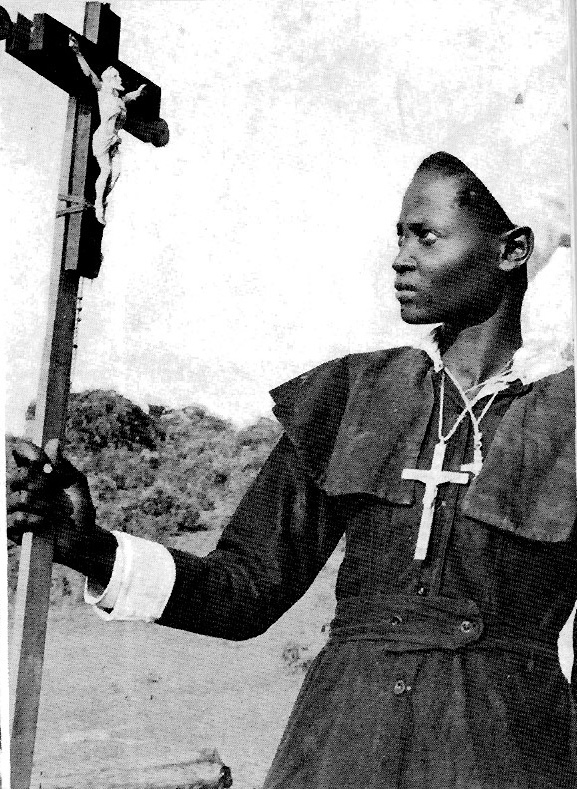
*The picture above has the following caption: “Gaudencia Aoko, or Mama Mtakatifu (Holy Mother), in western Kenya was a Luo girl aged 20 when called after the death of her two children in 1963; soon after, her movement seceded, broke from the Catholic Church and formed the Legion of Mary Church” – http://en.academic.ru/dic.nsf/enwiki/2985981
