
Towards a Paradigmatic Shift
on Ordering Race?
Chambi Chachage
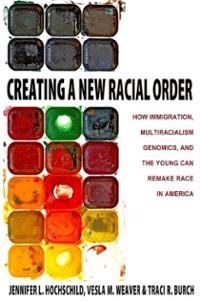
Jennifer L. Hochschild et al.’s book on Creatinga New Racial Order[1]
is both an optimistic and pessimistic projection of the future of race in the
US. In the case of the latter it employs empirical data on youths to show that
race matters less and in a significant way compared to older generations.
However, in the case of the latter the text shy away – not least
because of the indeterminacy of the state and societal structures – from explicitly
stating that these youths would create a new racial order. As a result the
policy implications deduced remains open ended.
Of
particular interest to me is the stability of the racial order at the institutional
level that continues to conflate race and class in the US society. While I acknowledge
that there has been significant strides in shaking the global racial order that
has manifested itself as a national/local racial order in the US across time
and space the residue of that old order that was created in the crucible of
slavery and colonialism remains intact. It is this order that continues to limit the US presidency of the first black
person from undertaking massive racial transformation despite the fact that it
was the same youths studied by the text that overwhelmingly elected him
regardless of his race. Moreover, it is the same institutional order that still
makes it dangerous to drive or walk while black, a situation that led to the killing of an innocent, unarmed young black man – Trayvon Martin. And it the same order that reproduces the glaring skewed
incarceration of black men in the US’ jails.
To
appreciate the argument that there has been a creation of a new racial order
one has to take an evolutionary rather than a revolutionary viewpoint. In this
regard there has been a series of changes that may have not necessarily been
visible and what is happening in the 21st century is a successive
change that may lead to a more radical transformation. The “racial order of the
late twentieth century that emerged from the 1960s’ civil rights movement,
opening of immigration, and Great Society”, argues Hochschild and her
colleagues, “is undergoing a cumulative, wide-ranging, partly unintentional and
partly deliberate transformation” (p. 13).
In a sense this is a relatively soft paradigmatic
shift in racial relations and institutional racism that can hardly lead to a
truly postracial society in the US. However, the authors are adamant that if
the racial reordering trend of what they refer to as four powerful
transformative forces – immigration, multiracialism, genomic science and cohort
change – continues then the US can finally reach the following order envisioned
by James Madison: “one in which no majority faction, not even native-born
European Americans, dominates the political, economic, or social arena” (p. 14).
Even though the authors seem optimistic, the analysis of what they refers to as
the blockages to these transformative forces pulls them toward pessimism. And
as recent developments indicate, there are significant backlashes against
immigration to the extent that the first black president in the US has not yet
effected his long awaited immigration reform. Even his medical reform that is
pro-minority is still under serious threats from reactionary forces.
Interestingly,
in a way the authors underscores wealth redistribution across the color line as
one of the main blockages. They thus aptly point out that “nothing suggests
that policy or economic changes to reduce wealth disparities are in the
offing—an important blockage to transformation of the American racial order”
(p. 153). As the black middle class expand
by creating and recreating itself through racial uplift, an optimistic outlook would suggest, this wealth gap will
increasingly be closed thus decoupling race from class within the US. However, pessimistically, that only remains a possibility.
Having
wavered between optimism and pessimism the authors thus settle for this more
realistic position: “the outcome of the contest between transformative and
entrenched forces will be decided through political actions not yet taken”
(p. 176). These actions ought to necessarily involve deracializing class at the
societal and institutional levels. In that regard this policy recommendation of theirs is
cogent: “taking political advantage of demographic change and growing
heterogeneity is the driving mechanism, and changing structures of wealth
holding and exclusion is the essential goal” (Ibid.)
[1] Jennifer L. Hochschild, Vesla Weaver
& Traci Burch (2012). Creating a New Racial Order: How Immigration,
Multiracialism, Genomics, and the Young Can Remake Race in America. Princeton-New Jersey, USA: Princeton
University Press.
