
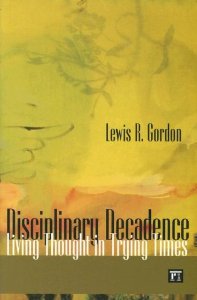
Beyond Boundaries? An Empathetic Reading of Lewis R. Gordon’s ‘Disciplinary Decadence: Living Thought in
Trying Times’
“There is thus a paradox at the heart of
human studies, and it is that the human being must be constituted by them while
always transcending them ” – Lewis R. Gordon
Chambi
Chachage
Seven years or so have elapsed since
Lewis R. Gordon (2006) published his autobiographical-cum-philosophical
reflections on Disciplinary Decadence:Living Thought in Trying Times. The texts demand one to read it backwards
within the context of its times. Those were the times when the disciplines and
fields of studies that the author has been engaging with within the broader
field of Africana Studies were in a state flux not least because of the
‘invasions’ of what is derisively referred to as the ‘posts’. Predictably, a number
of disciplines fortified their disciplinary boundaries in response to that wave
of the ‘postmodern’, ‘postcolonial’ and ‘poststructuralist’ among many other ‘posts’
and ‘studies’.
Thus, when read backwards, the telos of Gordon’s treatise, that is, the
end by which his attempt at transcending disciplinary boundaries is a means to,
is “the re-organization of social life” for each “subordinated community” (p.
106). To that end he marshals theoretical and methodological weapons from
disciplines as diverse as philosophy, sociology, history and linguistics.
Phenomenology proves to be handy. He defines it as “a form of enquiry in which
one suspends one’s ontological commitments for the sake of investigating
meaningful features of the world” (p. 102). It is those narrow commitments that
lock one within disciplinary and institutional boundaries even at the expense
of broader commitments to humanity. Hence programs become important than
people.
A “peculiar feature” of this “social
world”, which Gordon’s telos is its
radical reorganization, is “that some practices and institutions can become so
calcified that they function not differently than would a brick wall” that “one
cannot go through”, somehow, “without force” (p. 104). Of course he is not
calling for a physical and violent smashing of academic institutions harboring
disciplinary bricks. Nevertheless, at the realm of ideas, he is advocating for nothing
short of a revolutionary paradigmatic shift as captured in this Fanonian
apocalyptic formulation of his: “for we do live in times where such a radical
break appears as no less than the end of the world” (p. 106). Yet he
acknowledges that such a process would take time and effort as the epistemological
order that has been subordinating certain communities as the ‘other’ decay and
usher “the moment in which conditions for their liberation are ripe” (Ibid).
When read this way, his philosophizing is thus both a celebration and condemnation
of the decay:
We return here to disciplinary
decadence. Decadence, as we know, is a process of decay. Living things grow,
and eventually they begin to decay and then die. Disciplines are functions of
the living reality on which they rest, namely, living societies. As social
conditions for the life of disciplines decline, so, too, do disciplines, but
they do so, I contend over the course of the following reflections, primarily
through treating the proof of their decay as evidence of their health. Their
practitioners delude themselves that the elimination of opposition, the
eradication of an outside world, is the achievement of epistemic immortality.
Such rationalization is symptomatic of decay (p. 8).
The main culprits, in this case,
are those who “ontologize” their “discipline far beyond its scope” (p. 33) – to the extent that it “is advanced as the
ontological arbiter of all other disciplines without opening to the possibility
of its limits” (p. 83). They generally do so by criticizing other disciplines
for not being like theirs.
Thus, when offered evidence to the
contrary, by these other disciplines that they marginalize, “it could,
literally, be ignored simply on the basis of not being the point of view of
one’s discipline or field” (p. 33). This amounts to such disciplines “functioning,
literally, as “the world” (Ibid). A view thus becomes the worldview.
As someone who deliberately shifted
– two years prior to the publication of Gordon’s book – to the multi/interdisciplinary
field of African Studies after experiencing the disciplinary boundaries of psychology,
his arguments resonates with me. Even a course on critical psychology, which, as
a psychology’s critique of psychology, is analogically akin to “philosophy of
philosophy” (p. 124) demanded that I write as a psychologist with references
that mainly cited psychologists. Critical psychology itself was criticized as
not being psychology.
But African Studies, as it turned
out the more I engaged with it, was not a panacea as it was also bounded by a ‘western’
(read Euro-American) ontological and epistemological order. This ‘critical
decadence’, to use Gordon’s phraseology, is captured in his exposition on
‘Inventing Africa’ in chapter four whereby it is noted that by being “a
white-dominated field” in “much of its appearance” the consequence thereof is
that it “has been difficult for black scholars to play roles beyond those of
ethnographic informers” (p. 79). Here one is not simply talking about assisting
in providing information about ‘things African’. Rather, one is talking, in a
deeper sense, about being incorporated in the process of ordering knowledge in
accordance to the world order that has rendered the African the ‘other’. It
makes particular sense when one uses Gordon’s critique of ‘western universality’
in philosophy, which, by the very virtue of attempting to include African
scholars that it had excluded, proves that it is actually nothing more than a ‘western
particularity’. The quote below gives a
clue on how to transcend this:
For it is because of the presumed
universality of Western philosophy that many Western philosophers fail to see
their particularity. Conversely, it is because of their recognition of their
particularity that African philosophers often articulate universal dimensions
of the human condition. They tend to articulate how and what people really are.
In effect, a European may learn more about his or her morality through studying
African philosophy than Western philosophy because on the level of moral
agency, he or she may live more of the moral question broached there than in
European and American universities. Moral life does not mean to be obligated to
rational beings in the abstract but to people of flesh and blood, people who
are alive, people who lived, and people who will live (p. 57).
To save the field of
African Studies from disciplinary decadence, in Gordon terms, would thus
involve drawing “upon insights and intellectual resources of contemporary
African philosophical thought” for “it is the case that the natives have
transcended the status of informants and now offer an opportunity to coinvent a
new relationship beyond African Studies as white hegemony, the achievements of
which would be, at least in part, a genuinely new world” (p. 86).
When one grasps this telos it is relatively easy, then, to
navigate the philosophical jargons that permeate the book. One can thus read
the introduction and the first three chapters – ‘Decadent Knowing and
Learning’, ‘God Beneath’ and ‘Obligations across Generations’ – as expositions of disciplinary decadence in
old established ‘western’ disciplines vis-à-vis the ‘other’. Then one can read, as a sequel to chapter
three, the fourth chapter on ‘Inventing Africa’ as an advocacy for invention as
a form of agency among African subjects in their present in relation to their
past of ancestors and their future of descendants. Chapter five on ‘Decadent
Development’ can thus be read as a methodological call for “a postcolonial
phenomenological look at freedom’ beyond the confines of neocolonial and neoliberal
developmentalism and democratization. One can finally read chapter six on
‘Prospero’s Words, Caliban’s Reason’ as an inspiration for reorganizing the
world’s social order by resisting epistemic colonization.
Such resistance entails rejecting ‘western’
normativity as primarily encapsulated in ‘white’ and ‘male’ normativity. In
this regard it involves thinking for oneself as a self-determined subject
instead of relegating one’s thinking to the custodians of a western order of
rationality. It also includes reclaiming
ones’ voice and reason.
In the final analysis the book is a tribute to Gordon’s colleague –
Paget Henry – whom, according to the 1992 young doctoral student who debated
him on the phenomenology of the self, has/had committed “a teleological suspension of disciplinarity”
(p. 123) that occurs “when a discipline suspends its own centering because of a
commitment to questions greater than the discipline itself” (p. 34) and thus
revitalize its life. This does not only include the “question of how Africana
people should be studied, but also the constitutive question of the grounding
of such people in the first place – namely, their humanity” (p. 86).
Such a telos on achieving our dignity in trying times is a
commitment I share.
