
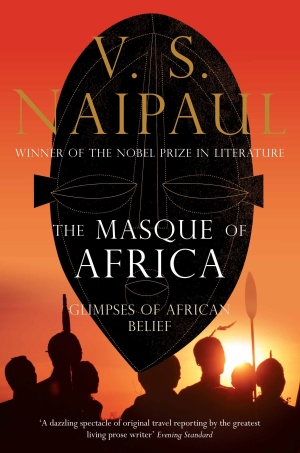
How Dangerous Can A Single
Story on Religions Be? A Critical Review of V.S. Naipaul’s ‘The
Masque of Africa: Glimpses of African Belief’
“In South Africa, with its
many groups, its many passions, its abiding tensions, the visitor, seeking a
necessary point of rest, moves from group to group, saying, rather like a Zen
student: ‘Not this, not this.’ ” – V.S. Naipaul (2010: 237)[1]
Chambi Chachage
V.S.
Naipaul’s (2010) 241-paged book on The
Masque of Africa: Glimpses of African Belief is a travelogue per excellence.
Retracing the footsteps of a number of Euro-American explorers who, in a way,
paved the way for the colonization of Africans, the 2001 ‘Winner of the Nobel
Prize for Literature’ looks for “the core of African belief” and tells his
readers about its “nature” within a space of six chapters. The travels started
sometime in March 2008 and ended in September 2009. Each chapter is a story of
what he claims to have seen, heard and experienced in a specific country.
Among
other reasons, the six countries are carefully chosen to give an impression
that these are indeed glimpses of the whole continent, except, of course, North
Africa that tends to be truncated from Africa in neocolonial and neoliberal
discourses. The journey starts in ‘The Tomb at Kasubi’ in Uganda. Readers then travel
with the author to Nigeria’s ‘Sacred Places’. From there the travellers move
next door to the so-called ‘Men Possessed’ in Ghana. Clearly influenced by the
author’s earlier travels to most of these countries, an excursion is made to
‘The Forest King’ of Ivory Coast. As if to ensure central Africa is somewhat
represented an agile turn is then made close to the author’s favorite Congo
River to take a Conradian glimpse at the ‘Children of the Old Forest’ in Gabon.
Finally the author bends down south to take a look at what he refers to as
‘Private Monuments, Private Wastelands’ of South Africa. Such a traversing is ‘sufficient’
to make him opt not to entitle his book in plural as in ‘Masques of Africa’.
Chapter
one on Uganda is a comparison between what the author observed in 1966 and in
2008 with the help of John Hanning Speke and Henry Morton Stanley’s colonial
travelogues. It is a scathing critique, laden with a colonial nostalgia from
someone who was born and bred in a British colony, of what has happened in the
post-colonial era. To him these were “forty years as bad as anything in Africa”
(p. 4).
However,
his account lacks a political analysis of the conditions that have led to this
apparent deterioration. But, as the author intimates in the final chapter, when
he “began this book” he “had wanted” to “stay away from politics” (p. 213). In
the first chapter he indeed managed to stay away from the political analysis of
religion as he uncritically presents – without even comparing the Ugandan conditions
with other African countries where Christian missionaries were welcomed by
colonial administrators – the account of how Kabaka Mutesa of Buganda turned
against his partly adopted Islam and requested Stanley to help in getting English
missionaries.
Without
historicizing Christianity in Africa and the ways it has been indigenized or localized
and globalized in the 20th and 21th centuries he thus asserts that the
following outcome is simply the fruit of that decision made by Kabaka in the 19th
century: “Foreign religion, to go by the competing ecclesiasts on the hilltops,
was like applied and contagious illness, curing nothing, giving no final
answers, keeping everyone in a state of nerves, fighting wrong battles,
narrowing the mind” (p. 6-7).
As if speaking the same language as radical
critics of Christianity in Africa such as the late Okot p’Bitek of Uganda the
author invokes the ‘iffy history’ as he insinuates that “it was possible to
wonder whether Mutesa himself, if he could come back, mightn’t have thought
that he had made a mistake, and that Africa, left to itself in this matter,
might have arrived at its own more valuable synthesis of old and new” (p.7).
But
in answering his own question on why “had the foreign-revealed religions
wrought such havoc with African belief”, he thus offers, tentatively, a
Hegelian[2]
response that dismisses the African’s grasp of religion: “These foreign
religions had a difficult theology; I didn’t think it would have been easy,
starting from scratch, to put it across to someone here” (Ibid.) The
contrasting answer he gets from a Muslim descendant of Mutesa is thus presented
without being problematized: “The Prince said I was wrong. Both Christianity
and Islam would have been attractive to Africans for a simple reason. They both
offered an afterlife; gave people a vision of themselves living on after death.
African religion, on the other hand, was more airy, offering only the world of
spirits, and the ancestors (p. 7). Which African religion? A narrative of the
people of Buganda is suddenly extended to all African people! But even if this
is an account of Buganda only yet there is no serious analysis of its religion
in its own right let alone in relation to various denominations of Christianity
some – such as the Seventh-day Adventist – of which do not believe there is a
soul or spirit that continues to live outside a dead person in a purgatory
transition or immediately in paradise after death. Nor does it analytically
compare the conceptual affinity between the notion of saints in Catholicism and
ancestors in the said African religion. Rather, in a couple of other chapters he
goes on to simply attribute such similarities to Christian influences whilst
oblivious to the role of Christian interpretations as aptly problematized
below:
When Christian missionaries arrived in the
kingdom of Buganda in the 1870s and told the biblical story of Genesis, it
already seemed familiar to the people who read it. The Baganda immediately
recognized similarities with their own stories of creation, especially about
origins of marriage, death, children, and human suffering. As one Ganda
Christian put it, “Christianity did not teach us anything new about God but
reminded us of something we already new”…Ganda Christians began to adapt the
story of Kintu and use it to express Christian teachings (Benjamin C. Ray
2000:12)[3].
Had
he cared enough Naipaul, who claims therein to have read literature on African
religion, would have at least offered a critical analysis of John S. Mbiti’s (1989)[4]
classification of Baganda’s conception of spirits as comprising, among others,
the “living-dead”. Rather than simply invoking what Olufemi Taiwo (1998)[5]
refers to as “Hegel’s Ghost” that ought to be exorcized in the study of African
philosophy and religion in claiming that “Mutesa arrived, quite marvelously, at
the idea that the true difference between himself and Speke, very much a
Victorian Christian, always ready to preach to the heathen, was philosophical
and religious” (p. 6), Naipaul could – had he wished to present Africa as
having religion and not simply ‘belief’ – have engaged with P’Bitek (1970)[6]
critiques of the ways missionaries and colonialists dismissed African religion
as animism whereby, for instance, Bishop Tucker called Baganda’s priest
“Doctors of Satanity” and their religion “the Lubare Superstition”. Instead of
shrewdly projecting Hegel on Mutesa in explaining why Christianity was embraced
in Buganda he could have at least critiqued the argument that its proselytizing
could also be coercive and conversion could also thus be pragmatic: “The African
was attracted to the Christian community simply because of the ‘useful thing’
and services that the church offered” (p’Bitek 1986: 66)[7],
that is, medicine, money, schooling and skills.
Chapter
two on Nigeria opens with the trademark prejudices on Nigerians as being obsessed
with status, magic and coning. As if to substantiate his earlier critique in
chapter one on the inadequacy of orality in storing historic knowledge of a
people Naipaul resorts again to Euro-American explorers, this time Mungo Park,
to explain what he noticed as “an attractive and mysterious sculpture: African,
but realistic, and not apparently magical: a life-size figure of a veiled man
in a high hat, and in a long coat, holding a thick stick” (p. 65). But before
Naipaul gets to the explanation he thus insinuates, like the way he does when
attempting to attribute certain indigenous African rituals to a Christian
influence without qualifications, about its origins: “The hat, like a top hat,
and the coat, like a Victorian frock-coat, gave an odd touch of Europe to the
figure” (p. Ibid.). “The motif was clearly known”, he affirms and claims that
no one he asked could tell him “with confidence what the mysterious figure stood
for” (Ibid.) Instead of problematizing why “perhaps they didn’t want to tell”
him in relation to his style of ‘intrusiveness’ he simply resorts to a literal
source. So in trust with the literary, in contrast to orality, he thus
reconstructs polygamy and explains away the failure to get a sufficient
explanation from Nigerians without questioning Park’s possible interpretive
biases and triangulating his book with African sources:
The figure with the hat and the veil and the
stick occurs early on Park’s book. Park called it Mumbo Jumbo. The name changed
its meaning later, became the pejorative which we all know; and yet, of the
English dictionaries I consulted, neither the Oxford dictionary nor Chambers
credits Park with the first, pure use of the word…Africa was polygamous. The
women often quarreled, and a husband was at times hard put to it to keep order
in his household. That was when he called upon Mumbo Jumbo. He might act the
part of Mumbo Jumbo himself, or he might call upon someone he could trust…Africa
is no longer polygamous; only the Muslims among them have many wives. Africa,
away from its Muslim segment, thinks of itself as Christian, even if ancient
currents of thought and belief and custom flow below. And it is easy enough to
understand that the figure of Mumbo Jumbo might create an embarrassment for a
modern African, and that people who know very well what the figure stands for –
the playacting, the comedy of the old bush culture – might not know what to say
to a stranger about it (p. 66-67).
The
passage above is quoted in extenso as it underscores what the Nigerian novelist
Chimamanda Ngozi Adichie has critiqued in her TED talk gone viral as the danger
of a single story[8].
By only centering on Park’s questionable account and a single country, or
rather, community, to analyze the practice the author ends up concluding,
wrongly, that polygamy is not practiced in Africa except among Muslims and,
perhaps, ‘below’ Christians. One even wonder what did Naipaul really observe in
his trip to South Africa, a country whose president, Jacob Zuma, has more than
one official wife. This is particularly startling given that Zuma’s name appears
in passing on page 227 of Naipaul’s book. Not even the neighboring country of Swaziland
with its King Mswati III and his many wives married annually could wake up the seasoned
Nobel laureate from the exotic myopia that tends to characterize mythical colonial
travelogues. Last but not least he does not even problematize his
generalization after hearing a “Zulu traditionalist” who claim to feel
“irritated” when people “talk against polygamy” while he is “a product of
polygamy and had no problems with it” (p. 230).
This
lack of engagement with African scholarship on religion is also evident in his
account of his informer known as Adesina “whose parents thought he was the same
child, always coming back to torment them” (p. 79) that does not engage with
the Yoruba conception of an ‘Abiku’ that has fascinated many a Nigerian
novelists.
The traveler cannot leave Nigeria without mesmerizing
his readers with another prejudicial story, this time on someone he refers to
as “the soothsayer, the herbalist, the magicians, the babalawo” (p. 89) without unpacking the differing meanings of the
terms. The author asked if his daughter
would get married. In his response that Naipaul ridicules as “an opinion”, the
‘babalawo’ said no because Naipaul
has many enemies hence they had to break their spells and that would cost
money. But as he intimated in BBC World Book Club[9],
Naipaul has no children. Now to him the fact that the ‘babalawo’ said his daughter wouldn’t be married proved that the
divination was not working. However, by not engaging in the politics of
religion he fails to locate this incidents within the presence of quasi
diviners or even conmen who are trying to eke a living out of the growing
interests among desperate people in Africa in the context of neoliberal
globalization and its assault on social wellbeing. This failure to glimpse at
this is also evident in his constant complaints about gifts or money having to
be ‘paid’ to those they encountered in such processes. Even though he heard the
explanation below in Gabon Naipaul does not use it anywhere to reflect on why
money is being often extracted within the context of the commoditization of
religion:
Claudine said, “They
know about money now. But those who really know their work, the genuine
healers, the real masters, will not want money because they feel it corrupts
the gifts. They look upon their gift as something that has come to them from
the ancestors. So you give the healer or the master whatever you want – cloth,
alcohol, food or tobacco. He will not ask for it. You do not give money. He
does not want it…” (p. 176-177)
Though he visited Ile-Ife, Naipaul doesn’t say anything about
the Ifá corpus and its literary history. He gives simplistic accounts of “two
types of Ife” and the Oni of Ife, trying to emphasize that they are, simply, myths
that “take life” by being “supported by other myths” (p. 98). His is an attempt
to show the so-called “other side of the Nigerian mindset, the side that fell
down a deep well into ancient beliefs and magic, the side that resisted
rationality” (p. 69) that one could be spared of by ‘modernity’.
Chapter
three on Ghana is a continuation of the author’s style, observable throughout
the book, of conflating or even hiding his voice behind African ‘informers’ to
give the narrative a veneer of authenticity whilst resorting to ‘outsiders’ as
the authority. It is quite clear, however, that the author is highly skeptical
of his ‘informers’. For instance, he put a disclaimer that “if what Kojo said
was true” the Ashanti religion “was not too intrusive” (p. 117). The chapter is
also a continuation of the author’s tendency to locate African practices in the
distant past with Greek and Roman mythologies as if they are so different from
the ‘modern religions’. For example, he asserts that the Gaa religion “is so
encompassing, so full of signs and portents that the true believers (rather
like the devout ancient Rome) might live in a constant fever of anxiety about
the messages of the gods” (Ibid.) But some Christians and Muslims also live
with such anxieties, trying to read God in virtually everything happening
around.
Chapter
four on Ivory Coast is an attempt to see what have become of the country after
the death of its first and long-serving President, Félix Houphouët–Boigny. It
opens with a legendary story from a previous chapter on how through magic he
turned into a powerful snake and back to a man again so as to acquire
protective power. Even though the author ‘disclaim’ that the retelling of
various versions of this story “was not disrespectful, as might have been
thought” since “it was by such supernatural or magical tales that the ruler’s
myth was kept alive among his people” he goes on to caricature the ‘modernity’
of Africa: “The story had a reliable witness: the trusted and powerful helper
who had wrestled the snake to the ground. She was Richmond’s aunt, and had been
Nkrumah’s cook, no less: Nkrumah the first president of independent Ghana, and
one of the great men of modern Africa” (p. 147). Continuing his jibe on what he
regards as the general lack of rationality in ‘African belief’ he thus add a
paternalistic reflexivity: “It was a tale for believers. I was not a believer
(p. 148).
Chapter five on Gabon is an exoneration of the
French as “unwilling colonists”, a celebration of the “great French-Italian
explorer Brazza” who explored to “within four days of the sighting of the
mighty Congo River”, a call to preserve the endangered ‘pristine’ forests and a
sympathetic, albeit very paternalistic, account of “the pigmies, the small
people” (p. 175) whom the Conrad[10] in
him found it “hard to arrive at a human understanding” of them and thus
insinuates: “Perhaps they weren’t” (p.178).
After prying into the ‘belief’ of his ‘native
informers’ Naipaul concludes his account of the “believers” in “the magic of
the forest” – as embodied in “a hallucinogenic plant, the eboga” (p. 168) – who “had many stories to prove” their “point”
(p.166) by shrewdly endorsing another colonial travelogue, the “famous book, Travels in West Africa,” published in
1897: “The subject of African religion interests Mary Kingsley too. She
consults Dr. Nassau at length about what she calls “fetish,” which is her
portmanteau word for African belief, and she gives the subject five chapters in
her book, a hundred pages” (p. 204). More than 100 years later he gives it six
chapters.
Chapter six is a culmination of chapter one’s
nostalgia. In this case the equivalent of colonial explorers’ travelogues is
the apartheid writers’ texts. “It is a saying of the extraordinary writer Rian
Malan (born 1954)”, notes Naipaul in agreement, “seeking always without
rhetoric or falsity, and in an almost religious way, for an illumination to the
racial pain of his country, that in Africa, the white people built themselves a
moonbase for their civilization; when that crumbles there is nothing for black
or white” (p. 208). To Naipaul the problem is the black – the African he had
seen forty years ago in Rwanda undoing the Belgian holiday settlement and in
the Congo where they had undone the Belgian Stanleyville, renaming it
Kisangani. In the case of South Africa, as a microcosm of Naipaul’s Africa, the
problem is the black/African and his/her sacrificial belief that is highly
detestable to the self-proclaimed animal lover:
I thought it all
awful, a great disappointment. The people of South Africa had a big struggle. I
expected that a big struggle would have created bigger people, people whose
magical practices might point the way ahead to something profounder. It was
impossible for any rational person to feel that any virtue could come from the
remains of these poor animals. As it was impossible later to feel that any succor
the local diviners offered could put right the great hurt that the big city and
its ancillary too-stringent township inflicted on the people who lived in…Here
was only the simplest kind of magic which ended with itself, and from which
nothing could grow (p. 210-211).
This is a travel writer who claims to employ
‘rationality’, while paying little attention to the political and economic life
in his travels, to get “Glimpses of African Belief” since to him – as it was
for Hegel – there can hardly be ‘African
religion’. And the only glimpses, nay possibility, of a rational religion he
got were in places where the African people at least thus seemed to care for
animals and forests that matters to him:
There was nothing here
of the beauty I had found in Nigeria among the Yoruba people, with their cult,
as it seemed to me, of the natural world; nothing here like the Gabonese idea
of energy which was linked to the idea and wonder of the mighty forests (p.
211).
Yet the blurb at the beginning of his book quotes
him as thus condescending the histories of religions in more than fifty
countries into one dangerous single story:
I had expected that
over the great size of Africa the practices of magic would significantly vary.
But they didn’t. The diviners everywhere wanted to ‘throw the bones’ to read
the future, and the idea of ‘energy’ remained a constant, to be tapped into by
the ritual sacrifice of body parts…To witness this, to be given some idea of
its power, was to be taken back to the beginning of things. To reach that
beginning was the purpose of my book.
Apart from its glaring biases Naipaul’s travel book
has useful information from his ‘informers’. When unpacked it is a significant
contribution to constructive knowledge on Africa. The onus is to analyze it
through the rich scholarship on African religions.
[1] Naipaul,
V.S. (2010). The Masque of Africa:
Glimpses of African Belief. Toronto, Canada: Alfred A. Knopf.
[2] Hegel (1956). The Philosophy of History. New York
City-New York, USA: Dover.
Hegel’s
(1956) lectures of 1830-1831 claimed that in ‘African/Negro’ life consciousness
had not yet attained to the realization of the substantial objective existence
of God and thus, to him, the knowledge of an absolute Being as “an Other and a
Higher” than the individual self was “entirely wanting in Africa” as ‘confirmed’
by missionaries.
[3] Ray, Benjamin S. (2000).
African Religions: Symbol, Ritual, and
Community: Second Edition. Upper Saddle River-New Jersey, USA: Prentice
Hall.
[4] Mbiti, John S. (1989). African Religions and Philosophy: Second
Edition. Oxford, UK: Heinemann Educational Publishers
[5] Taiwo, Olufemi (1998).
Exorcising Hegel’s Ghost: Africa’s Challenge to Philosophy. African Studies Quarterly. 1 (4): 3-16 <
http://www.africa.ufl.edu/asq/v1/4/2.pdf
>
[6] p’Bitek, Okot (1970). African Religions in Western Scholarship.
Kampala, Uganda: East African Literature Bureau.
[7] P’Bitek, Okot (1986). Artist, the Ruler: Essays on Art, Culture
and Value. Nairobi, Kenya: E.A.E.P
[8] Ref. <http://www.ted.com/talks/chimamanda_adichie_the_danger_of_a_single_story.html>
[9] Ref. <http://www.bbc.co.uk/worldservice/specials/133_wbc_archive_new/page4.shtml>
[10] Achebe, Chinua (1977).
An Image of Africa: Racism in Conrad’s ‘Heart of Darkness’. Massachusetts Review.18 (4): 782-794 <http://web.cocc.edu/cagatucci/classes/eng109/achebeonconrad.htm
>
Achebe
(1977) chides Conrad’s “suspicion of their not being inhuman” – people living
along the Congo River.
