
Comments
on Space and Time as Analytical Concepts
“If one
started to talk in terms of space that meant one was hostile to time”– Michel
Foucault
Chambi Chachage
Every
now and then authors preface ‘time and space’ with ‘in’ or ‘across’ in their
articles or abstracts. It has become academically fashionable to do so in the
social sciences, I suspect, because of the ascendancy of methods of enquiry
associated with political geography. David Harvey, I also suspect, has been
influential in this regard.
Michel
Foucault’s answers to ‘Questions on Geography’[1],
however, indicate that this celebrated conceptual marriage of space and time
has not always been the case. The “devaluation of space”, he observed in the
1970s, “has prevailed for generations” (p. 177). “Space”, he thus noted, “ was treated
as the dead, the fixed, the undialectical, the immobile. Time, on the contrary,
was richness, fecundity, life, dialectic” (Ibid.)
This
tension continues. When one is analyzing something ‘across’ space she/he is still
privileging time. Moving from point A to point B in a given space entails the
passage of time. Space becomes a function of time. Analyzing an entity ‘in’
space probably provides the possibility of doing so in its own right. But can
space exist outside time?
Foucault,
in critiquing this dichotomy, thus provided a method of historicizing: “For all
those who confuse history with the old schemas of evolution, living continuity,
organic development, the progress of consciousness or the project of existence,
the use of spatial terms seems to have the air of an anti-history…. It meant,
as the fools say, that one ‘denied history’, that one was a ‘technocrat’. They
didn’t understand that to trace the forms of implantation, delimitation and
demarcation of objects, the modes of tabulation, the organization of domains
meant the throwing into relief of processes – historical ones, needless to say
– of power. The spatializing decription [sic] of discursive realities gives on
to the analysis of related effects of power (178).
To
historians, however, time matters. Historical time for that matter is the conceptual
benchmark for examining changes and continuity in space. Take, for the example,
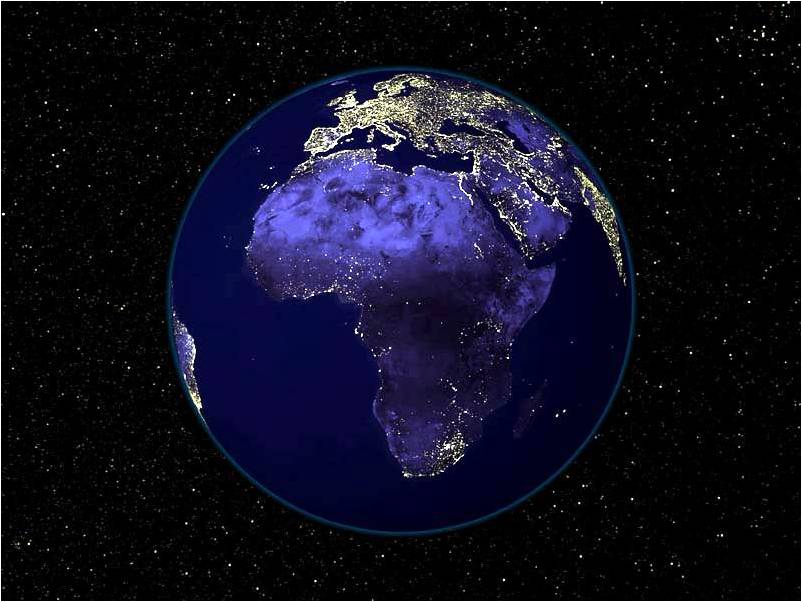
this definition from a historian: “Africa is a place, a
material and imagined place, or rather a configuration of places, an embodiment
of spaces that are socially produced and produce the social. Its material and
symbolic boundaries are constantly shifting, for Africa’s spatiality, like all
spaces, encompasses the vast intricacies, the incredible complexities, and
interlocking and dispersive networks of relations at every scale from the local
to the global…. Africa in short, is a geography, a history, a reality and an imaginary
of places, peoples and positions, both an invented intellectual construct and
an object of intellectual inquiry.”[2]
Indeed Africa, as a space, has been shifting in and across time. Admitting
Haiti to the African Union (AU) in 2012, for example, has expanded the
continent’s political space even if symbolically. One, of course, could argue
that Haiti already inhabited that space since the Haitian Revolution in 1803.
Yet in both cases the changes in space has been delineated in terms of
(historic-al) time.
[1]Reprinted from Colin
Gordon, Ed. (1980) Power/Knowledge: Selected Interviews and
Other
Writings, 1972–1977. New York: Pantheon, 63–77.
[2]Zeleza, Paul T. (2003) Rethinking
Africa’s Globalization Volume 1: The Intellectual Challenges. Asmara,
Eritrea: Africa World Press.(p. 3).
