
Tanzania’s Industrialization Journey: Updated Book Review
This book came out in 2017. My review in Tanzanian Affairs120 in May 2018 helped to publicise it. This is a revised and corrected version of the review.
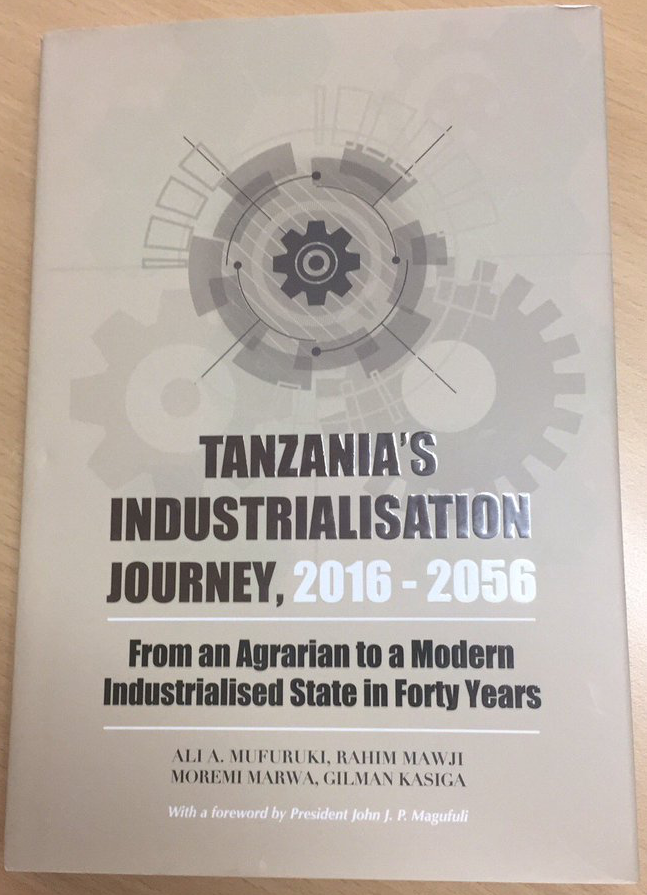
Ali Mufuruki, Rahim Mawji, Moremi Marwa, Gilman Kasiga. Tanzania’s Industrialization Journey, 2015-2056: From an Agrarian to an Industrialised State in 40 Years. Nairobi: Moran Publishers, 2017. Also on the internet at http://dicotaus.org/wp-content/uploads/2017/11/Tanzania%20Industrialisation%20Journey,%202016%20-%202056.pdf
This is the most original book about economic strategy in Tanzania for many years, but its deeper purpose it to give Tanzanians confidence that they can take control of their destinies and make their nation a better place, socially as well as economically. Its authors are three leading businessmen (two of whom trained as engineers, one an accountant) and a mathematician. It demonstrates how Tanzania might industrialise: a manifesto set out in simple, direct language, supported by well-produced tables, graphs and charts. But it also shows the self-belief, and the need for cultural revival and confidence to make this happen.
The authors draw on the conclusions of the Korean and Cambridge economist Ha-Jung Chang and Justin Lin, born in Taiwan, offered the chance to study for a doctorate in the United States, Head of Economics at the World Bank, now Professor at the National School of Development at the University of Beijing. From these and their own experiences of the Asian tigers the authors have realised that comparative advantages can be changed by strategic investments engineered by a state which uses “strategic protectionism as an active industrial policy”. From Lin, and from their understanding of industrial strategy in Ethiopia, they have a vision of African states which can manufacture labour intensive items such as garments or leather goods as cheaply as anywhere else in the world, provided the supporting infrastructure is effective, including the ports and reliable electric power and water, and there are supplies of skilled and semi-skilled labour and engineers capable of maintaining the machinery. As they say on page 31, “with this scenario, globalisation is our ally”. They illustrate their arguments from Malaysia, Korea, Vietnam, even the motor industry in Uzbekistan, developed with Korean assistance to supply the Russian market. They propose to start with “light manufacturing”, including textiles and garments, footwear, electronics assembly, other consumer goods, and some of the steel, plastics and other intermediate goods which go into their manufacture. Many of these products will be for domestic markets, some exported to neighbouring African countries.
Two key proposals for Tanzania are controversial. In contrast to current proposals for developing garment manufacture which are largely based on increasing the value added of Tanzanian cotton to supply local and regional markets for clothing, their proposal is to aim for a small portion of the US market for garments, to which Tanzania has tariff-free access, and to do so using a range of yarns and fabrics, most of them imported, and factories in export processing zones with reliable electricity and water supplies. Implicitly (though not stated as such in the book), if the cheapest way to clothe the Tanzanian population involves continuing to import mitumba, clothes donated to clothes banks in advanced countries, and therefore almost free other than the costs of transport, then so be it: the big prize is to be able to export almost limitless quantities of garments produced more cheaply than would be possible in China or Bangladesh.
Their second controversial proposal starts by recognising that gas and oil prices are not likely to rise substantially in the near future. Tanzania is not going to become a petrochemical state comparable with Nigeria or Angola. But the costs of generating power from renewable sources are falling rapidly, and Tanzania has plenty of sun, twelve-hour days, and no shortage of land that can be used for large solar power “farms”. The technologies to store this power during the dark hours of the night are evolving rapidly, and hydropower can be used during the nights. Different scales of solar power generation would mean that every village could be electrified, some just for lighting and the recharging of mobile phones and laptops, but many others with electricity for the operation of basic machines such as pumps or welding aparatus. Every Tanzanian would have 100-150 Watts of solar power by 2025. The scale of the use of solar panels would make it possible to manufacture them in the country, and to export to regional and perhaps international markets. “Use of solar power will keep the environment safe. By embracing its benefits and crafting policies to encourage its use while making sure that extremely poor people are not left behind, Tanzania has the unique opportunity of becoming the world leader in the use of sustainable energy, environmental protection and growing its economy at fantastic rates” (p.87).
The proposals for developing light industries, and the coal deposits at Mchuchuma near Mbeya, and iron ore at nearby Liganga, to produce steel for the construction industry, for various light industry uses (and, presumably, for export to China), are in line with current policies.
There is a well written chapter on the needs to strengthen the education system, with emphasis on the quality of the education not just the quantity, and on technical and manual skills. The chapter on finance argues for joint ventures with international companies, but with the state involved with key projects. The Tanzanian diaspora is a possible source of finance for some projects. The final chapter, on “policy imperatives” argues for the very selective use of tax breaks and subsidies, “pioneer firms”, clusters of industries in geographically appropriate locations, special employment zones, and “experimental cities” – all with nods to China and Korea. Also for severe but sensitive regulation to coordinate investments from overseas and ensure that inappropriate behaviour is found out and addressed.
But for this reviewer the most important part of the book is Chapter 9, on “national exceptionalism”, or developing Tanzanian culture. This includes Tanzanian national dress, local cuisine, preserving and studying the inherited local environment and its history (in which colonialism is but a passing phase), poetry, literature and art, and using the media to spread knowledge of history and national values. Ultimately, it is about “embracing the African identity”, while getting Tanzanians “to feel psychologically empowered, personally invested, and to triple their efforts to drive the nation forward” (while also drawing inspiration from the rest of the world). Above all it means developing the Swahili language, with mass programmes of translation and the use of Swahili in all possible circumstances. This chapter goes far beyond a narrow technocratic tool box and bears comparison with the work of Walter Rodney. It is worth reading the book for this alone.
