
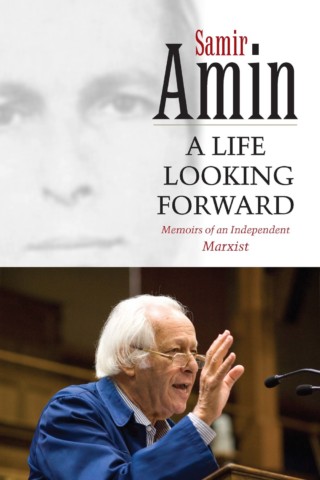
A Life Looking Forward Beyond Capitalism: Farewell Samir Amin
Chambi Chachage
I only met him once. It was at the Mwalimu Nyerere Intellectual Festival Week in the hallowed Nkrumah Hall of the University of Dar es Salaam. In an electrifying keynote, he summed up the long history of capitalism and its discontents, charting the way out of it.
As a historian of capitalism, I was awed. “Capitalism is a small bracket in the long history of human civilization”, he asserted. Then he asked: “If it continues for another 100 years so what?”
For him, capitalism is not a given. It is not inevitable. There was life before capitalism. And there will be life long after capitalism.
So, there are alternatives to capitalism and its neoliberal form of globalization. Elsewhere, Samir Amin stressed that “globalization is never absolute, it is always relative….” With the possible exception of Noam Chomsky, probably no one has consistently unpacked the history of capitalism from a radical leftist viewpoint than Samir Amin in our contemporary times. No one since Marx.
When we mourn his passing, may we celebrate his contribution to, and indeed innovation, in making sense of capitalism. It is in light of this that I share the excerpt below from my old essay on the history of capitalism in Africa. One may see what I mean when I say he was innovative in his diehard analysis of capitalism.
—
To the Egyptian Marxist, Samir Amin, capitalism is a global system that developed out of ingredients that came from various sources[1] His analysis is in tandem with the institutional analysis of Daron Acemoglu, Simon Johnson & James Robinson at least in one respect.[2] Both perspectives view the rise of capitalism in Western Europe in the 16th century as an outcome of a long and gradual process. However, Acemoglu et al. locates its evolution within the disintegration of feudalism in Europe that went hand in hand with what they view as the consolidation of institutions that provided checks and balances to the monarchs. For them, these legal and administrative institutions protected private property and created the conditions for the accumulation of wealth through trade and other means.[3] In contrast, Amin locates this evolution within the long transition from the tributary mode or system that was the form of organization that generally characterized pre-modern society. This lengthy preparation of, and for, capitalism, he asserts, started in about 1000 CE and lasted for nearly 8 centuries.[4]
Thus, in Amin’s historicization of capitalism, in contrast to Acemoglu et al., internal contradictions of advanced pre-modern societies were not only confined to feudal Europe. Rather, they characterized all such societies and thus created successive waves of the inventions of ingredients that were to constitute capitalist modernity. In this regard, the first major wave came from China in the 11th century during the Sung era followed by the Middle Eastern wave in the Arab-Persian Caliphate before moving, in the context of the Crusades, to Mediterranean Europe in the towns of Italy such as Venice. According to Amin, the “last wave”, then, “concerns the long transition of the ancient tributary world to the modern capitalist world which began in the Atlantic part of Europe as from the conquest of the Americas, and took the form of mercantilism for three centuries (1500-1800).”[5] Thus, as he reiterates elsewhere, historical capitalism “did not start and appear suddenly in Western Europe as most of Eurocentric visions of history presented”, but rather, it was a product of a series of waves whose ingredients made possible the last wave “that crystallized in the small triangle between London, Paris and Amsterdam late in the 16th, 17th centuries.”[6]
What Amin attempts to do with relative success is to deconstruct the Eurocentric history of capitalism that renders it a western phenomenon. However, he pays little attention to the contribution of Africa’s tributary modes in this development. This is particularly striking given that all the three key waves that Amin refers to as having played a major role in the development of capitalism were linked, at least in relation to trade, with Africa. Such a conspicuous absence, it seems, stems from locating Africa primarily within the last wave that is associated with the Atlantic trade. It also appears to stem from his selective engagement with the world system theory. As a reviewer of his book on Global History: A View from the South points out, Amin does not, at least in this case, think in terms of such system that reaches back 5000 years hence his reluctance to conclude that prior to 1500 CE “the trading links between these different tributary systems implied that they were part of one and the same overall system.”[7] Nevertheless, this historical approach is useful since it does not outright preclude contributions of other waves in the history of capitalism.
[1]Samir Amin’s Lecture on ‘The Trajectory of Historical Capitalism’ at the International Conference on ‘New Emancipatory Struggles’ in Zagreb on May 17, 2011 accessible at <http://www.youtube.com/watch?v=X46v6ak0btA> (last accessed: December 10, 2012).
[2] Daron Acemoglu, Simon Johnson and James A. Robinson, “The Rise of Europe: Atlantic Trade, Institutional Change and Economic Growth,” American Economic Review95, 3 (2005).
[3]Ibid.
[4]Amin, “The Trajectory of Historical Capitalism and Marxism’s Tricontinental Vocation,” Monthly Review62, 9 (2011): 1.
[5]Ibid.
[6]Amin’s Lecture on ‘The Trajectory of Historical Capitalism’.
[7]Andreas Bieler, “Samir Amin, Global History and the critique of Eurocentrism, ” Trade Union and Global Restructuring Blog May 24, 2012accessible at <https://udadisi.com/2012/05/samir-amin-global-history-and-critique.html>(last accessed: December 10, 2012).
—
Farewell Samir Amin. Like you, may will live a life looking forward as we struggle with this (bracket) called capitalism. May we realize your childhood dream of changing the capitalist world.
