

This is Part 1 of a series of commentaries on Udadisi Blog entitled Tanzania Institutional Diagnostic: A Response and Comments By Andrew Coulson
Chapter 1: Political and Economic Development
This chapter, by François Bourguignon, has three sections: a summary of Tanzania’s political and economic history; a review of the macroeconomic data; and a discussion of some of the information on education and healthcare.
It is hard to write a convincing summary of the history of a country in less than 10 pages, so there are bound to be gaps, but here are some of the points that struck me when I read it:
Tanzanian history did not begin with the German conquest. There was an active empire with its capital in Zanzibar, and increasing trade inland before the Germans, as well as many craft skills. There was also slavery, though not on a scale comparable to that in West Africa.
The Germans were incredibly productive in a very few years (that is after they won militarily and created a new state): they mapped the whole country, discovered most of the minerals, conducted pioneering medical and veterinary research, built the Dar es Salaam to Kigoma and Tanga to Moshi railways, and created a new capital and harbour in Dar es Salaam. Governor Rechenberg in particular was not purely authoritarian. The return of the tsetse fly was related to the wars of conquest – when there is human habitation the fly are controlled; in times of war the people move to a few places to seek safety and the fly return. The situation was bad following the Maji Maji rebellion, but probably even worse during and after World War 1, when German and British armies largely lived off the land.
Tanganyika under British governance was neglected, especially when compared with settler colonies such as Kenya and Zimbabwe. But after World War 2 there was more interest. The Groundnuts Scheme was a classic failure of large scale agriculture – but there were similar failures post-Independence (the Basotu Wheat Scheme of the late 1970s, and the agricultural aspects of Big Results Now in the 2000s). Coffee and cotton were developed for export markets, adding to sisal which expanded earlier. By the time of Independence, there was close cooperation between the British administrators and the nationalist politicians.
Nyerere was very cautious about the Soviet Union and countries in the Soviet sphere of interest. He was more influenced by the Fabian socialist thinking which he encountered in Edinburgh, and he resisted strategies based on heavy industry, and attacks on “kulaks” when these were advocated by some of his political colleagues, such as Abdul Rahman Babu. If anything he and the country were closer to the Chinese.
Sisal exports declined because their main uses – string to tie up parcels and ropes for ships – were replaced by cheaper and lighter plastic-based substitutes. Tanzania did export food in some years, but it also imported food.
The war with Amin was quite short. I have often wondered why it appears to have consumed so many resources, and suspect that it was followed by a heavy investment in the military.
I have little to add to what is written about the years of structural adjustment etc. I did not visit Tanzania in that period, or keep up to date as the situation developed.
Pp.10-26 is an important review of the macro-economic data for Tanzania. In terms of GDP the country has done well since the turn of the millennium. No sector became a dominant “growth centre” in this period, with much of the growth coming from a movement out of agriculture, where productivity is low, into other sectors where it is higher. In terms of trade, the biggest increases in exports came from gold and tourism, but imports have exceeded exports – with the balance made up from overseas “aid” and government borrowing. 30% of GDP is invested – a high figure – but it does not appear to have been invested particularly well, or growth would have been even higher. The net borrowing from overseas reached 33% of GDP in 2015, which is sustainable as long as international borrowing rates stay low, but will quickly become a big problem if they rise.

There are many places in this narrative where difficulties with the data are acknowledged, most where different sources give different figures for what should be the same. It may be that the data we have is better than not having any data. But I think that the problems are even worse than described. Difficulties with the data on small-scale agriculture were discussed by Skarstein (in Havnevik and Isinika (eds.) Tanzania in Transition: From Nyerere to Mkapa, 2010 pp.99-130), and in an Annex of the Agriculture Sector Development Programme Phase Two (ASDP II) in 2016.
My interpretation: agricultural censuses produce a baseline for the areas devoted to different crops. But yields and prices vary greatly from year to year and in different parts of the country and are much harder to estimate. In colonial times and when I worked in the Ministry of Agriculture in the 1960s, District Agricultural Officers were rung up on the telephone and asked to make estimates of by how much yields were likely to be higher or lower than the previous year – not reliable but it explains some of the contradictions. This fell into disuse when the agricultural officers concerned became employed by district councils, and could not be forced to respond to requests from the Ministry. I am told that there are better methods now, including use of aerial photos, but I am not sure that the task is possible.
There are even bigger problems with prices, e.g. if there is a good yield of cashewnut or maize but the farmers are paid half of what they were promised, or payments to them are delayed, how do you value the crop in GDP calculations? Or if a very good crop of tomatoes rots in the field? Should you value a food crop such as maize which is consumed locally at its value that would have been achieved if it was sold, or its value if the farmer or producer had to buy it at the end of a long dry season, when its value is much higher? Should the same price/value for food crops such as maize or bananas be used for the whole country?
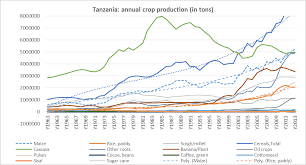
There are issues of smuggling and associated under-reporting (see Lofchie, The Political Economy of Tanzania: Decline and Recovery, 2014, p.167 for a telling paragraph on the smuggling of raw coffee to Kenya). One of the challenges is that there has been a green revolution in the South, Rukwa and parts of central Tanzania, based on hybrid maize and sunflower, potatoes, tobacco, cashewnut and other crops. However, climate change, plant diseases (affecting bananas in particular) and declines in both prices and quantities of coffee and cotton have turned what were, not long ago, the success areas of Northern Tanzania into huge challenges. Figures for the country as a whole do not reflect this diversity (See Figure Below from ASDP II, 2017).
There are issues with the informal sector generally. Rizzo (Taken for a Ride, 2017, esp. pp.76-8) pointed out that a problem with the translation of the labour force surveys into Swahili has led to most of those in the informal sector who work for others (e.g. on daladalas) being recorded as self-employed – thereby overestimating the number of businesses and underestimating their scale. But generally, in rural areas as well as urban, the sector is growing so fast that it is very hard to keep track. For example, artisanal mining has in recent years employed more than a million people (seeBryceson and Geenen in African Affairs, Feb 2016, and work bySarah Hayesfor the World Bank).
The dark sector is even more of a problem. Smuggling, to avoid local taxes and cesses as well as border controls, is significant. It is alleged that most of the property boom in high-rise buildings in Dar es Salaam is based on money laundered from the Middle East – I have no evidence for this. Lofchie (pp.137-9; p.151ff.) describes the various forms of rent-seeking that emerged due to the overvalued exchange rate in the 1980s. Those who could persuade the Bank of Tanzania (BOT) to give them dollars in exchange for shillings, could import goods and sell them for many more shillings – and go back to the BOT for more dollars (pp.168-9). But, he argues, many other members of the elite made money by making and selling goods, and the reforms of the Mwinyi period were acceptable because this group of salaried individuals realised that they would find it easier to make money from businesses if they could do so legally (pp.41-2; 151-161). But if individuals could play the currency markets like this, how much more so companies which were regularly involved in importing?
The discussion of poverty and inequality again highlights almost insuperable disparities between the different sources of data, though none of them doubt that “there is a challenge in transforming GDP growth into poverty reduction” ( p.30) – i.e. not much of the growth has trickled down.
How should scholars respond to these huge problems with the data? The most common approach, followed here with great diligence, is to study the different sources and make judgements about which is the most plausible for any particular figure. But this gives a spurious impression of accuracy. Maybe every figure should be given a range of possible values. Or any figure for which there is more than one official estimates should be marked with a *.
Perhaps it is time, in a country study such as this, to question the utility of the international systems of statistics, and in particular GDP as a measure. It has been controversial ever since its creation by Kusnets, Richard Stone and others in the 1940s. There are fundamental problems about valuing investment, unpaid labour such as housework or care of elderly relatives, environmental externalities, and public services provided by states (customarily included as the value of wages and salaries paid to those involved, which makes no allowances for differences in quality or productivity). It makes no allowances for inequalities, or (un)happiness. The difficulties/disagreements are bad enough in developed countries, but far worse in countries such as Tanzania. So possibly the author should have concluded that GDP for Tanzania is uncertain, and given more weight to figures which are collected as part of public administration – imports and exports, taxation, employment in the formal sectors.
Pp.31-5 report on education and health. It is helpful to highlight the weaknesses in the quality of education, lack of teacher skills, and absenteeism, and the lack of attention given to technical training programmes. Similar points could be made about the Higher Education (university) sector. And to point to the failure to deliver budgets for basic medical services. The institutions involved could have been the subject of chapters in their own right, as could other services devolved to district councils – agricultural and livestock extension, domestic water supplies, feeder roads, etc. The discussion of decentralisation in Ch.5 is about tax revenues and the income side of budgets, whereas an institutional approach cries out for focus on functions and expenditure, such as how allocations of drugs for rural dispensaries are managed, or whether the village-based extension service can be effective without better links with research stations and without adequate transport.
