
Yesterday I watched this interesting play depicted by the photos above at the University of Dar es Salaam. A similar play, we were told, “was carried out in Ifakara, Kilombero District by University Students from Fine and Performing Arts and the School of Journalism and Mass Communication.” In fact we were further told that the “play is a result of research by the same students, who lived with ordinary wanavijiji for 21 days watching how the communities interface with the environment. They then put their observations together in a creatice piece of work and took it back to the communities where they lived and performed it for them.” Interestingly, it known as “Creative Insights” Project Program, and it supported by Norway through the Programme on Institutional Transformation, Research and Outreach (PITRO).
Indeed the performers were creative, adapting a ‘traditional’/’cultural’ dance associated with invoking the ‘ancestors’ so as to ‘inform’, or rather, ‘teach’ the local communities on how to conserve the environment (mazingira) through ‘good governance'(‘utawala bora’). As I watched I could not help but wonder: Since when did the local communities lose sight of (indigenous) ways of preserving their environment to the extent that they now have to be taught how to do it. I ended thinking of what one of their assistance lecturer refers to as ‘donor theatre.’ She thus aptly describe this form of ‘aid-ed’ theatre and its ‘dependency’ consequences:
“The history of donors and NGOs in African theatre, like any other field, coincides with the
adoption of the economic liberalization policies…. In practical sense, there is no area of theatre in Tanzania that is today free from the varied consequences of donor funding. Conversely, theatre practitioners and other stakeholders are turning to donors with the ready-made socio-economic and development agendas for assistance. The most favourable area for funding by donors is [Theatre for Development] TfD. Donors have taken theatre and mostly use it as a ‘medium of communication’ to address global agendas. They include issues such as Millennium Development Goals (MDGs)…. Donor theatre has created audience which prefers free admission, and it becomes difficult for the same artists to stage a creative performance and ask the same audience to pay for admission…. Market callousness which donors have created for theatre has been basically to satisfy targeted audience sitting in donor countries’ offices abroad and not the poor and the so-called marginalized Tanzanians…. One of the basic and fundamental conventions of theatre is aesthetics in the creative imagination… So when funding is embodied it is clear that the performers’ imagination has been interfered, influenced, manipulated and even corrupted. These sensations and imaginations are the ones which aroused audiences’ emotions and feelings, ‘make believe happens’. Most of the theatre plays themes revolve around donor funding priorities; such as campaign for human rights, malaria, HIV and AIDS and others. Audience is now used to low quality, ‘parroting’ theatre and it is difficult to persuade (the audience) to pay for such performances. The theme of performances’, have to relate to donors’ funding areas as mentioned before. For more than ten years, the focus has been on the same themes which to a certain extent it becomes monotonous. In some places especially in big cities, it is difficult to mobilize audience to watch such plays. One of the audience members complained that, “today’s plays are very dry, they don’t have taste”…. In some incidences, actors do not even understand the content of the messages but they present the information to the audience who are expected to understand and take action…. Clearly stipulated, donor theatre does not emphasize on the ‘aesthetics’ but ‘message’ and this is a TfD practice…Theatre has to depend more on donors and, as a result it compromises its status….” – Vicensia Shule on ‘Tanzanians and Donors: Opposing Audiences in Public Theatre’

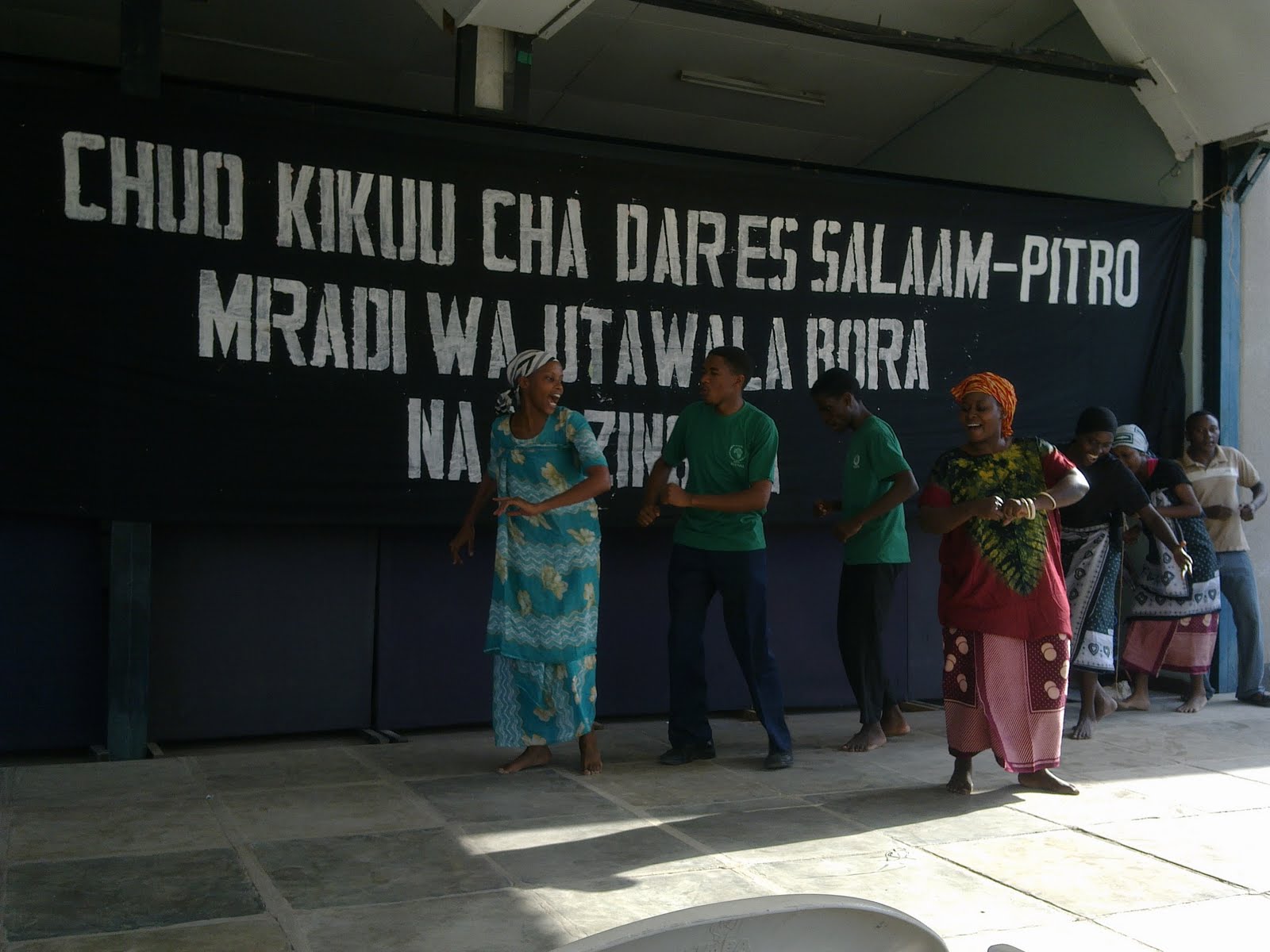


 Yesterday I watched this interesting play depicted by the photos above at the University of Dar es Salaam. A similar play, we were told, “was carried out in Ifakara, Kilombero District by University Students from Fine and Performing Arts and the School of Journalism and Mass Communication.” In fact we were further told that the “play is a result of research by the same students, who lived with ordinary wanavijiji for 21 days watching how the communities interface with the environment. They then put their observations together in a creatice piece of work and took it back to the communities where they lived and performed it for them.” Interestingly, it known as “Creative Insights” Project Program, and it supported by Norway through the Programme on Institutional Transformation, Research and Outreach (PITRO).
Well i tend to agree moslty with your argument. However, i thought the students stayed for 21 days in those villages observing the indegenous practices and how they interface with their enevironment. From that observation i presume they deduced the inapropriate paractices which again reflects that the communties had lost track/violated their earlier indegenous ways of presrving their own environment.I would querry if the thearte play put across complete new/foreign ideas of preserving the environemnt or whether it simlpy built on the same traditional ones that were used by the same communties.If they showed new ones, then i think the play should have somehow indicated that among the findings they got, was that the traditional ways were no longer working for them (communities)for various reasons including technological and contextual reasons.Maybe, just maybe, it is Donor funded because it is one very rare area that many researchers/Theatre itself visit(s) in detail in conventional research and Theatre in general. I find the blend btn' utawala bora and Mazingira very inetresting and relevant given the current context.
Mimi huwa si mchangiaji saaana wa mada but i have a particular ineterst because I participated in almost a similar programme while i was in my First year in the same department, the programme was titled-'Creative Insights into Poverty Reduction'—and for me in the end it was not so much about the funding but what I learnt from the ground level, infact we were posted in Morogoro Mvomero and It taught me alot from the ground.
G.S
Mradi wa Utawala Bora na Mazingira? Oh dear.
and she's right, aid has killed the arts. But didn't the state have a part too, with it's eagle eyed censorship and nation building goals?
It is great to get some more perspective on this rather than seeing the drama as a negative thing. Right now it seems like only intellectuals are only dissing and only from the sidelines, except for in a few cases like Shule's.
If the drama were such a bad/degrading/pointless thing, wouldn't we be seeing some sort of backlash along the lines of the contemporary and historical subversive arts scenes around the world? And aren't these drama groups outdated in today's world of M. Mkandamizaji and Nakaya?
All I can say about the Mazingira aspect of the performance is that some serious funds or some serious creativity are needed to make that topic interesting. For most audience members "tunza ikutunze" is beyond passe. I didn't see the performance, but speak from what I know about seeing past shows.
However, I am not totally convinced that the shows are pointless and wish more drama groups and those who employ them would find an interesting way to share their impact.