
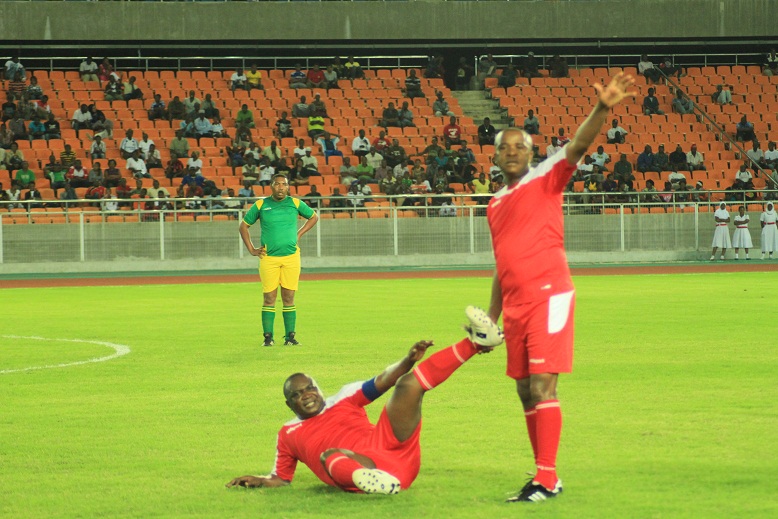
If Politicians Were Players
9 May 2008
His fans nicknamed him “The Phenomenon”. He was indeed a
marvel to watch as he dribbled past dazed defenders and scored dazzling goals.
This is none other than Ronaldo Luis Nazário de Lima, the three-time world soccer
player of the year.
At the age of 31, Ronaldo is now struggling to prolong his
illustrious career after a recent knee surgery. However, in the world of soccer
the average retirement age is so close to that. It is only in very rare cases
you get to see the likes of Roger Milla and Romario de Souza Faria who retired
in their forties.
One wonders what would happen if politicians were players.
Would they be able to sustain their careers even when they can no longer meet
the playing demands of the times? Interestingly, the other day my uncle, a
former player of the Tanzanian national soccer team that ever competed in the African
Cup of Nations, asked me why youngsters are not seriously taking over politics.
They, the old guards, have outlived their usefulness, my
uncle who would be considered young in the political arena insisted. How can a
political party remove one of its top leaders, claiming that he is too old,
only to replace him with another old ideologue from the same generation, he
queried?
Indeed it will be ridiculous for politicians to retire at
the same average age as players. But they can learn a lot from them. Players
don’t retire early simply because they want to. Soccer as an institution ensures
that they go when they can no longer cope with the pace.
Surely Diego Maradona would have loved to keep on playing
what Pele of Brazil dubbed “The Beautiful Game”. He even tried to do so by any
means necessary in the 1994 World Cup. But the drug test, nay, his own weary
body he was trying to force to play, ruled him out. That was a simple
indication that the time had come to give way to a new generation of
Argentinean players that is now epitomized by Barcelona’s sensation, Lionel
Messi.
All the signs of the times indicate that some of our
politicians have to give way to young politicians not just because they want to
but because the dynamics demands so. Of course we need the wisdom of age. But
in a way, as the Prime Minister of Ethiopia, Meles Zenawi, observed, this tend to
make our wise old leaders do the same things over and over again expecting
different result. As a result they maintain the beaten track even it is a dead
end.
Admitting he doesn’t have the same type of ambition and
courage he had 35 year ago, Zenawi concluded thus: “I think it’s partly because
of the experience of defeats, the achievements, and the experience of life
itself which makes a person wiser and at the same time less courageous and less
ambitious. If we could combine the wisdom of age and the courage and ambition
of youth then we can break out of a mad situation of doing over and over the
same thing.”
It is this courage of youth that led Anton Lembede, Oliver
Tambo, Walter Sisulu, Nelson Mandela among others to form the African National
Congress (ANC) Youth League in 1944 to awaken the then old guards. Many of them
“felt, perhaps unfairly”, notes the author of ‘Long Walk to Freedom’, “that the
ANC as a whole had become the preserve of tired, unmilitant, privileged African
elite more concerned with protecting their own rights than those of the
masses.” As history tells us, this passion of youth transformed the party into
a formidable freedom movement.
Hopefully, the youth wing of our ruling party will take a leaf
from this history of youth struggles. In fact it is standing on the shoulders
of its very own legendary predecessors, the Afro-Shiraz Party (ASP) and
Tanzania African National Union (TANU) youth leagues. It ought to use this rich
legacy, as a base, to fly. Its Tanga branch has shown the way: “CCM Youth now
call on ‘tainted’ members to go” (The Citizen 5th May 2008).
When a player retires or moves one of my Zambian friends, a
diehard Liverpool fan, consoles himself by saying players come players go. They
go but the team stays. The institution stays put. Captain Patrick Viera left
but Arsenal went on to almost win the European Champions League final. Roberto
Baggio, christened “The Divine Ponytail”, was a ‘retiree’ when Italy won the
World Cup in 2006.
We need to strengthen ‘politics’ as an institution rather
than a personality. It has to be a stable, democratic institution that can
survive beyond iconic politicians. If we do so we will be able to also truly
say politicians come politicians go.
Yes, if we do so we will be able fight corruption even if moral
personalities like Mwalimu Julius Nyerere are no longer there to enforce a leadership
code. All this will be possible simply because of stable institutions that have
self-regulating mechanisms to enforce public accountability. Politics is too
precious to be personalized by politicians.
© Chambi
Chachage – The Citizen
