
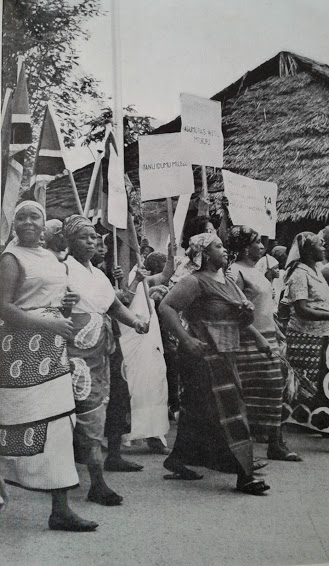
What about Unsung Heroines?
Chambi Chachage (2007)
Have you ever heard or read something that you are already
very familiar with? If yes, did you agree with what was said about it? Did you
feel the narrator or writer represented it accurately? Or did you sense that
s/he overlooked some of its important aspects?
Now imagine someone who claims to know Tanzania very well
and yet talk about its landscape without even mentioning Mount Kilimanjaro or
Lake Tanganyika. Imagine someone who is an authority on Tanzanian history and
yet write about its heroes and heroines without even noting down the names of
Mwalimu Julius Nyerere orBibi Titi Mohammed. How will these acts of omission
make you feel?
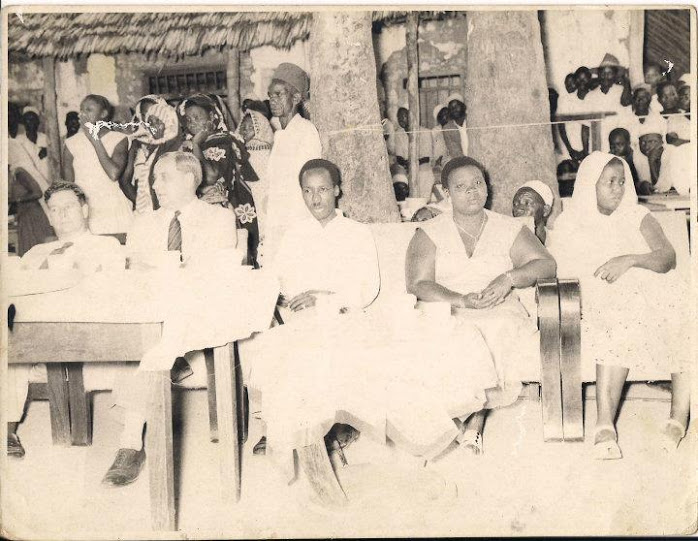
Strange as it is, we often talk and write about heroes of
our society as if there are no heroines. Even our recent commemoration of the
Heroes Day on 25 July 2007 was more of a men’s show. One can even go as far as
saying that it was an exhibition of masculinity vis-à-vis femininity. A couple
of dignitaries, all of them men one would correctly presume, laid weapons at
the foot of the Heroes Tower. It was a wreath, sword, shield, bow and arrow to
be precise. If what I was taught in school is true, that it is men who fought
in wars while women remained at home, then this homage had little to do with
heroines.
The tendency to sing praises to heroes at the expense of
heroines may be deeper than we think. It has been part and parcel of our
collective imaginaire. The gender consciousness movement sees this tendency as nothing
more than a product of patriarchy. In layman/woman terms, patriarchy is a
dominant way of thinking and living that systemically privilege boys and men at
the expense of girls and women. When our councilors meet and a respected
newspaper report that ‘city fathers meet,’ that is patriarchy. And when no one,
not even self-proclaimed feminists, questions that newspaper then that is
patriarchy working at its best. Patriarchy tends to make us overlook the
building blocks of gender oppression.
It is not surprising then that most of us have a gender
blindspot. Unfortunately, even our intellectuals, the so-called keepers of our
collective memory, have been plagued with blindness. For instance, ten year ago
Paul Zeleza’s survey of Gender Biases inAfrican Historiography revealed that most African history textbooks
underestimate the role that women have played in all aspect of our history. Out
of the seven studies on nationalism and decolonization surveyed, four do not
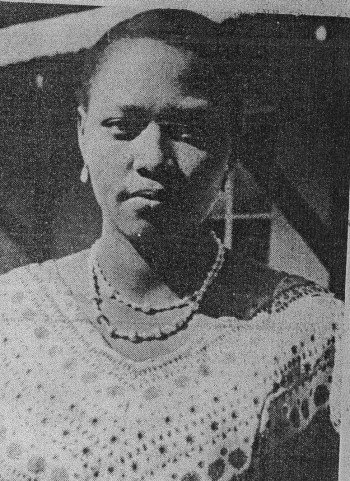
mention women at all. Tanzania is no exception. No wonder no history textbook in our schools taught us about Mwami Theresia Ntare’s controversial ascendancy to the throne of
the Kingdom of Buha let alone his role in the struggle for independence and national building in the 1960s.
In this context, then, there is a need to rethink our gender
dynamics in our ongoing construction of our collective memory i.e. in our
celebration of the Heroes Day and in retelling stories of our heroes and so on.
This need cannot be overemphasized given that, as a nation, it is this very
memory that tells us who we are, where we are and where we ought to be. It also
gives us a glimpse of how we can get to where we ought to go. Now imagine how
difficult it is to get there if virtually half of our population tends to be
written off. Thus, it is a historical necessity to rethink our history. Susan
Geiger, Magdalena Ngaiza and Bertha Koda, among few others, have paved the way.
In her book TANU Women,
Geiger deconstructs and reconstructs the mainstream or ‘malestream’ history of
the nationalistic struggle. She shows how their role in financing and
mobilizing the struggle, significant as it was then, was not given its due
credit in the annals of our history. On their part, Ngaiza and Koda edited a
book, Unsung Heroines, which collated
life histories of some ‘forgotten’ Tanzania women. In both cases, one gets to
hear the other side of the story (‘herstory’) of our society.
It is encouraging to note that five young researchers are about
to enter the field to carry on the torch. As a part of the popular feminist
history research project, they will document life histories of women who
contributed in the struggle for independence. I can hardly wait to hear their
‘herstories’ presented at the Gender Festival in 11-14 September 2007. The
struggles of these heroines can help us rethink the Heroes Day. More
significantly, they can inspire us to rethink our collective identity.
