
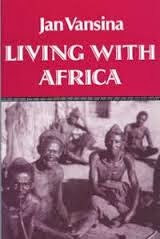
Contextualizing Jan Vansina’s Memoir
‘Living with Africa’[1]
Chambi Chachage
“The new historiography advertised its virtues by damning the old trend,
now labeled ‘Africanist’” – Jan Vansina
Vansina’s memoir is both an intellectual autobiography and a celebration
of the development of the academic study of the history of Africa. Written in
1994, at a time when the historiography of Africa was going through what he
refers to as an introspective phase, it traces the history of the Africanist field
that had reach nearly half a century. It is Africanist in the sense that, in
contrast to the earlier historicizing of Africa that W.E.B Du Bois and Carter
G. Woodson spearheaded, emerged with the rise of African Studies in the US
Academy. One of founding fathers, Philip D. Curtin, played a major role in
initiating Vansina when he recruited him at the University of Wisconsin at
Madison. Interestingly, he had started his career as an anthropologist.
Although Vansina was earlier trained in the positivist tradition and had
a stint with functionalism that pervaded Anthropology, he was
anti-establishment. It is this tendency, coupled with a keen interest in
history from below, that prepared him to become the father of Oral History.
Reminiscing on his first ethnography, he writes:
By the time I went off
to initiation, my resolve to study Kuba history forced me to abandon the
then-recommended pattern of participant observation anyway. To begin with, the
pursuit of oral traditions meant that I was granting much more weight to what
people said than was then usual (p. 240).
When the nationalist historiography and modernization theory pervaded the
field in the aftermath of independence in Africa and national building initiatives
in the 1960s, Vansina fully participated. However, as the epigraph shows, he was
among those whom the Dependency and Marxist historiography, which emerged in
the wake of the crises of the 1970s, critiqued. “I was not alone”, he recalled,
“in rejecting historical materialism” (p. 206). This trend, however, passed.
What followed, respectively, were structuralism and postmodern trends. By the
time he was writing his memoir African history was thus far from having a
consensus it ostensibly had when they started:
Today the historiography of Africa is in flux.
Old habits and doctrines are crumbling, a great variety of new approaches is
being tried out, and many novel imaginative topics are being broached (p. 221).
The memoir is indeed an informative overview of how the modern academic
field of African History developed alongside one of its illustrious pioneers. It
weaves the pessimism and optimism in the field – from the anguish on the
decline of studies on precolonial history to the hope on the prospects of oral
history – in a balanced and nuanced way. Hence it leaves the reader who aspires
to be an African historian with a realistic perspective of the ups and downs of
the discipline and its practitioners. After all the study of African history,
as he intimately concludes, becomes for him – and, one may add, any concerned
historian ‘Living with Africa’ – “a meditation on the African incarnation of
the grandeur and the misery of the human condition itself” (p. 254).
[1] Jan Vansina, Living with Africa (Madison: University
of Wisconsin Press, 1994).
