
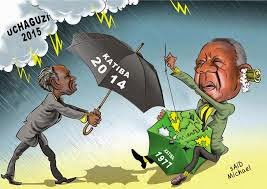
Rekindling Hope for a New Katiba for Tanzania
Salma Maoulidi
Tanzania is in need of a miracle to get out
of the mess it finds itself in after partisan interests derailed the
constitutional review process embarked on at the end of 2011. Competing interests
within the ruling party, which was originally opposed the constitution review process,
as well as among those vying for power in the upcoming general elections, have
polluted, not just the review process, but the overall political environment in
the country.
The endorsement of the Proposed
Constitution (PC) by the Constitution Assembly (CA) leaves very little room to manoeuvre a middle ground, leaving many exasperated. Amid the hopelessness, Humphrey Polepole, an ex-member of
the Constitution Review Commission (CRC), urges citizens and civil society to
refuse to surrender their destinies to a ruling clique that is bent to get
their way in dictating Tanzania’s fate.
Crisis
over the Constitution’s Legitimacy
Regardless what the outcome of the
Referendum will be, Tanzania will have little cause to celebrate. The rationale that prompted the rewriting
the 1977 Constitution was that it was not enough to fine tune problematic
provisions through regular constitutional amendments. More drastic measures
were warranted if Tanzania hoped to become a mature democracy. The prudent
choice was to engage in a new constitutional pact through a consultative and
inclusive process.
Part Six of the Constitution Review Act of
2012 states that if the proposed constitution fails to garner more than 50% of
the vote in the Referendum then Tanzania will continue to use the 1977 constitution. Such a condition is in complete opposition to the primary objective of undergoing a constitution review. Additional concerns over the legitimacy of
the PC include the fact that it departs significantly
from the CRC Draft which is being defended as encompassing the will of the
masses. The disregard of popular views by the CA is one of the key reasons behind
the Katiba stalemate.
The adoption of the PC was also problematic.
The CA endorsed entire sections of the PC instead of individual provisions.
Also votes that are purported to have passed the PC have been contested as
irregularities over tallying have been confirmed. There is overwhelming
evidence of foul play with key constituencies planning to challenge the anomalies
in court. Therefore, voting for the PC as it is amounts to a political blunder
and a constitutional mockery.
Equally there are legal and operational
challenges in facilitating the Referendum. For example, the Voter’s Register is
yet to be updated potentially disenfranchising millions of eligible voters. Similarly, the National Electoral Commission (NEC) of Tanzania is yet to outline the modalities between itself and the Zanzibar Electoral
Commission (ZEC) in administering the Referendum in light of the fact that each
side of the union has its own legislation pertaining to the conduct of
elections and referendums.
Contextualising
the Separation of Powers
Khoti
Kamanga, a law lecturer at the University of Dar es Salaam, contends that the
constitutional review process has brought some of the theoretical
constitutional concepts alive. The question of separation of powers, for
instance, has been vividly displayed in the overall conduct of the CA and most
recently in the handling of the Tegeta Escrow Account saga. Article 55(4)
of the 1977 Constitution requires that Ministers are Members of Parliament (MPs), a fact that compromises the notion of accountable governance. And if ministers are
let go for abuse of office or incompetence, such dismissal does not affect
their other portfolios. Former ministers forced to quit office in the course of
their service remain in Parliament where they influence or oversee key policies
they may have vested interest in.
Opposition
legislators captured the mood of many when they objected to the former Attorney
General (AG), Andrew Chenge, who was also implicated in the Escrow deal to input
deliberations that were in fact discussing his fate. Despite his many
controversies, Mr. Chenge heads the Parliamentary Budget Committee (a position he is expected to be forced to vacate by January following the parliamentary resolutions on the Escrow scandal), and was the
Chair of the Drafting Committee in the CA. Fredrick Werema, the outgoing AG, is also a
High Court Judge. His prosecution will, however, be complicated by the fact that, as a Judge of the High Court, he is thus immune from ordinary prosecution. Prior to a presidential demotion, Prof.
Anna Tibaijuka, on her part, argued against her resignation stating that she was not directly responsible for the ministry implicated in the Tegeta Escrow
scandal nor has her ministry been linked to Escrow.
Separation of powers is not only relevant
with regards to the exercise of power within the three arms of government, but
also in the fuzzy separation between party roles and representative roles.
Members of the CA, for example, were expected to represent the interests of the
groups or constituencies they derived from, but time and time again Party whips
influenced decisions of committees as well as of the CA. A similar situation arises
with ministers who defend their party’s manifestos instead of the national
interest.
Who Best to Police Impunity and Excesses?
Escrow exposed public officials who failed
to exercise due diligence in handling matters of national and public interest. But
other legislators, pushed by partisan sentiments or electoral ambitions,
vigorously opposed any action against accused officials in disregard of Article
53 providing for collective ministerial responsibility. Nor the Ethics Council
envisaged under Article 57(2)(g) or the Secretariat of The Public Leaders Ethics
Commission have proved effective in checking official impunity.
Escrow also showed how public officials regularly
disregard legal or ethical codes when discharging their functions. During the
last parliamentary session, for instance, the Deputy Minister for Justice and
Constitution Affairs, Angellah Kairuki, at various times, called on the former
AG, Andrew Chenge, to suggest the legal language
that was to be used to formulate Parliamentary resolutions over the Escrow deal in which
Chenge was implicated. Even the Speaker did not sound the alarm when this was
done until members of PAC and the Opposition objected to it on principle. And
even then, the ruling party’s MPs serving in government protested.
The defiance exhibited by cabinet ministers
to assume responsibility, symbolic or actual, over lapses or violations has
exposed the despotic nature of the political regime. It also begs the question
of the utility of Article 53 on assuming collective responsibility. Ministers
implicated in Escrow each wanted to be tried individually provided that actual
intention to abuse their authority was established. In an effort to save face
before the local elections, ruling party legislators thought it more pressing to
negotiate the fate of the Prime Minister (PM), Mizengo Pinda, instead of defending the Constitution, promoting the
national interest and the rule of law.
The question of accountability has also
been underscored in the recently concluded flawed local government elections. The
minister responsible for local government, Hawa Ghasia, is caricatured in one of
the local dailies distancing herself from the local government authorities which
oversaw the elections countrywide. The primary concern of most Tanzanians partaking
in different stages of the constitution review process was enhancing the accountability
of public institutions and officials. But key provisions of the PC have been
rendered toothless by the CA. Kamanga believes that the present leadership crop
in Tanzania could not afford to retain the leadership qualities outlined in the
CRC Draft Constitution since they hardly measure up.
The Zanzibar Factor
Zanzibar amended her Constitution in 2010 in
a move Mainland Tanzania believes violated the 1977 Constitution of the United
Republic of Tanzania (URT). Among other things, the 2010 constitutional
amendment redefined the status of Zanzibar, declaring it is a country or
autonomous entity within the URT. The amendment also provided for the
Government of National Unity (GNU) whose future has been tested following the machinations
of the CA in passing a PC that is believed, by some factions in Zanzibar, not be in
her interest. Even so the former AG of Zanzibar – who was forced out of office due to his stance – has attracted much praise on
the Mainland over his defence of the Zanzibar Constitution.
Similarly, during the constitutional review
process, the Revolutionary Government of Zanzibar (SMZ) was periodically accused of not meeting its obligation in servicing
the union financially pursuant Chapter 7 of the 1977 Constitution. However, Escrow
and other persistent graft accusations involving key ministries operating under
the ambit of the URT has absolved Zanzibar with one commentator noting “why
would Zanzibar want to associate with thugs?”
Keeping Hope for a New Constitution Alive
Among the numerous benefits of the
constitution review process, aside from increasing political consciousness among
Tanzanians, is the opportunity to address pervasive impunity in Tanzania’s
governance culture. What prescription can release Tanzania from its present
predicament?
Harold Sungusia from the Legal and Human
Rights Centre (LHRC) suggests that the Constitution Review Act can be amended
to overcome the current impasse. Said Juma, an Assistant Programme Officer with
the Tanzania Council for Social Development, (TACOSODE), stresses that the
emphasis should be to allow Tanzanians to make their own minds about the
constitution, not to impose views or decide for them.
Importantly, salvaging the constitution
review process requires that Tanzanians must believe that all is not lost, even
within the current legal setup. The PC can still be amended
if it does not go through the first round of voting on either side of the
union. Independent voices can influence the content of the problematic
provisions at this stage so that the necessary changes are incorporated before
the PC is put once again for the final vote. If no miracles
happens in between it is the second stage of voting that will decide if
Tanzania adopts a new constitution or remains with the 1977 Constitution.

This is very well said, the constitutional review process cost the country to the last penny, yet the assembly ended up rejecting the whole thing because it had tremendous effects on their future power abuse. The problem started when all members of parliament constituted the majority in the CA, the composition of the regular National Assembly is made up of the majority of the ruling party members, how could they write their own death decree? In my opinion, the whole machinery of constitutional review assembly was questionable nothing new was expected. What do we do from here? The only available hope is through the referendum, let Tanzanians reject this 1977 constitution under the cover of the proposed constitution. Enough is enough, awake Tanzanians let us act bravely.