
Imagining Tanganyika
Chambi Chachage
Now it is clear that those who want Tanganyika back
have different views. They differ on what it is or would be. For some it is a government.
Others see it as a country. Yet others perceive it as a state. We also have
those who envision it as a nation if not a nation-state.
It is about time now that we imagine Tanganyika vividly.
Not just on paper but also on the ground. We have been given at least two main
blueprints: A three-government (S3) structure and an improved three-government
(S3z) structure. S3 is federal. S3z is unitary.
Both structures draw from the second draft of the
Constitution that the then chair of the Tanzanian Constitution Review
Commission, Judge Joseph Sinde Warioba, submitted to the President and the
Constituent Assembly (CA). In fact even S3 is as an improved structure as S3z
as no one really expects the CA will pass the draft as it is word by word.
S3 is now primarily associated with the
self-proclaimed Union of the People’s Constitution i.e. Umoja wa Katiba ya
Wananchi (UKAWA). Its political face is a consortium of 3 opposition parties
and their chairs: CUF, CHADEMA and NCCR-Mageuzi. Among the 201 members of CA
whom the President elected, purportedly on the basis of public recommendations,
there are champions of S3 and a couple of members of the mainland arm of the
ruling party, CCM, and ostensibly many in its Zanzibar’s arm.
Zitto Zuberi Kabwe (ZZK) is the main proponent of S3z.
In a twist of irony his proposed model invokes the letter “z”, albeit implying
“zilizoboreshwa” (improved). This, in a way, is also a concoction of S3 and S1,
the latter standing for a one-government structure.
Even though S1 seems to be the most ideal structure,
it remains a no-go zone as it continues to have the potential of swallowing
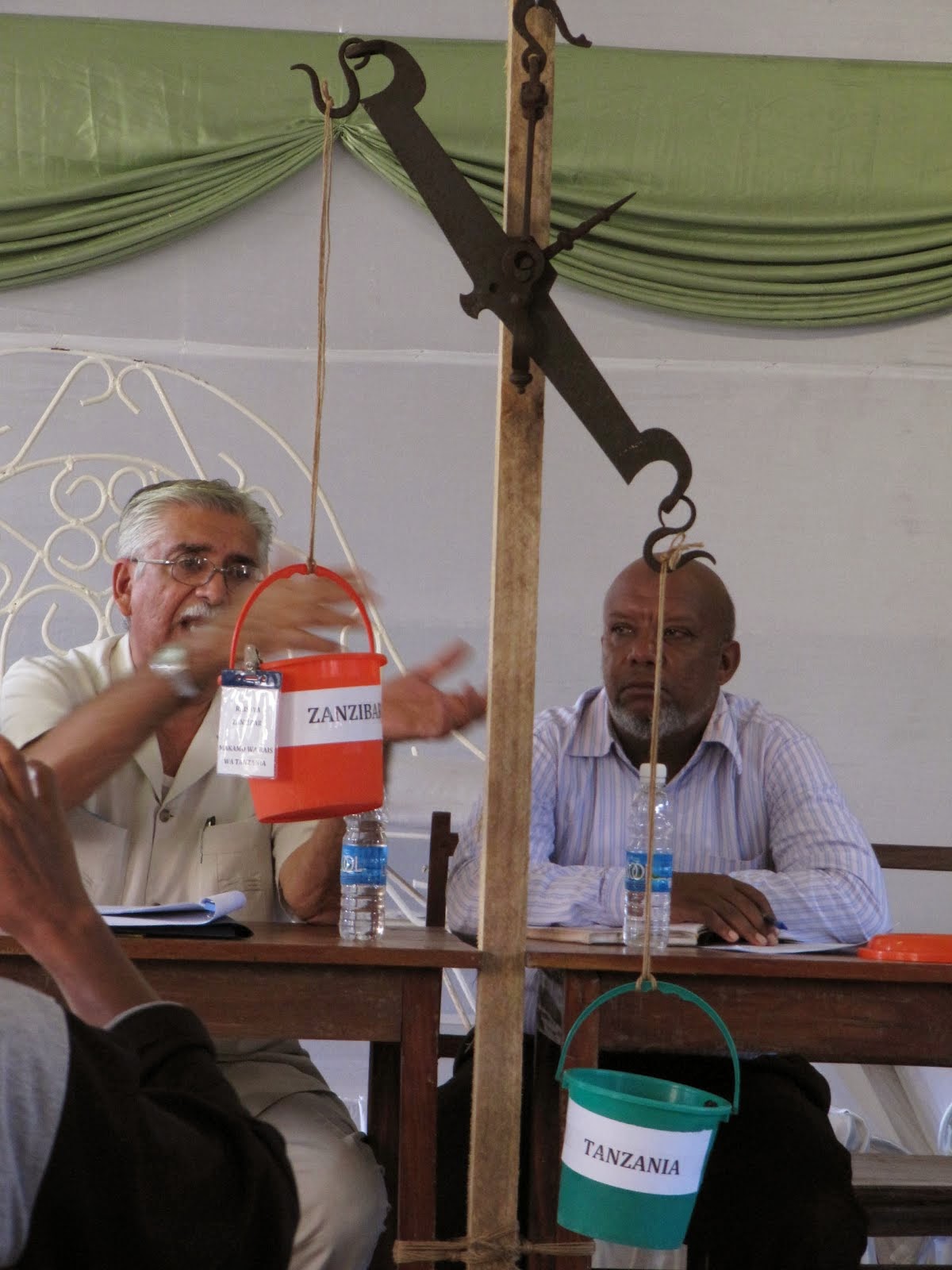
Zanzibar even more than the current two-government structure (S2). To see this
one only has to look at the picture above, of a scale, that Prof. Abdul
Sheriff, now a CA member, used to illustrate why the current Union government
has been constraining Zanzibar’s autonomy over the years through the doubling
of Union matters from 11 to 22. It sums up the position of Zanzibar
nationalists.
Why, I keep wondering, we are not seeing Zanzibari
nationalists embracing S3z in contrast to S3. The answer, I am convinced, is in
the relatively more bargaining power that Zanzibar would have in a S3. This
also includes the power of implementing its exist strategy when and if the
government of Tanganyika in S3 end up being way much bigger.
This is what I had in mind when my article ‘Can
the Union be successfully implemented under any form of power?’ asked
ZZK to move beyond arithmetic and engage with power analysis.[1]
His S3z, as I have repeatedly tried to show, aims to resolve the weakness of
the Union government in S3 by concentrating more power on it at the expense of
the proposed government of Tanganyika and that of Zanzibar. But it ignores the
fact that it is such centralization of power that the Zanzibari nationalists
have been protesting against.
As a dilemmatic Pan-Africanist who supports the Union
and yet support the relative autonomy of Zanzibar, I wrote this in 2009: “It
may be true that “the founder of the Union”, as Dr. Sengondo Mvungi recalls in The Citizen cited above, “had said that
the two governments was merely a transitional stage toward a single
government.” But why then have we witnessed a lot of high level reservations
over the years toward the increase of Union matters in the Constitution of the
United Republic of Tanzania? Indeed those matters have constitutionally doubled
from the original 11 in the Articles of Union. To make matters worse, as Prof.
Abdul Sherrif and Ismail Jussa observes in their chapter on ‘One Step Forward,
Two Steps Backwards: The State of Constitutionalism in Zanzibar-2007’, out of
the 17 areas covered by the East Africa Community Treaty only 4 are Union
matters! In that regard the other 13 areas fall within the jurisdiction of the
revolutionary government. Yet its representation in the fast-tracking of the
East African Federation is as ambiguous. No wonder, as the two authors note, “a
question that was raised repeatedly by the people of Zanzibar during the Wangwe
Commission public hearings was one related to the fact that the Union
government had assumed powers that are exclusively under the jurisdiction of
the Zanzibar government. If we don’t deal squarely
with these reservations they will surely pile up and explode. Perhaps in the
spirit of the Nyalali Commission there is a need to hold a referendum. What do
people want?”[2]
Jussa, a member of both CA and UKAWA, has been
reiterating those same arguments in his eloquent submissions in Dodoma.[3] No
wonder S3 is appealing to him and his fellow Zanzibari nationalists. It will
enable Zanzibar’s government to exercise its (lost) power.
Unfortunately, S3 would weaken and thus break the
Union government, directly through the government of Tanganyika and indirectly
through the government of Zanzibar. With three centers of executive powers that
need to be separated from, and across, three centers of judicial powers and
three centers of legislative powers, power will tilt in favor of Tanganyika because
of its enormous human and natural resources. The juggernaut will grind into a
halt when Zanzibari nationalists realize (if they had not yet anticipated)
their wish for Tanganyika to take off the coat of the Union has been realized,
albeit ironically.
Our weak Tanzania will be at the mercy of the powerful
Tanganyika thus providing a recipe for disaster – Zanzibar parting ways not
least because Tanganyika will have to either ‘wear’ the coat of the Union to
save Tanzania or simply abandon it to wither away.
Coming to the rescue is ZZK’s S3z that in effect
attempts to create a bigger monster with parallel if not conflicting heads, that
of a Union government that is more powerful than the governments of Tanganyika
and Zanzibar. We are told that it “is centred on Tanzania being a one sovereign
state headed by One Head of State called the President of the United Republic
of Tanzania” who “will have an exclusive authority on all Union matters and
henceforth apart from being a head of state he/she will also be an executive
head of the Union Government” who, together “with
his/her Union Cabinet”, he/she “will be assisted by two Vice Presidents, one
being a head of Government of Tanganyika with executive powers on all non union
matters in Tanganyika and the other one a head of Government of Zanzibar with
executive powers on all non union matters in Zanzibar.”[4]
Yet, we are also told, Tanganyika and Zanzibar will
have their own executive Prime Ministers (PMs) who “will come from a political
party with majority in the Zanzibar House of Representatives and that of
Tanganyika”. One wonders if these Prime Ministers (PMs) and the Vice Presidents
(VPs) are one and the same people. If they are not, why are executive VPs assisting,
on non-union matters, a president executing union matters?
Engaging with power analysis on variants of S3 remains
pertinent. Judge Warioba’s unpacking of power dynamics remains as powerful and
relevant: “Sasa hivi kiini ni ugomvi
wa madaraka kati ya Serikali ya Muungano na Serikali ya Zanzibar. Hivi ukileta
serikali tatu, ugomvi huu hautakuwapo? Ukileta Serikali ya Tanganyika yenyewe
haitadai madaraka? Mwisho wataomba madaraka hadi Serikali ya Muungano isiwe na
chochote. Hivi Serikali ya Tanganyika kwa mfano ikawapo, ikataka iwe na wimbo
wake wa Taifa, bendera yake, nembo yake, kisha inadai ifanye biashara ya nje,
unafikiri tutakuwa tumefika wapi? Ni kwamba tutakuwa tunaondoa Muungano na
kurudisha Tanganyika na Zanzibar. Lakini kama wananchi wanataka hivyo, sawa
(i.e. Now the source is the conflict/struggle for power between the Union
government and the government of Zanzibar. If you bring three governments, the
conflict/struggle won’t be there? If you bring the government of Tanganyika, it
won’t ask/demand power? At the end they will ask/demand power until the Union
government has nothing. For example, if the government of Tanganyika come into
being and if it wants its own national anthem, flag, court of arms, and then
demand to trade with other countries, where do you think we will get to? We
would thus be doing away with the union and going back to Tanganyika and
Zanzibar. But if that is what the people want, okay). [5]
Yet S3z has 9+ centers of power?
Patience is of uttermost importance. As the late
member of the Constitution Review Commission, Dr. Mvungi said in quote above,
S2 was simply a transitional structure. Understandably, Zanzibar nationalists
have been fed up as Jussa has repeatedly affirmed in the CA. Theirs, as we have
noted in my previous article, is a cry of broken trust. It is difficult for
them to trust that the ruling party will keep their promise of modifying S2 in
such a way that it will meet their demands. We need another dispensation to
rebuild trust.
Finally, let us take a walk of imagining Tanzania.
Imagine its executive head is in Dar es Salaam or Dodoma. Also imagine the
executive head of the United Republic of Tanzania is in the same or another
city. Then imagine is Tanganyika a land, a people, a nation, a nation-state, a
government, all of the above or none of the above. After that imagine what is
Tanzania then in any of those sets of imagination and what power does it have. Is
it still an imaginable a father/motherland? Or is it just a figment of our
imagination-Utopia?
[1] https://udadisi.com/2014/04/can-union-survive-under-any-form-of.html
[2] https://udadisi.com/2009/08/beyond-two-governments-in-tanzania.html
[3] https://www.youtube.com/watch?v=xb-ufmFMQJM&feature=share
[4] https://udadisi.com/2014/04/zitto-kabwe-power-balances-under-s3z.html
[5] http://www.raiamwema.co.tz/jaji-warioba-tusidanganyane-kutaka-serikali-tatu-ni-kuvunja-muungano#sthash.XMjhRYCx.gd9YFh5E.dpuf
