
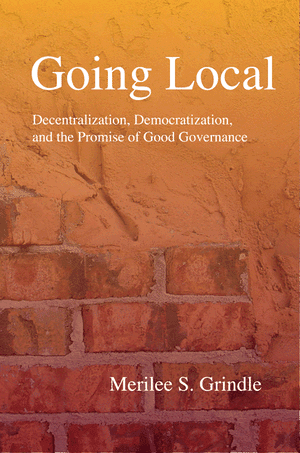
Commentary on ‘Going Local: Governance on the Line’
“Decentralization can mean progress toward improved
governance and democracy as well as the erosion of local conditions of
well-being”– Merilee Grindle
By Chambi Chachage
Merilee S. Grindle’s first chapter in her 2007 book on
Going Local: Decentralization, Democratization, and the Promise of Good Governance provides a rigorous
analytical framework for explaining and even predicting varying outcomes of
decentralization. It is divided into four main sections: An untitled preamble;
‘The Decentralization Revolution’; ‘Explaining Diverse Outcomes: Four
Propositions’; ‘The Book in Brief’.
In the preamble the author presents anecdotes from
various countries across the developing world to show that local governance has
had both positive and negative outcomes. Using a random sample of 30
medium-sized municipalities in Mexico, she measures the performance of these
local governments and uses the results to explain why they perform similarly
and/or differently across a success-failure spectrum.
The second section is presents an historical
overview of the decentralization wave that swept national governments between
the 1980s and mid-2000s in the context of the democratization wave. For her,
the concept refers to “the formal and informal mechanisms and rules that
allocate authority and resources downward among different levels of
government”. As she aptly unpacks it, decentralization can and did occur simultaneously
or successfully on three levels: (1) fiscally, (2) politically, and (3) administratively.
It can also be put into effect in at least three different ways: (1) devolution,
(2) delegation, or (3) deconcentration. These analytically distinct types of
decentralization, as she fittingly points out, can also be experienced at the
same time even in the same local government. Such interplays, contradictory as
they may seem, are byproducts of a local governance reform that does
necessarily follow a linear progression. In her words, decentralization
amounted to a structural revolution. Thus its seemingly newness necessitated central
and local actors to structure or restructure their responsibilities in order to
meet new/renewed institutional and societal demands.
Section three advances four hypotheses that provide distinct
explanations of why a given local government might respond differently to a new
opportunity associated with decentralization. These propositions, as she points
out, centers on the following four factors that tends to encourage and/or
discourage better governance practices in the contexts of developing countries:
(1) political competition, (2) public sector entrepreneurship, (3) administrative
modernization, and (4) civil society. When there is greater party competition
and local elections whereby the opposition can win, she thus argues, the
incumbents would be motivated to prove their competence in local governance.
The adoption a public sector initiative, she further argues, depends on the
behavior and concerns of public official in regards to local governance reform.
Inputs for enhancing the public sector, she also argues, shapes the performance
of local government regardless of partisanship and electioneering. And the
activeness of civil society in mobilizing and demanding accountability, she
then argues, enhances local government performance. When conversed all four
factors erodes local governance.
Lastly, section four provides snapshots of each
chapter. Of particular interest here is the way the author ties her specific findings
to the central argument of her book. She acknowledges that, out of the four
factors associated with her propositions, two – civil society activism and
administrative modernization – did not seem to significantly account for the
differences in municipalities not least because of Mexico’s legacy of
centralization. “Indeed’, she affirms, “the impact of increased political
competition and the interest of public officials in reform provided more robust
explanations of differences among municipalities”. It is these simultaneous,
albeit, skewed resultant changes that suggests, to the author, that the “four
hypotheses do not stand in isolation from each other but are in fact closely
interconnected.” I cannot agree more not least because of my experience of
working as a policy analyst and activist in a civil society organization
advocating for local governance in my country. With a ‘new’ ostensible Decentralization-by-Devolution
policy under the Local Governance Reform Program that fiscally disburses money
to schools through the Ministry of Finance, politically oversees those schools
through the Ministry of Education and administratively run them through the
Ministry of Local Governance, Tanzania echoes Grindle’s study.
In sum this text is about coping with the ‘new’, a
keyword that runs across its pages.
