
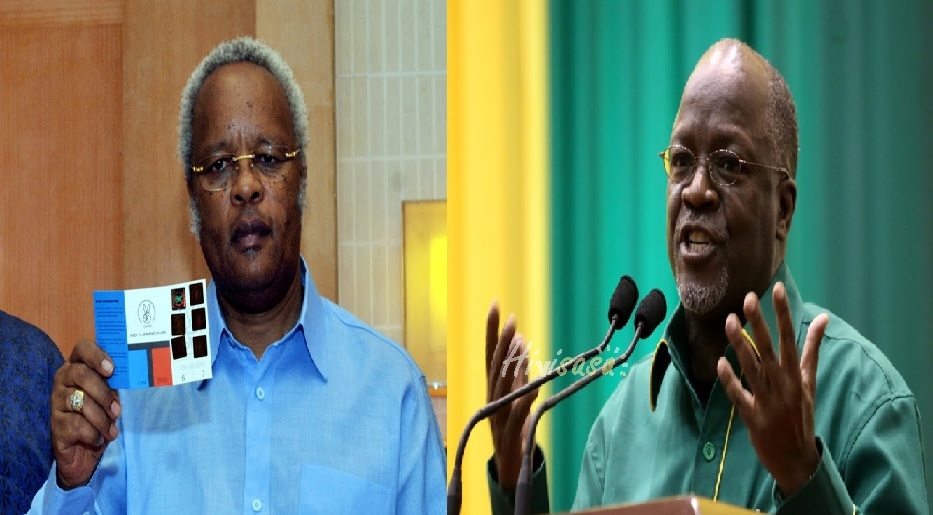
John Magufuli
and the Future of Opposition Parties
By Chambi Chachage
With the nomination of John Magufuli as its presidential candidate, the ruling party in
Tanzania – CCM – has resolved the ‘Lowassa Question.’ So it seemed near the end of July. Its committee responsible for ethics managed to ‘blot out’ Edward Lowassa’s name when it shortlisted 5 aspirants who were vying for the top
position in the country. Hence his followers in CCM’s National Executive
Committee (NEC) and General Assembly (GA) could not even vote for him.
To the
bewilderment of many in the opposition parties who view Lowassa as the face
of grand corruption, the former Prime Minister has joined the main opposition
party, CHADEMA, and its coalition of opposition parties known as UKAWA. I, for
one, wonders why this is so shocking to the then diehard fans of this party
that both Aikande Kwayu and Ben Taylor aptly affirm
attracted many followers not least because of its ‘anti-corruption’ stance
against CCM.
As for me, I
have always known CHADEMA as a business-oriented party. When my family moved to
Changanyikeni, a peri-urban area in the outskirts of the commercial capital, in
1995 we were neighbours with one of its then top leaders. A club where the
business elites from downtown and intellectual elites from the nearby
University of Dar es Salaam (UDSM) hanged out was opened. Interestingly, the place –
and indeed the heart of our suburb – became known as CHADEMA. The party was
simply a business club no wonder the working people shunned it.
Little wonder
the late Joel Barkan had this to
say about it in 1994: “Led by former finance minister and Central Bank governor
Edwin Mtei and ex-deputy agriculture minister Edward Barongo, CHADEMA appealed to
the same middle-class elements and potentially prosperous farmers as the
Democratic Party in Kenya. It was
outspoken in favor of private enterprise and classical liberal political
values.” As far as the disgruntled youth were concerned, the opposition party
of the day, in the wake of the return to multiparty democracy in 1992, was NCCR-Mageuzi.
And in the 1995 General Elections the man of the moment was a former Deputy
Prime Minister, Augustine Mrema who, after exposing a corruption deal and
getting demoted, fell out with his colleagues and defected from CCM to join the
then radical NCCR.
What did CHADEMA do? Mtei’s Autobiography recalls: “Parliament was about to be dissolved pending the elections, and Mrema, who was
very popular with the masses, was being courted by a number of political
parties to join them. CHADEMA sent a delegation to discuss with him the
possibility of his joining us. His conditions, which he spelt out, were that
CHADEMA should nominate him as the Presidential candidate for the next
elections, as well as appoint him national Party Chairman.” It was such a tough,
albeit tantalizing compromise.
CHADEMA seemed to have been desperate enough but there was one hurdle –
the party required that the chairperson could only be elected by the national
conference. “So”, Mtei reminisces, “even if I personally had been willing to
resign to make way for Mrema, logistics and cost meant it was impossible to
reconvene such a conference.” This is how they thus lost the opportunity to
field the then ‘prized candidate’ in 1995: “CHADEMA was, therefore, prepared to
nominate Mrema as its presidential candidate, but not so as its Party Chairman.”
Money mattered. It still does. This time around, the chairman of CHADEMA,
Freeman Mbowe, is first and foremost a businessman. He has counted the cost.
How can one be foolish enough, so he says, to bypass the opportunity to get million voters that Lowassa is allegedly coming with to UKAWA? Masked in that
cost-benefit analysis is this question: Why can anyone say ‘no’ to billions of
Tanzanian shillings when elections are now more about money?
His father in
law, Mtei, knew very well that without money the party can hardly compete with
CCM’s machinery that includes resources it has inherited from its then single
party government. Mbowe has thus learned from the best. Here is an interesting
anecdote from Mtei’s Autobiography that shows why it is so easy for
cash-strapped parties to say yes when it comes to money: “I apologized to the
businessman for interrupting him in his transaction at the bank, but I
explained that I was trying to mobilise funds in order to purchase a new
vehicle for the party. He said he had read about CHADEMA and – there and then
agreed to contribute one million shillings by re-writing the bank pay-in-slip
and giving the sum in cash. He insisted that his name should not appear in any
party records, and I wrote him a receipt in the name of ‘Kobe’…I never knew the
name of that Asian businessman, although the bank manager later told me the
company’s name.” Today most parties and politicians have a lot of such tortoises.
When he was
announcing his then attempt to vie for CCM’s candidacy in Dodoma, Lowassa was
bold enough to say he has no money but he has a lot of friends with money. It
was thus premature to presume that Magufuli’s candidacy, coupled with his image as a clean version of – and thus an alternative and answer to – the seemingly hardworking Lowassa, would
virtually wipe away the opposition as Jakaya Kikwete almost did did in 2005 due to
his popularity. This time around it is a contest of the heavyweights and the
byproduct might do us well: a parliament that is nearly ‘fifty-fifty’, that is,
with the integrity and potentiality of ensuring that there is no ‘one-party hegemony’ that has left many a youth angry.
Understandably,
CHADEMA is loosing some, if not many, of the youth who had/have been rallying
behind it because of the pragmatic approach to the politics of ideology it took especially during – and
between – the 2005 and 2010 elections. In regard to 2005, this is how Mtei put
it: “Freeman Mbowe argued candidly and persuasively that the CCM of Mwalimu
Julius Kambarage Nyerere had undergone complete metamorphosis, and that under
Ali Hassan Mwinyi and Benjamin Mkapa it was no longer the party of the
downtrodden. It was now the party of the ‘filthy rich’, backed by unscrupulous,
corrupt international capitalist tycoons, masquerading under the umbrella of
globalization.” The tables were being turned, CHADEMA was ‘appropriating’ CCM’s
image.
Zitto Kabwe, the former
Deputy Secretary General of CHADEMA and current leader of ACT-Wazalendo, asserts
that he was also instrumental during that phase even though, curiously, Mtei’s
Autobiography that was published in 2009 does not credit him for anything. In
his version, Kabwe affirms that, apart from those of Kigoma, Kilimanjaro,
Shinyanga, Karatu and Ukerewe, people tended to avoid CHADEMA and the youth
could then identify with other parties, such as CCM, CUF and TLP, because they only saw
CHADEMA as the party of the bourgeoisies. He thus asserts it is Mbowe and Kabwe, who “brought
about all the transformation in the party” that were to be seen between 2001
and 2010. Among other things, this included the recruiting and grooming of members such as
the fiery youngsters, John Mnyika and Halima Mdee.
Kabwe, the
self-proclaimed ‘socialist’, and the left-leaning professor, Mwesiga Baregu who
was once a member of NCCR, indeed made CHADEMA appear as if it was no longer
the party of the ‘business class’. So did Kitila Mkumbo who, tellingly, was
once a member of CCM, and the firebrand activist, Tundu Lissu, who was already well
known for critiquing multinationals and corporate capitalists. Yet we kept wondering what were they doing
in the same party with the likes of Philemon Ndesamburo and his fellow
businessmen-oriented-politicians. For us, CHADEMA was simply a ‘potpourri’ – a broad
church – that had not shed its original mask.
Probably no
one understood this better than its controversial sympathiser and the left-leaning ‘inactive member’ of CCM,
Azaveli Lwaitama, who described it as a capitalist oriented party that is using
the very language of socialism inherent in the popular demand for free
education and other basic social services, in the 2010 elections. In
that year the Secretary General of CHADEMA, Wilbrod Slaa, was the ‘prized
candidate’ of the main opposition party. Shrewdly, he also described his party as
center-right, albeit, using the philosophy of “people’s power” to bring about
change.
Now the
lingering question is: What is the political future of Slaa after the coming of
Lowassa? Will he also vouch for the very same person he once listed as ‘grandly corrupt’ in the
‘list of shame’? If not, can Slaa go back to his former party i.e. CCM? Or can
he move to ACT and thus follow Kabwe and Mkumbo whom he participated in ‘co-facilitating’ their ‘ousting’ from CHADEMA?
If CHADEMA
has indeed lost its credibility among the conscientious electorate because of Lowassa, what
will be the future of the opposition? Could this be the ‘golden chance’ for ACT
to take over as the leading opposition party? Will it be able to do so without
the money that seems to be relatively dry in its coffers? Is it living up to its
promises, such as that of being transparent about its sources of finances and
that of its leaders’ wealth, or its story is just like that of ‘Mtei and the
Tortoise’? Can it speak out, boldly and transparently, against Lowassa whom it is
also alleged to be connected to? If and when it does, will the disappointed
voters trust it enough to listen? Or they will wonder why it didn’t quickly cite its Tabora Declaration’s
Leadership Code of Conduct and tell us ‘plainly’ and publicly that Lowassa does
not qualify to lead ACT?
One can only
but wonder why, as one of the brains behind the founding of a party that is
expected to rise to the occasion, Mkumbo has the
audacity of proclaiming, tactically, that the “basis for Lowassa’s perception as
a deceitful entity, however, has neither been established legally nor
scientifically; it remains largely a political gimmick.” Moreover, at a time
when CCM seems to be turning into the Lake Zone party partly due to the votes
Magufuli may get there, CHADEMA appears as the Northern Zone party
where Lowassa hails from, and ACT is projected as a Western Zone
party where Kabwe comes from, the future seems bleak.
We need political coalitions
that can reunify the country. Yes,‘unity is victory’. May Tanzania(ns) win. So help us all God. Amen.
