
Comments
on the City and the Countryside in the Southern Question
“It is
well known what kind of ideology has been disseminated in innumerable ways by
the propagandists of the bourgeoisie among the masses of the North: the South
is the ball and chains that prevents a more rapid progress in the civil
development of Italy; Southerners are biologically inferior beings, either
semi-barbarians or out and out barbarians by natural destiny; if the South is
underdeveloped it is nor the fault o the capitalist system, or any other
historical cause, but of the nature that has made Southerners lazy, incapable,
criminal and barbaric.” – Antonio Gramsci on ‘The Southern Question’
Chambi Chachage
Antonio
Gramsci provides an analysis of four dichotomies that are of particular
interest in my work – the North/South, City/Countryside, Workers/Peasants and
Bourgeoisie/Proletariats divides. For him, the then relatively industrialized
Italian North and its bourgeoisie and cities exploited the Italian South and
its peasants and their countryside that were predominantly agrarian. In his
view it needed the workers, as a vanguard, to unite with peasants to lead the
revolution against the bourgeoisie.
Such
a revolution, however, is not anti-industry or even anti-state. Rather, it aims at reorienting industry and the state in line with agricultural production for the
benefits of peasants. To that end Gramsci and his fellow Communists called for
a replacement of the “capitalist State” with the “workers’ State” through the ousting of the ruling bourgeoisie
from state power. This reorientation, they contended, would bring peace
between the city and the countryside as well as between the North and the
South.
My
country – Tanzania – attempted to create a socialist state and society in the 1960s
that would be based on an alliance between workers and peasants. Even though it
did not claim that the workers would be the vanguard, it privileged them more
than the peasants. It also concentrated it powers on the then capital city –
Dar es Salaam – although its rhetoric focused on rural development. As a result
the bourgeoisie tended to be located in the capital city and other cities. This
urban primacy made the countryside poor. In a way the country also became
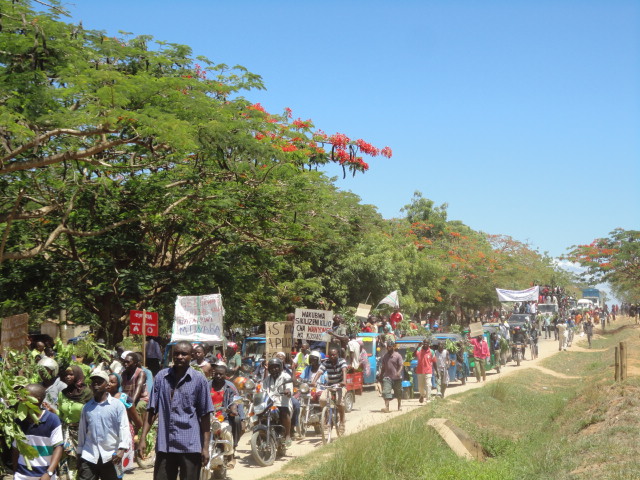
divided, even if in imaginary terms, between the North and the South. Recent
protests against the construction of a pipeline to distribute gas from the
Southern region of Mtwara to Dar es Salaam attests to this. It would be
interesting to apply Gramsci’s analysis to this situation given that the
attempts at uniting the workers and peasants in Tanzania failed by the early
1990s.
Gramsci
assertion – that the peasant question in Italy is historically determined with
respect to the specificity of Italian history, as predicated on the Southern
and Vatican questions, instead of the peasant and agrarian questions in general
– notwithstanding, the following general questions emerge: What unite impoverished
people? Is it regional or class affiliations? When and if it is both, how do
they reconcile their differences with people of the same class in other
regions? In Gramsci’s case of the poor of Sardegna, they opted for national class
solidarity instead of a regional alliance with the Sardinian gentry. Could the
same be said of Mtwara? Was it the poor or/and gentry of Mtwara who came together
on a regional basis? Who supported them in Dar es Salaam and elsewhere? Was it
the bourgeoisie and/or the poor in the cities that are benefitting, in varying
ways, from urban primacy at the expense of the countryside?
