
Obama What is so Special about Ubungo in
the Battle for Power?
“As your current saying goes, out of all
places in the world, why Obama and Hillary visited Ubungo. If you answer this,
what is smelled here may be smoked out” – Colleague
Chambi Chachage
I remember the day vividly as I almost missed my
flight. Dar es Salaam city was busy hosting the President of the United States.
Roads leading to Ubungo became blocked. A Boda
Boda came to my rescue as it ‘circumnavigated’ my small childhood
neighborhood.
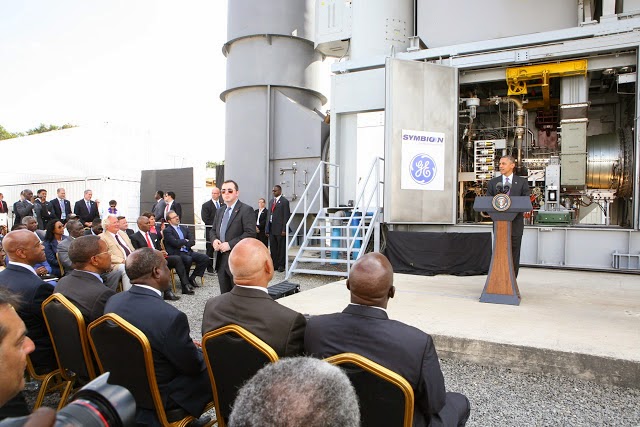
After the naming Barack Obama Drive
besides the State House of Tanzania on 2 July 2013, the first one to be named
after an American president in the country, the celebrated leader visited Ubungo and delivered one of his trademark speeches. Why Ubungo?
This question is relevant now as the debate on the
Tegeta Escrow Account scandal rages on. Mind you Tegeta, like Ubungo, is
another small area in Dar es Salaam. In our legitimate quest to ‘bring
our money back’, we can easily miss the bigger picture – the battle for
power between the key global and local players in the energy sector.
The best place to start, I think, is with Brian
Cooksey’s 2002 controversial chapter on ‘The Power and the Vainglory: Anatomy of a $100 Million Malaysian IPP [Independent Power Plant] in
Tanzania’. For more than a decade it has influenced the debate
that reached its peak during the parliamentary session on Escrow in November
2014. It has been going ‘viral’, being cited and shared in blogs, websites,
newspapers and listservs.
Even the Chair of the parliamentary Public Accounts
Committee’s (PAC) briefing paper that appears in, among other places, the official
website of the Development
Partners Group (DPG) Tanzania, quotes Cooksey’s chapter extensively. Fittingly
entitled ‘How
Pan Africa Power Ltd [PAP] acquired Independent Power Tanzania Ltd [IPTL] for
almost nothing and looted US$124m from the Bank of Tanzania[BOT]’, it contains a
footnote that affirm that its first “section summarises Cooksey (2002)”. It
also contains a footnote that provides this revealing disclaimer: “This paper
expresses my own views, not those of the PAC. On 29th July, 2014 I
submitted this brief with evidences (including letters, judgments, Bank
transfer records and receipts of payments to TRA) to the Investigative team
under Controller and Auditor General (CAG) that was conducting Special Audit on
this matter. The Audit on IPTL matters was ordered by PAC on the 20th
March, 2014.” As we all know by now, PAC presented the CAG report in the
parliament in November 2014, unleashing an unprecedented level of public debate
at least in terms of energy and intensity of ‘burning the midnight oil’ if not
scrutiny and probity.
For better or for worse such is the influence
Cooksey’s chapter has had in shaping, even if indirectly, our Escrow debate. His
is such a fiery text no wonder in 2010 he was officially told to leave the country.
But what does it say about my beloved Ubungo?
Before we delve into the matter let us get a bit of a
background from J.V.S Jones’s book on Resources
and Industry in Tanzania: Use, Misuse and Abuse written in in 1981 and
published in 1983. He wrote: “Ubungo Power Station was established through a
loan of Shs 35 million from the World Bank in 1968 and the [then] recently completed
Kidatu project (Phase 1) was financed jointly by the World Bank and SIDA[Swedish International Development Agency] to the extent of Shs 800 million.
The high tension power linking Kidatu with Dar es Salaam…were financed by CIDA[Canadian International Development Agency]…. All the major projects are
designed and constructed entirely under the supervision of overseas firms.”
Earlier on Jones thus observed: “Most of the small
towns in Tanzania are supplied from thermal stations. However the biggest,
Ubungo Power Station, is in Dar es Salaam, with a total capacity of 46.6 MW
from eight diesel engines plus 15MW supplied by a gas turbine generator. With
the introduction of hydro-power from Kidatu, Ubungo Power Station is retained
as a standby station for emergency and there are plans to dispose the gas
turbine unit altogether (at the time of writing tenders were being sought). As
already pointed out, it is extremely expensive to run, especially if operating
24 hours per day, which was the case prior to opening of Kidatu Supply…. It
might be of interest to give an idea of the fuel consumption of Ubungo Power
Station: the gas turbine unit consumed 4000 litres of high grade oil per hour,
i.e. 96,000 litres per day! – for only 15 MW! The eight diesel sets at Ubungo
(46.6 MW) consumed 150,000 litres per day of the much cheaper fuel oil which, although less expensive
than the diesel oil, still represents a considerable outlay…. Dar es Salaam’s
original thermal power station built in the 1930’s at Kurasini, with an
installed capacity of 15.8 MW, has now been demolished.”
Then Jones documented a
scandal that sounds like what we might dub ‘Richmond Déjà Vu’ and ‘Escrow
Reloaded’:
“Prior to the completion of the Kidatu
project the maintenance problems of TANESCO were exacerbated by the need to run
all generating systems at near maximum capacity, in order to meet the demands
for electrical power. In fact, that was not
entirely successful because TANESCO was forced to make frequent power
cuts when demand exceeded supply, resulting in a loss of production in many
industries, particularly in Dar es Salaam. Secondly, machine breakdowns became
more frequent because many power units had foregone
routine maintenance owing to the pressures upon TANESCO to maintain
power supplies. The net results was often the need for more extensive (and more
expensive) repairs. One reason for the purchase of the controversial gas
turbine generator at Ubungo at a cost of Shs 14 million was to meet the
shortfall in generating capacity while awaiting completion of Kidatu. It was
intended to cover peak demands only, but TANESCO was forced to operate it for
24 hours per day, because of breakdowns in other parts of the power supply
system. No other type of generator could have become operational in the space
of three months from the decision to buy (diesel engines take at least 6-9
months to install and hydro-stations more like 4-5 years). However, even the gas
turbines (which was purchased second-hand) was not without its breakdown
problems, and moreover, it seems that its installation was faulty. One of the
crucial bearings was incorrectly aligned, thus allowing the turbines blades to
make contact with the outer casing, which lead to considerable losses of power
and excessive fuel consumption. Tanzania, therefore, paid dearly for a lack of
forward planning to ensure that expansion of power supply corresponded with the
expansion of industrial activity….”
Of course with the help of foreign firms we are now
discovering gas in abundance and the hopefuls thinks it would be a panacea to
the ‘power of poverty’. The critics
and the cautious, however, think otherwise. All in all we
are still experiencing power cuts.
Coming back to Cooksey, it is important to note that
his chapter mentions Ubungo eight times. After documenting, graphically, the plights
of another power crisis in 8 September 1997, he wrote: “But the crisis is
largely of the government’s own making. While the dams are running dry, the four
turbines have been mostly idle. They are shut down from March to September
1996, through lack of cash to pay duty on the imported kerosene on which they
run, and achieve only about 30% capacity utilisation from October 1996 to
September 1997. TANESCO is broke. Customers owe $55 million. The biggest
sinners are government departments and parastatal companies, and the
semi-autonomous island of Zanzibar. Lack of maintenance of existing plant
further reduces the country’s effective power generating capacity. Tanesco
fails to respond to an offer from Finland to rehabilitate old diesel
generators. While the Treasury refuses to waive the duty on fuel, it grants
exemptions to an importer of cooking oil, leading local wags to speculate on
whether the Ubungo turbines could be converted to run on cooking oil. Failure
to fire up the turbines is the cause of the 1997 crisis, not the drought.”
He also noted this: “Conspiracy theorists in Dar es
Salaam are convinced that this example of gross mismanagement is not accidental,
but orchestrated by IPTL and its local supporters to sell their proposal to the
public. Although the project was initially launched as a short-term solution to
the 1994 power crisis, IPTL quietly drop this idea and instead negotiate a
long-term investment in diesel generators. IPTL and government officials cite
the ‘unmet demand’ for power and the consequent urgent need to increase
generating capacity as reasons for completing IPTL without further delay. The
1997 drought ‘proves’ the dangers of relying on hydropower. But the addition of
75 megawatts at Ubungo (October 1995) and a further 180 megawatts from the
donor-funded Kihansi hydro scheme that is soon to be commissioned are more than
adequate to meet projected demand and avoid another power crisis. By the end of
1997, the hydro catchments are full again. In other words, IPTL amounts to
excess capacity using one of the most expensive power generating technologies.
But by now, politics is already firmly in control of power policy and the local
technocrats and their foreign advisors are ignored.”
Ubungo reappears in the following prediction that
Cooksey made in 2002: “IPTL will bankrupt Tanesco, force up the price of
electricity to industrial and domestic users alike, and oblige the Treasury to
introduce power subsidies. The consequences are likely to be catastrophic for
the industrial sector, foreign investment prospects, and the planned
privatisation of Tanesco…. In brief, by Tanzanian standards, IPTL is a rip-off
of unprecedented proportions…. In the event that Tanesco runs short of cash,
the Treasury will step in to foot the bill. The 2001 Finance Act contains a
provision to that effect, although it did not figure in the Minister of
Finance’s budget speech of 14th June. The Treasury have already held
discussions with the International Monetary Fund [IMF] on how to pay Tanesco a
monthly cash subsidy to offset the cost of IPTL…. Without IPTL, the Ubungo
turbines would now be running on natural gas. (The Songo Songo project was
purposely held up by IPTL intrigue). Not that it matters: three of the Ubungo
turbines have been ‘shut down and need a staggering (sic) 4bn/-for repairs,
Tanesco engineers told the Daily News.’ (December 14th)…. The current rains
have raised water levels in the dams. Curious therefore that Tanesco should decide
to shut down one of Kidatu’s 50 megawatt turbines – for ‘routine maintenance’ –
just as water levels are rising. Why not wait for a few months until water
levels begin to fall? … Tanesco may soon be forced to spill water from our dams
in order to keep IPTL chugging along as planned.”
Then the coup de
grâce comes in Cooksey’s epilogue: “The direct and opportunity costs of
IPTL to the Tanzanian economy are extremely high. Without IPTL, the country
would already be exploiting its huge resources of natural gas and saving on
imported kerosene for the Ubungo turbines. The losses to the Tanzanian economy
as a result of the power shortages of 1997 could have been avoided had Songas
been implemented on time rather than sidelined by IPTL. Huge private
investments in stand-by generators were another avoidable cost. The amount of
time, energy and travel wasted by government officials in chasing after IPTL,
including international arbitration, particularly by Patrick Rutabanzibwa,
could have been put to much better use.”
But Cooksey was very aware that his analysis,
convincing as it is, smacked as promoting the North-South investment deals and
demoting, if not demonizing, those of the South-South. No wonder his chapter
contains this defensive undertone: “I soon ran foul of IPTL. In a long letter
to the African (1 June 1998) titled ‘Brian’s phobia against South-South
Commission’, I am dubbed a racist with a ‘pathological hatred of South-South cooperation’,
with ‘derogatory tendencies towards African governments, leaders and its
people.’ In a letter to [the then] Minister of Planning, Nassoro Malocho, IPTL
copied an article that appeared in East African Alternatives, and accuse me of
having vested interests in Songas. I am referred to as a ‘dangerous underground
advisor,’ ‘an academic and business crook,’ with ‘prejudices against African
and Asian leaders’. I am further described as a tax-evader, an unlicensed
gemstone dealer, a frequenter of a disreputable Dar es Salaam dance hall, a ‘foreigner
and a self-appointed energy expert.’ East African Alternatives promptly
published excerpts from this five-page diatribe. [The then] Minister Malocho
never got in touch, though he did circulate the letter among the pro-IPTL group
of ministers.”
In fact the chapter contains scathing critiques of the
Malaysian statesman who, ironically, is one of the mentors
and role models of our chair of PAC who has been instrumental in briefing
us about – and blowing up – PAP’s
scandalous acquisition of IPTL and looting of Escrow money from BOT. After
noting that “Rutabanzibwa tries to convince the President that IPTL is a
disaster waiting to happen” and that if “the cost of IPTL is passed on to the consumer,
Mkapa will not make many friends” given that “Business and private consumers
will face huge increases in electricity prices” and “Donors will be incensed” as their “dismissive
attitude towards IPTL is on record”, Cooksey wrote: “Benjamin William Mkapa
does not know what to do. He is caught in a hugely difficult bind. Malaysian
Prime Minister Mahathir had buttonholed him at a recent meeting of Commonwealth
heads of government in Edinburgh to ask why Mechmar’s project was not
progressing faster. Rugemalira is publicly challenging the government to put up
or shut up, as IPTL’s affairs become increasingly convoluted. Cancelling IPTL
would look like capitulation to donor pressures, a point hammered home in the
press by IPTL.”
“In meetings in London and Kuala Lumpur, and via
e-mail,” Cooksey intimated, “Tunku Abdul
Aziz pulled me gently, but firmly, into line with invaluable advice on the
subtleties of the relationship between the Malaysian state and the promotion of
foreign investment. In the article cited above, he declared that: … the
sight of the Prime Minister [Mahathir] herding a gaggle of assorted
“businessmen” on his official overseas trips and bending over, ever so
protectively, witnessing the signing of one grand MOU after another, has
created the impression that the Prime Minister has a direct personal interest
in all these deals… we are dealing, very often, with people in places where
corruption is so rampant that they cannot imagine that there are Malaysians who
can win major overseas contracts without resorting to corruption. (East African
Alternatives, September 1998, p. 24)”
After referring to an econometric analysis that “found Malaysia to be one of
the cleanest major trading nations in the world”, Cooksey informed us that his
“more qualitative and journalistic approach led” him “to diametrically opposed
conclusions.” One of his findings was that the “bribers’ index gave the lie to Prime Minister
Mahathir’s rhetoric claiming that it is invariably companies from the North
which bring corruption to the South, the argument he used to denounce TI’s
corruption perception index in 1997.”
Finally, Cooksey thus sums up his conclusion on the matter: “My own
investigations led me to a number of simple conclusions on the pattern of Malaysian
investments in Africa. First, the speed with which MOUs and contracts are
signed suggests that Malaysian investors circumvent the lengthy procedures that
DFI into poor countries normally involves. It is rare for a Malaysian company
to lose a ‘competitive’ tender. This suggests, second, high level political
support for the proposed investments, and, third, the likelihood that
systematic bribery is involved. Fourth, sectors targeted by Malaysian companies
are often those undergoing privatisation — with pressure and funding from the
Bretton Woods institutions and the donor community — including power,
telecommunications, and banking. In all these sectors, rents can be earned as
long as the privatisation process and regulatory environment are
non-transparent and open to manipulation. This was also true of Malaysia’s
experience of privatisation, of course (Gomez and Jomo 1999). Another
similarity, fifth, is the mobilisation of targeted political and diplomatic
support for the proposed investments. Prime Minister Mahathir actively supports
Malaysian investments in Africa and elsewhere, appealing to South-South
solidarity as a means of ‘delinking’ from the hegemony of Northern
multinationals in the global economy. Mahathir actively lobbies for
Malaysian-backed projects when he meets with African heads of state at various
international gatherings. There is no secret that Malaysia contributed to the ANC’s
election campaign in 1994.”
It is clear that, notwithstanding the Tegeta Escrow
scandal, the battle for Ubungo was/is the battle between the global North – in
this case represented by the United States of America – and the global South –
in this case represented by Malaysia – almost as it was between the West and
the East back in the hot heydays of the Cold War. This reality is thus captured
in Cooksey’s chapter when it documents what transpired in 1997: “Jim McCardle
is not happy. The World Bank is pressuring the government to sign off on
Songas, a Canadian backed joint venture to develop Tanzania’s huge reserves of
natural gas, and the government is dragging its feet. The Bank is ready to lend
Tanzania $200 million towards Songas’ $350 million price tag. Songas, which
McCardle manages, was conceived years before IPTL, yet no contract has been
signed to date. The contrast with IPTL, which obtained government agreements,
tax exemptions and other requirements in record time, is no accident. Without
IPTL, Songas could have been up and running in time to help avoid the 1997
power crisis. Songas plans to build a pipeline to Dar es Salaam to fuel the
existing four turbines that are currently running on expensive kerosene. IPTL
say they will happily convert to natural gas when it comes on stream, but this is
disingenuous on their part…. Tanesco has a serious cash flow problem. If both
IPTL and Songas are commissioned, Tanesco will be saddled with monthly bills
for gas and electricity of $11 million that it could not possibly meet out of
income from electricity sales. McCardle admits that Songas seriously
underestimated IPTL. ‘Nolan was a joke. Nobody could take his project seriously.
We thought nobody would take IPTL seriously either. We were wrong!’ When the
cabinet hesitates to endorse IPTL because of the cost implications for
electricity, James Rugemalira
accuses the World Bank and Songas of mounting a joint conspiracy against him,
with Patrick Rutabanzibwa, Permanent Secretary at the Ministry of Energy and
Minerals, as their front man. At one point, he refers to Songas as
‘the stillborn child of the World Bank’ (February 1999). In a brilliant
tactical move, the government announces final agreements with IPTL and Songas
on the same day….”
At this juncture it is interesting to not that in Africa’s
Winds of Change: Memoir of an International Tanzanian, Al Noor Kassum
(2007) recalls that as the then Minister for Water, Energy and Minerals, he
“persuaded the World Bank and the European Investment Bank to drill more wells
at Songo Songo” in the early eighties. “Our initial plan”, he noted, “was to
use the gas to produce ammonia and urea fertilizer for the local market as well
as for export, but the high capital cost of the project (about US$ 500 million)
as well as the slump in the price of fertilizers in the world forced” them “ to
abandon that proposal” of theirs. “Instead”, he affirms, “we decided … to use
the gas as a substitute for fuel oil in electricity-generation turbines.” The
“Songo Songo gas-to-electricity project”, reminisces Kassum, “was inaugurated
on 4 October 2004 and was expected to save Tanzania US$ 50 million every year
through reduced imports of jet fuel and oil. As the result of the steep rise in
oil prices since then, the savings have been even higher. At that time the
government announced plans to meet nearly half of the total electricity demand
in Tanzania through gas-based power generation.”
Kassum proudly recalls that at “the ceremony marking
the inauguration of the Songo Songo gas-to-electricity project, which was
presided over by the then President Benjamin Mkapa”, he “was one of the several
people presented with awards for ‘extraordinary contribution to the success of
the Songo Songo project”. He also notes that in outlining his contribution, the
then Permanent Secretary of the Ministry of Energy and Minerals, Patrick
Rutabanzibwa said, among other things, that Kassum “thus put in place the basic
gas infrastructure and created the market for the gas” whereby without “those
two fundamentals, the Project could not have happened.”
“His Excellency Jakaya M. Kikwete,” Kassum also recalls
enthusiastically, “was also given an award on the same occasion” whereby
“Patrick Rutabanzibwa” thus “said of him:
As Minister for Water, Energy and Minerals from 1990 to 1994 he guided
the initial Project negotiations with Ocelot [one of the original sponsors of
the Songo Songo gas-to-electricity project, which subsequently became
PanAfrican Energy]. In 1994 he selected the original sponsors, Ocelot and
TransCanada Pipelines, over their rivals for the Project, Enron. Subsequent to
that, as Minister for Finance in 1995 he gave crucial support to what was then
seen as an alien concept, that is providing payment and currency convertibility
guarantees to private investors.”
Hence the Remarks
by President Obama at Ubungo Symbion Power Plant should thus be
understood in the context of this backdrop. Arguably the most powerful
president in world came all the way from ‘the land of the brave’ to the ‘haven
of peace’ to thus declare: “And this plant represents the kind of
public-private partnership that we want to replicate all across the continent.
This facility was idle. But the Tanzanian government, under President Kikwete’s
leadership, committed to making reforms in the energy sector. With support from
the Millennium Challenge grant, General Electric, and Symbion, they got it up
and running again.”
With due respect and covetous admiration to David Kafulila,
whom – together with The Citizen
newspaper – the chair of PAC dedicated “all the work” of whistleblowing the
Escrow scandal, I humbly query whether, vindicated
is it later became, the analysis informing his
spirited debate with the Minister of Finance, Saada Mkuya Salum and the
beleaguered Minister of Energy and Minerals (MEM), Professor Sospeter Muhongo,
on the Millennium Challenge Corporation (MCC) grant went beyond the curtains of
the corridors of power. Of course we need money for power. But at the expense
of what?
John Cheyo who also participated, passionately and
positively, in the parliamentary debate on Escrow and was once the chair of PAC
has recently been referenced saying what may not sound as popular in regard to
the parliamentary power dynamics vis-à-vis donors from superpowers. In a post
on Donors
and Dodoma: The International Challenge to Tanzania’s Parliament his
interviewer writes: “Following allegations that Tanzanian government officials authorised
fraudulent payments worth US$124m to private energy company IPTL, a group of 12
donors suspended
a total of US$493m of general budget support. Assurances from donor
representatives that the funds will be released as soon as the Government of
Tanzania has responded to the recommendations of the Controller and Auditor
General (CAG) did little [to] assuage the doubts of parliamentarians regarding
the legitimacy of the funding freeze. In October 2014, Budget Committee
representatives told us that Bunge had not been consulted ahead of the donors’
decision, and were unanimous in depicting the action as premature. In their
view, the IPTL affair had not yet been properly investigated and reported upon.
Cheyo explained his misgivings about donors attempting to hurry along
publication of the CAG’s report: “If anything, the originators – the PAC – can
write to the CAG and ask why it has taken so long. If you start interfering
with the work of the CAG and prematurely predicting results from the
investigation, where is the independence of the auditing body?”
Now I, for one, was very happy about the accountability
measures taken in regard to Escrow. But, strangely, I got some mixed feelings when
I was reading the CAG report prior to my
own analysis on ‘Who is Who in Escrow’, I couldn’t help but notice the
haste in which the audit took place. For instance, I continue to wonder why the
name of then TANESCO lawyer, Godwin Simba Ngwilimi, who (apparently) took an
oath in regard to what IPTL (apparently) owed TANESCO does not appear among the
33 people appearing in Annex 1 who were called for a debate/discussion with CAG
during the audit. If the chair of the board of TANESCO, who is recorded in the
CAG report as stressing that they were not aware of that oath, is among the 33,
why not the lawyer who was so central in the Escrow debate between the chair of
PAC and the Minister of MEM?
We are told the audit report trumps other (unaudited)
reports and presentations as it is audited. But who audits the auditor? In the
case whereby
CAG categorically notes that new information may alter the opinion of the
special audit, to what extent can we simply sit and agree that we now know
what happened hence we have gone to the bottom of it?
More significantly, the seemingly hasty nature in
which the CAG special audit on Escrow was conducted can be conjectured from
its page 50 and 51. CAG lists the following 9 court cases involving IPTL’s
shareholders and/or creditors and informs us that it only focused on the first 2:
Misc Civil Case No. 49 of 2002 pitting VIP against IPTL and Mechmar Corporation
in the High Court of Tanzania; Misc Civil Case No. 254 of 2003 pitting VIP against
IPTL, Mechmar and the Administrator General in the High Court of Tanzania; Civil
Application No.163 of 2004 pitting VIP against Mechmar in the Court of Appeal;
TANESCO against Independent Power Tanzania Limited (IPTL) ICSID Case No. ARB /
98 /8; Standard Chartered Bank against the United Republic of Tanzania – ICSID
Case No. ARB I 10/12; Standard Chartered Bank (Hong Kong) Limited against TANESCO
ICSID Case No ARB / 10/20; Martha Kaveni Renju the Administrator Receiver of IPTL
against IPTL Case No.124 of 2003; Martha Kaveni Renju the Administrator
Receiver of IPTL against IPTL and VIP Engineering and Marketing Ltd Case No. 98
of 2013; Case for Review No.1 of 2012 pitting Standard Chartered Bank (Hong
Kong) against Mechmar Corporation, VIP Engineering and Marketing, IPTL, the
Liquidator of IPTL, the Bank of Tanzania, TANESCO and TRA in the Court of
Appeal.
Is it simply a matter of curbing corruption and
affirming accountability, this interest that the donor community has on IPTL?
Why, for instance, did a British Ambassador helped Standard Charter Bank
delegation contact the PAC chair – then chairing POAC – in an attempt to lobby
for the Escrow money? And if the chair had not recently said so publicly in defense
of his integrity during the parliamentary debate, how would we have known?
Well, it all about access to power and information.
The then US’ Secretary of the State and a presidential hopeful, Hillary
Clinton, knows this very well. When she visited Ubungo in 2011 this
is how she put it: “We believe in partnership, and we believe in
competition. You heard Paul say that when MCC put out the bid to build power
lines across this country, a lot of companies competed. But two American
companies won. We are very proud of that because we, frankly, want more
American companies competing for business in Africa. And we are going to take
that message back to America, and urge them to get out here and compete for
these foreign projects.”
And the Physics I was taught in Azania and Tambaza High
School tells me that power is about pressure. Clinton also knows this. Little
wonder she thus concluded her Remarks
at the Symbion Power Plant in Ubungo: “So, I don’t want to put a lot of
pressure [on] Symbion and Pike Power, and on the linemen and the government,
but this is important for everybody. If you do it right, we are going to go and
tell that story across the world.”
Yet the pressure is mounting as the following excerpt
from the MCC
Statement on Board of Directors’ Discussion of Tanzania at the December 2014
Meeting: “MCC takes
seriously all of its country partners’ commitments to combat corruption. At
today’s meeting, MCC’s Board expressed continued concern over corruption in
Tanzania, including the implications of the recent case involving Independent
Power Tanzania Limited (IPTL). The Board noted that Tanzania has experienced a
significant decline over the past seven years on the key indicator measuring
efforts to control corruption. While the Board voted to allow Tanzania to
continue working to develop a compact proposal—given its passage on MCC’s
policy scorecards and its strong previous performance as an MCC partner—the
Board stated its expectation that the Government of Tanzania must take firm,
concrete steps to combat corruption before a compact is approved. Further, the
Board voted to continue MCC’s engagement with Tanzania with the understanding
that, in accordance with the Tanzanian State House December 9 statement, the
Tanzanian government would act promptly and decisively on the late November
parliamentary resolutions regarding IPTL. The Board also reaffirmed more
broadly that Tanzania must undertake a series of previously agreed upon
structural reforms to improve the efficiency, effectiveness and transparency of
the energy sector, and more generally to deal with wider corruption.”
In a way it partly, albeit significantly, echoes
Obama’s following remarks
at Ubungo: “So Power Africa embraces
this [Public-Private Partnership] model. Public and private resources will be
matched with projects led by African countries that are taking the lead on
reform. In this case, African governments commit to energy reforms. And
the U.S. is committing some $7 billion in support, and private sector companies
have already committed more than $9 billion. And this is just the beginning —
because we look forward to even more companies joining this effort.”
But as the soon-to-be outgoing President, Obama was/is probably in
a hurry more than Clinton: He thus also
remarked: “Now, in order for this to
work, then we all have to feel a sense of urgency. One of the things, Mr.
President, that I learned around the business roundtable is if we are going to
electrify Africa, we’ve got to do it with more speed. We can’t have projects
that take, seven, eight, nine years to be approved and to get online. If
we’re going to make this happen, we’ve got to cut through the red tape, and
that can only happen with leadership like the leadership that President Kikwete
has shown.”
Isn’t the message clear? Away with ‘Ugly
Malaysians?’ Enter ‘America
the Beautiful’?
