
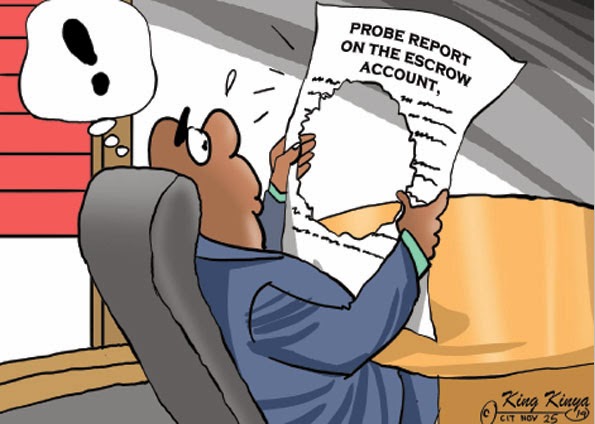
PAC was CAG compromised on ESCROW?
Chambi Chachage
At last Professor Sospeter Muhongo has resigned as the
Minister responsible for Energy and Minerals. His belated decision, however, has not laid
the Escrow ghost to rest. Rather, his long and ‘hasty’ resignation
speech and subsequent interview with DW
has raised more questions.
By insisting that there are multiple (political and
business) conflicting interests on Escrow, the former Minister reaffirmed what we noted
when discussing the ‘Global
Credit Crunch and the Quest for Escrow Account Money’ and querying ‘What’s
the Hidden Agenda in the IPTL Saga?’ We find this interesting given
that the
Daily News has just reported an ongoing case in the High Court involving: VIP
Engineering and Marketing Limited, Wartsila Nederland BV, Wartsila Tanzania
Limited, Standard Chartered Bank PLC, Standard Chartered Bank (Hong Kong)
Limited (SCBHK), Standard Chartered Bank (Tanzania) Limited and Joint Liquidators of Mechmar Corporation (Malaysia) Berhad.
What is particularly interesting to us today, however,
is what the then Minister said about CAG’s special audit report on the Tegeta
Escrow Account. He asserted that he
read the report four times and yet he did not see anywhere that it
implicated him. We can almost picture a tired and sleepless professor lowering
his reading glasses and going through the body of the report throughout the night
only to notice his name mentioned once on page 45 in an instance that does not
say anything about his role on the transfer of money.
Probably nothing short of a ‘conspiracy theory’ would
enable the inquisitiveness in us to make sense of why the Prof. could not and
cannot yet see what the parliamentary Public Accounts Committee (PAC) saw in
CAG’s report. Let us revisit the report. But before we do that let us hear what the PAC’s chair said in the wake of the then awaited resignation.
In his Facebook page, Zitto Kabwe
wrote: “….Napenda kuchukua nafasi hii kutambua busara aliyochukua ambayo
naamini itasaidia harakati za kujenga demokrasia yenye uwajibikaji. Naamini
uamuzi wa Ndugu Muhongo umewezesha kulinda heshima ya Bunge na maazimio yake.
Kwa muda mfupi alioongoza Wizara hiyo, Ndugu Muhongo ameweza kuongoza
mabadiliko kadhaa muhimu ya kiutendaji katika wizara hiyo na taasisi zake. Hata
hivyo, nafasi ya Wizara aliyokuwa anaongoza katika suala la Tegeta Escrow
imemtia doa kubwa ambalo ilikuwa lazima awajibike….”
Among other things, here the PAC chair reiterates that
in regard to the Escrow matter, the position/role of the Ministry he was
heading has tainted him ‘big time’ and therefore it was imperative that he
resigns. The chair of PAC also states that he believes the decision to resign
has helped to preserve the integrity of the Parliament and its (eight) resolutions.
Could it also be that PAC, in attempting to preserve
the integrity of CAG, went out of its way to implicate Professor Muhongo beyond
any reasonable doubt? If that was so, was it a strange case of CAG being
compromised or of its incompetence in showing clearly and squarely the role of
the Prof. in the Escrow scandal? Is this the reason why the PAC chair
questioned the Presidential decision to share the CAG report publicly, going as
far as informing
us that, procedurally, the role/mandate of interpreting the said report
rest with the Parliament through PAC and not the government that is the one
being audited?
The line that makes some of us speculate that,
probably in its good (patriotic) intention, PAC stepped up its investigation/interpretation
to rescue the then Acting CAG is found on page
52 of the special audit report. It reads in its original Swahili under the
heading “Mapendekezo”: “Kwa kuwa PPA inahusu manunuzi ya megawati 100, katika
utekelezaji wa uamuzi wa mahakama ambao unaitaka IPTL kuongeza uzalishaji wa
umeme kufikia megawati 500; TANESCO na IPTL wapitie na kujadili upya mkataba
husika”. But which IPTL? The original
IPTL of MECHMAR and VIP? The IPTL of VIP? Or the IPTL of SCBHK?
What we are seeing here is CAG being in agreement,
partly or wholly, with the then ‘conventional’ interpretation of Judge Utamwa’s
ruling hence advising that IPTL and TANESCO should review the Power Purchase
Agreement (PPA) in relation to adding 500 megawatts. Here we need to pause and revisit what both Professor Muhongo
and Zitto Kabwe said about the 500MW.
On 30 May 2014 the Prof. said this in the Parliament
as recorded
on page 316-317 of its Hansard: “…hii ni hukumu ya Mahakama. Halafu amesema
akipata atatoka sasa hivi ni megawatt mia moja anakwenda megawatt mia tano,
anauza umeme kwa senti sita mpaka senti nane. Huu ndiyo unakuwa ufisadi au nyie
mnaotetea ndiyo mnatetea ufisadi?”
Professor Muhongo was essentially referring to Judge
Utamwa’s court ruling dated 5 September 2013, which he thus quoted on page 316
of the Hansard: ““Mheshimiwa Mwenyekiti, nyingine inasema: “The provision liquidator shall handle over all the affairs of IPTL including
the IPTL Power Plant to Pan African Power Solution [PAP] which has committed to
pay off all a legitimate creditors of IPTL and to expand the plant capacity to
about 500 megawatts and sell power to TANESCO at a tariff between US six cents
per unit in the shortest possible time after taking over the public interest”.”
This is very important given that in his interview with DW
on 27 January 2015, Professor Muhongo seemed to question Zitto Kabwe’s
(seemingly) contradictory positions on Judge Utamwa’s ruling in his case against CHADEMA vis-à-vis Judge Utamwa’s ruling in the case regarding IPTL. Now
let us turn to what the PAC’s chair said about the latter.
In Wanazuoni’s online public debate on 4 January 2015,
Zitto
Kabwe said: “Simba Trust ndipo wote wenye maslahi na escrow wamo humo.
Wamepewa IPTL bure, wamepewa tshs 306 bilioni na wanaendelea kuvuta $2.6m kila
mwezi. Hukum[u] imewapa fursa kufika 500MW! Hivyo watapata new PPA yenye miaka
isiyokwisha. Watu wanaona hili kwa jicho la mgawo wa escrow pekee, hawaoni kwa
picha kubwa. Hii ni more than $1bn scandal. If we don’t kill it now, it will cost
us more than our comprehension”.
Earlier, on 2 January 2015, in the same online forum Zitto
Kabwe stated in an ‘ironic’ if no ‘sarcastic’ tone: “Mahakama gani duniani
inapanga bei ya bidhaa? Ni Usanii tu”; “Jaji Utamwa alipanga bei na kutoa PPA.
Tumeweka rekodi ya Dunia. Mahakama kupanga bei na kuamua Tanzania inahitaji
500MW. PAP itabidi wapewe PPA na mahakama”.
What we are seeing here is a critique of (the interpretation
of) the ruling that would (have) effectively allowed IPTL, through PAP, to
continue providing electricity/power to TANESCO thus costing the citizenry dearly for years to come. Recall Ag. CAG’s contentious recommendation on this as cited above. If PAC had endorsed that recommendation, it
would have simply affirmed IPTL-cum-PAP.
Now the troubling, nay, disturbing question is: To
what extent was PAC fair to Professor Muhongo in their (seemingly) attempt
to save us and CAG from PAP’s ‘hooks and crooks’? Zitto Kabwe is on
record for reiterating that they were not trying to be unfair to anyone in
their (proclaimed) patriotic duty to our country. Dr. Hamisi Kigwangalla, who
was invited to take part in preparing PAC’s report, has
also reaffirmed that position, arguing that he would have objected or resigned
if they were unfair to anyone.
Salim Khatri, a
leading critic of PAC’s report in Wanazuoni’s debates, thinks otherwise. In
his recent critique he has come up with what he claims to be part
of the agreement between PAP and VIP that he asserts PAC distorted, deliberately.
If they did so, why?
This is how the contested part appears on page
24 of PAC’s report: ““On 11th July
2013, the Minister of Energy and Minerals, Hon. Dr. Prof. Sospeter Muhongo
invited VIP to submit to him the amount of money if paid VIP would conclusively
settle VIP claims against IPTL”. And this is how it appears on page of 5 the said agreement: “On 11th July 2013,
the Minister of Energy and Minerals, Hon. Dr. Prof. Sospeter Muhongo, (MP)
invited VIP to submit to him the amount of money which if paid, VIP would
conclusively settle VIP’s claims arising from the IPTL Disputes….” Note very
carefully the last words.
Now this is a serious
allegation against an institution that some, if not many/all, of us hold so dear in
the tough battle against grand corruption. It is a normal practice to quote something
in part and when we do so we can simply put a couple of dots to indicate that
there are some omitted/remaining words. What is not a normal practice is to do
so by changing the last words to fit with our own interpretation of what the
whole passage was/is actually saying.
Hence if the two quotes are
indeed coming from the same authentic source then there is a very serious
problem with the first one not least because the latter source indicates that
Professor Muhongo was (actually) trying to sort out the dispute between VIP and
SCB regarding IPTL. It is thus serious enough to warrant an explanation from what we (still) regard as
a parliamentary institution that is lead according to very high standards of
integrity and probity. Anything less would continue to sow and water the seeds of doubts
that started springing up quietly when the
President directed that CAG’s report ought to be distributed/publicized and
read widely.
Zitto
Kabwe has already assured us that, when preparing PAC’s report, they were
not aware of SCBHK’s
letter to the then Director of TANESCO, Dr. Idris Rashid, which was, in essence, calling for relying on the parliament and bypassing of courts as these were not
in their favor in contrast to VIP. As evidenced in his interview with DW,
Professor Muhongo keeps reiterating what he said in the Hansard cited above
that it is important to rely on our own courts in sorting out such IPTL issues.
Yet, as the DW interviewer also noted, it is these same courts that two of
their judges – Mujulizi and Ruhangisa – received million of Tanzanian shillings from VIP.
Of course there is no evidence so far implicating two
other judges – Utamwa and Kaijage – who have/had been central in the courts’
proceedings regarding IPTL affairs but, frankly, that cannot help to stop the (general) feeling
that the judiciary has/had been (partly) compromised on the matter. In the wake of
the ongoing case pitting banks and companies cited above one wonders whether CAG was also
compromised in their recommendation. All this also makes one wonder whether
Professor Muhongo is right after all when he reiterates, via DW, that
there are five sets of conflicting interests on the matter that is why he was
too tired to stay and fight on and on.
By way of conjecture, a leading lawyer thus aptly captured
those ongoing wars/battles over IPTL affairs after reading the said
letter from SCBHK to TANESCO: “Shorn of legal jargon and verbosity, I think
the objective of the Bank appears to take over IPTL (Unfortunately we don’t
have the details of the Agreed Plan) but the scenario would be something like
this. The Bank gets paid its debt from the escrow account. Some restructuring
takes place such that the bank is represented on the decision-making body of
IPTL. In short, it is the story of the camel and the Arab. Get a foothold in
the tent (in this case IPTL, and larger picture energy sector), then push out
both Mechmar and VIP, deal directly with TANESCO and the government, advance
another loan to help convert to gas, thereby getting indirectly into gas,
appoint a British company to take care of the bank’s interests in IPTL – since
the bank will hold some debentures in the restructured company because of its
loan. Speculation, maybe. But the plot seems to be what you failed to get
through courts – being outmaneuvered by VIP – get it through
parliament. It is a fight of elephants over the control of the
energy/electricity-gas sector in which VIP is a local irritant, which has the
local knowledge of how to manipulate the domestic judicial system”.
No wonder one of the editors of a leading newspaper in
whistleblowing the Escrow scandal thus noted: “…kwa hakika, kulingana na
taarifa na nyaraka ambazo sisi (their newspaper) tunao, hakuna ushahidi
unaomhusisha Muhongo moja kwa moja na sakata hili kwa maana ya kunufaika
kifedha. Kuna ushahidi wa kimazingira ambao unamweka Muhongo kwenye mashaka
kuwa amekula fedha. Yeye ndiye alipaswa kujiridhisha kuwa fedha zile zinalipwa
kwa mtu anayehusika. Lakini ushahidi unaonyesha kuwa fedha hazikulipwa kwa mtu
anayehusika. Kuhusu wafadhili haya ni maoni yangu binafsi. Wafadhili
naamini wanamchukia Muhongo kwa sababu ndiye aliyefanikisha PAP kulipwa wakati
wao michongo yao ilikuwa ilipwe Standard Chartered. Wanaamini kuwa kama si
Muhongo, fedha zile zingekuwepo kwenye akaunti mpaka leo na wangekuwa
wanaendelea na mipango yao ya kuhakikisha zinalipwa kwa benki yao”.
This can simply be translated as saying that the
newspaper did not have any information that directly implicated Muhongo as having benefitted from Escrow money. However, there were
circumstantial evidence given that he did not ensure that the money were paid
to the one who was supposed to be paid. Regarding donors, the editor is saying that he believes that they don’t like Muhongo because he enabled PAP to
get the money and thus thwart their ‘deals’/attempts to ensure that the money
were being paid to Standard Chartered Bank. The donors, this editor concludes,
believe that if it were not for Muhongo the money would have remained in the
account up to now/today and they would have continued with their attempt to ensure
that it is paid to their bank, that is, Standard Chartered.
For some us one thing is certain, i.e., Zitto Kabwe is
right that there is a big(ger) picture. And we indeed need to capture it ASAP. Who
knows, probably the end (Bring Back our Money) justifies the means (Away With
Muhongo). And maybe that is why Zitto Kabwe
ended this message with a (seemingly) tone of disappointment regarding
the new Minister of Energy and Minerals et al.: “nothing spectacular in cabinet reshuffle. But Sitta
and Mwakyembe swap is really good. Mwakyembe to deal with ‘coalition of the
willing’ and Sitta has the will and capacity to push forward Railways, Aviation
(ATCL) and Ports projects. He served in this docket under Nyerere (and built
S[e]lander Bridge….) Others, I reserve my opinion”.
Here it is instructive to recall, inquisitively, that
way back on 10 October 2012 in one of his (pointed) responses – fittingly
drawing its title from Gandhi’s
famous quote – to the (then) supporters of Professor Muhongo, Zitto
Kabwe wrote this: “Lakini suala la Waziri kutokuwa na taarifa
lili[t]hibitishwa na ujio wa Naibu Waziri George Simbachawene, aliponifuata na
kuomba “details” kuhusu taarifa niliyotoa. Kulikuwa na haja gani kwa Waziri
kusema bungeni yeye anajua zaidi na baadaye kumtuma Naibu wake kutafuta
taarifa? Huu ni udhaifu mkubwa sana wa uongozi. Kutojua si makosa, inawezekana
kuwa wengine hatukusomea miamba lakini tumesomea masuala ya kodi kwenye madini
na mafuta. Waziri makini anayejali nchi yake anawezaje kukutana na mwekezaji
anayekataa kukulipa kodi yako bila wewe hata kuulizia utalipwa lini? Unaulizwa
bungeni unasema “ninajua zaidi” na Mwandishi mahiri kama Mbwambo anasema “mpeni
nafasi atende”!”
Wasn’t the message clear, that for him the professor was simply exhibiting weakness in his leadership of the Ministry? Fast-forwarding
to 21 December 2014 and we find Zitto Kabwe insisting: “Wezi wanataka kuweka
jambo hili kama vita kati ya standard chartered dhidi ya Seth. Ama kwamba eti
Zitto ana ugomvi na Muhongo. Hii ni vita kati ya watetezi wa wizi dhidi ya
watetezi wa Mali ya umma”. And moving to 24 January 2015 we observe Zitto Kabwe
thus concluding his thoughts regarding the resignation of the
Prof.: “Naamini Rais Kikwete atamteua mtu mchapakazi na makini zaidi atakayeweza
kuendeleza yale mazuri ya Ndugu Muhongo na kurekebisha mapungufu
yaliyojitokeza.”
Ultimately, the Gandhian motto prevailed: Zitto won, Muhongo
lost. The battle was won but what about the war? The war rages on and on and Prof. Muhongo has not (really) conceded if what he said to DW
regarding ‘(deliberate) deception’ is something to go by.
Now the person who has been appointed in his place is
none other than one George
Simbachewene, the very person that Zitto Kabwe referred
to above as once being sent by Prof. Muhongo to him request the details. It is the
same George Simbachewene who, defensively, towed the government’s line in the
parliamentary debate on Escrow in November, 2014. Yes, it is the same George
Simbachewene who became the Deputy Minister of Energy and Mineral during the
May, 2012 cabinet reshuffle that also made Professor Muhongo the then Minister
of the same Ministry. And it is the same George Simbachewene who was moved to
the Ministry responsible for Land two years later after (yet) another reshuffle.
What George Simbachewene once told Raia Mwema in an
article that has gone ‘viral’ and thus republished therein on page 23 of
its January 28-February 3, 2015 issue gives us a glimpse of how he regard(ed)
the war involving the Prof.: “Kuna watu wanashindwa kumwelewa
lakini nadhani watakuja kumwelewa baadaye. Ninachoomba Watanzania ni kuwa
wanatakiwa kumwacha afanye kazi yake. Najivunia kuwa naye kama Waziri wangu na
najua baadaye, wakati wakiwa wamemfahamu vizuri, Watanzania watajivunia kuwa
naye.” That was George Simbachewene, then, defending Prof. Muhongo and, alas, looking forward to the day when Tanzanians will at last understand the beleagured Prof.
Has escrow, as
the Prof. said, indeed become escrow? Did we get the leader(s) we deserve? Are we better off now after the ‘good riddance of arrogance’? Or we are on the resource-cursed road to hell that is paved with good intentions about oil, power and gas?
Time will tell!
