
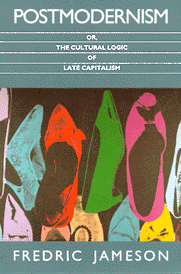
On ‘Postmodernism, or, the Cultural
Logic of Late Capitalism’
Chambi Chachage
“Yet if postmodernism is a historical
phenomenon, then the attempt to conceptualize it in terms of moral or
moralizing judgments must finally be identified as a category mistake” –
Frederic Jameson
It has been quite a while
since I read Frederic Jameson’s texts. Rereading his critique of postmodernism
has made me realize how much I agree with him. Since it is very difficult to
critique what one concurs with, in this paper I only stress on the points of
agreement.
For a historian periodization
is important. Even a postmodern reading
of history cannot run away from periods. Little wonder the term ‘postmodernism’
contains the prefix ‘post’ that refers to a period after, or rather, beyond and
against the ‘modern’. Jameson thus captures this preoccupation of postmodernism that,
ironically, subjects it to periodization:
One
of the concerns frequently aroused by periodizing hypotheses is that these tend
to obliterate difference and to project an idea of the historical period as
massive homogeneity (bounded on either side by inexplicable chronological
metamorphoses and punctuation marks). This is, however, precisely why it seems
to me essential to grasp postmodernism not as a style but rather as a cultural
dominant: a conception which allows for the presence and coexistence of a range
of very different, yet subordinate, features.
In other words,
postmodernism, though critical of linear history, has a history. This is not to say that history is simply linear in the sense of moving from premodern to
modern and, thereafter, postmodern. Rather, it is to say that anything that
defines itself in relation to what precedes it, or what it aims to transcend,
is bound by its timeframe and framework.
Michael Echeruo terms such a
limitation the first liability of a counter-discourse, “the fact that it must begin
with a premise from the primary discourse.” In the postmodern case the primary
discourse is the modern that has a specific historical periodization. For
Jameson this is the period of capitalism and its high modernism. What follows
after is the period of late capitalism that coincides with, and feeds on, the
postmodern. Multinational capital characterizes this period. Jameson
notes that the late capital does not only finance “fresh waves of ever more novel-seeming good”, but it is also
dialectically linked to them.
Out of this dialectics are attempts at the destabilization or blurring
of historic time and periodization through fast-paced renewal and revision of
what preceded the postmodern. Multinational capital
enables the constant production and reproduction of the image i.e. the
simulacra. This “logic of the simulacrum, with its transformation of older
realities into television images” as Jameson observes, “does more than merely
replicate the logic of late capitalism; it reinforces and intensifies it.” What
is old appears new. No wonder one poet exclaimed: “there is nothing new under
the sun”. It is always post-something.
