
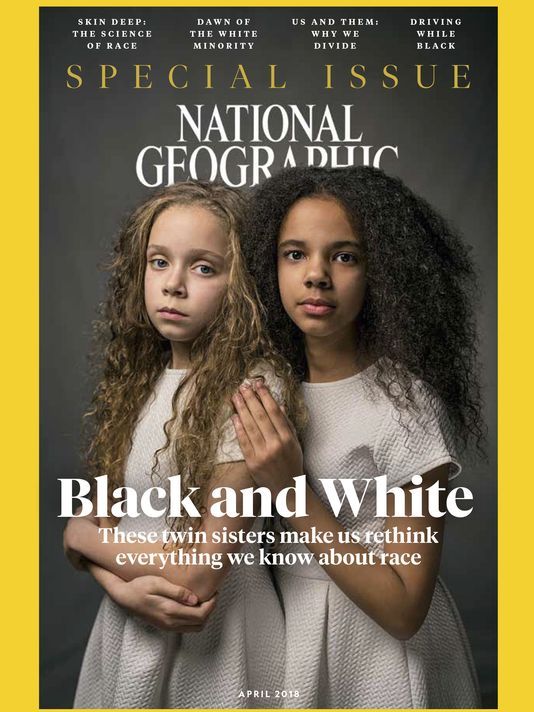
This week we have been treated to this controversial confession: ‘National Geographic’ Reckons With Its Past: ‘For Decades, Our Coverage Was Racist’. Some critics have welcome it while others remain critical. I hereby post an essay I wrote 15 years ago.
IMAGES OF AFRICA FROM BELOW OR FROM ABOVE? A CLOSE READING
OF NATIONAL GEOGRAPHIC MAGAZINE’S REPRESENTATION OF TANZANIA AND TANZANIANS IN
1975
“In its polemical stance, then, African discourse
presents itself as a thorough-going deconstruction of the Western image of the
Native, the Black, the African” (Irele, 2001, p. 69)
BY THE WAY OF INTRODUCTION
“And I ponder what will happen here in
Tanzania…” (White, 1975, p. 474)
At on the onset I am constrained
to categorically state that this essay is based on the following three premises
that account for my subjective standpoint as a reader and a writer: the terms
‘Africa’ and ‘African’ are very problematic notions/constructs/ideas which need
to be deconstructed and reconstructed for the benefits of the so-called
‘African people’; the Western image of the African, which owes much to the
universalizing discourses of colonialism, civilization and imperialism, is
still alive and well in its virulent metamorphoses and subtle forms; in as much
as Africa and Africans are heterogonous, the social, economical and political
construction/creation of Africa has created, not only a ‘real’ homogenous place
called Africa, but also some ‘real’ common consequences to the majority of
Africans (Mudimbe, 1994, Zeleza, 1997; Irele, 2001). These premises impose a
moral responsibility that constrains me to subscribe to what Irele (2001)
refers to as the polemic stance of African discourse, by engaging myself in a
thoroughgoing deconstruction of the Western image of the African.
In this essay, then, I attempt on
the basis of the above-mentioned polemic stance to offer a close reading of how
one of the African country by the name of Tanzania and its people have been
represented by the National Geographic Magazine. I acknowledge the fact deduced
from http://wwwnationalgeogaphic.com
that the writers of the magazine sometimes mention Tanzania in passing when
they are writing about other African countries and other related issues but for
the purpose of this essay I would particularly focus on one article that was
the only article that was wholly devoted to Tanzania as a country and therefore
formed a part of the ‘selling’ cover story/stories of the magazine.
However, I
would attempt to compare this article, which was written by White (1975), with
other cover stories/article on other African countries that were published
during the first half of the 1970s. Moreover, I would also attempt to consult
other subsequent articles on phenomena and events that were experienced in
Tanzania. A copy of National Geographic of April 1975 will accompany this essay
as an attachment. Unless otherwise specified, all the italicized and underlined
texts that appear in all the quotes below are my own and they are employed for
the purpose of substantiating my analyses and arguments.
WHEN AN AFRICAN NATION MARCHES ON A ‘NON-WESTERN’
DRUM
“Alas
the Serengeti ecosystem isn’t easy to fathom, any more than the socio-economic
dynamics of Tanzania. I must move on.” (White,
1975, p. 490)
The year is 1975 and what Legum
(1999) calls the Romantic period in Africa has or is rather giving way to what he
terms as the period of Disillusionment. The Cold War between the so-called
Western and the Eastern bloc is still at its best and Africa is one of its
favourite staging grounds: on the southern part of Africa the Apartheid regime
is till causing a lot of havoc to the liberation struggles in the African
countries of Zimbabwe, Angola and Mozambique; the Soviet bloc and the Chinese are
busy supplying weapons to aid these liberation struggles and the last of the
Western colonialists i.e. the Portuguese are on the verge of granting Angola
and Mozambique their independence; Tanzania and their leader, Julius K. Nyerere
(1978), are busy leading this ‘Crusade of Liberation’.
This is the year Peter T.
White (1975), a staff of the National Geographic Magazine, decided to travel to
Tanzania and write a travelogue that was heavily laden with carefully selected
images as photographed earlier by his compatriot, Emory Kristof. Why 1975? What
so special in Tanzania in 1975? Why not 1964 (the year Tanzania was born after
the unification of Tanganyika and Zanzibar)? Why not 1967 (the year the Arusha
Declaration was proclaimed so as to usher the famous policy of Ujamaa na Kujitegemea i.e. Socialist Familyhood and Self-reliance)? Who did White (1975) target as his main audience
and what did he intend them to see, and for what purpose? Upon which discourses
and myths did he build his travelogue? With these questions in mind its time
now start tackling White’s (1975) texts and its accompanying photographs.
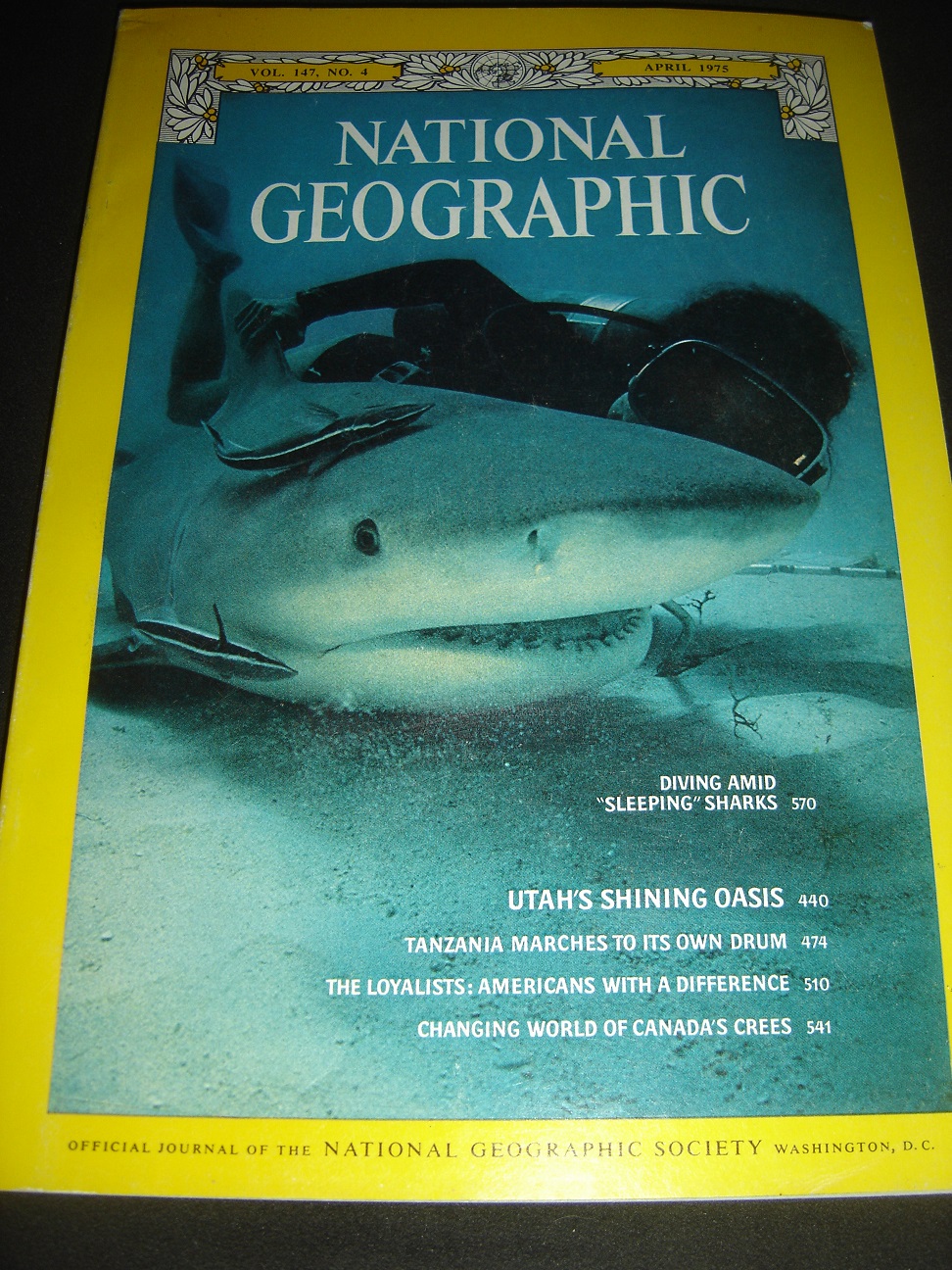
The first thing one encounter is
the title of the travelogue being juxtaposed with other titles in the front
cover. Actually the title, “TANZANIA MARCHES TO ITS OWN DRUM” is sandwiched
between “UTAH’S SHINING OASIS AND “THE LOYALISTS: AMERICANS WITH A DIFFERENCE.”
One of the things that this title as well as the way it was located
presupposes, is that there is another kind of drum i.e. a drum which is not Tanzania’s
‘own’ drum. It also presupposes that Tanzania was either not marching at all or
if it was marching, then it was not marching “to its own drum.” Drawing from
Achebe (1989), I hypothesize that the title of White’s (1975) travelogue, just
like the way Joseph Conrad’s River Congo acted as an antithesis to the River
Thames, is meant to act as an antithesis of above titles which are based on
myths engendered in the song “America the Beautiful.”
This hypothesis is
supported by the fact that throughout the texts things Tanzanian are
comparatively analysed with respect to America: “Consider first a few notable aspects of Tanzania (Tan-za-NEE-a), whose
14 million inhabitants and 363, 000 square miles roughly approximate the population and size of Texas plus New Mexico”
(White, 1975, p. 474); “ Zanzibar…. produces more than two-thirds of the
world’s cloves. That means some 35 million dollars annually…. If the U.S. sold a crop on a similar scale,
it would bring 17 billion dollars” (White, 1975, p. 501); “Nearby, men in
Arab-style white robes discuss the price of dagaa
[this word is italicized in the original and it defined as “local freshwater
sardines”]…The price is high across the lake, in Zaire. A policeman tells
me the smuggling is brisk; back come
secondhand American clothes. In the market I see shirts neatly laid out on the
ground. Sear. Brooks Brothers. Nothing in my size” (White, 1975, p. 504); “Lake Tanganyika has a tremendous underexploited stock of sardines, a man from Idaho [U.S.A] tells me. He should
know – he’s an aquatic biologist working for the U.N., and he just surveyed the
lake with an echo sounder” (White, 1975, p. 504).
The above universalizing language
of western modernity reminds me of the genealogy of the myth of the “Dark
Continent” which was produced by the imperialist ideology that was based on the
self-validating and legitimizing idea that “ there was only one civilization,
one path of progress, one true religion” (Brantlinger, 1988, p. 17). Though White (1975) attempts to be charitable in his representation of Tanzania and
Tanzanians, a close reading reveals that this myth that rendered Africans as
backward and in need of progress is so pervasive in his travelogue. In the very beginning of the article the
reader is introduced to someone and something ‘impressive’ that is happening
“UNDER THE EQUATORIAL SUN” in East Africa, in the Dodoma region of the United
Republic of Tanzania: “a little girl with a big gourd on her head walks into a
dry riverbed”(White, 1975, p. 474). White’s ‘gaze’ scrutinize her as “she digs
a hole in the soft sand, armdeep.” The gaze fixes her as she “waits, until
enough muddy water has seeped into the hole to fill her gourd” and then the
gaze follows her along as “she walks back a quarter of a mile to a row of grape
seedlings, to pour a bit of water on each.”
We are not told long this gaze was but the conclusion we are given is
that she “has done this all morning, and will do it again in late afternoon. I
am impressed – such hard work, to nurse along a few seedling after the expected
rains did not come” (White, 1975, p. 474). This gaze implies that there was
enough time to talk and ask her name but her name is not given. Her reaction to
the gaze is not described either. She was just a “little girl” after all who
“impressed” White, the traveler with “such hard work” to the extent that
she qualified to be used to set the stage for the representation of the
predicament of Tanzania and Tanzanians with respect to labour and progress.
What we see above is a gaze per excellence for indeed “‘the gaze’ is more than a long, fixed
look of wonder and (possibly) admiration upon a body/subject. It is rather ‘a
fundamental structure in the ways in which the subject relates to the cultural
order … the way in which subjectivity itself is formed through [its]
mechanisms … [It is] something that
impacts on, shapes, and contorts the body/subject’”(Kamenier,
1998). Moreover, a close examination of this charitable gaze and some other
subsequent ones reveal that White is practicing a very subtle form ‘othering.’
Just like Pratt’s (1986) John Burrow, White ensures that the people he wants to
other are homogenized into a collective ‘they.’
The only difference is that
White is clever and subtle enough to include the term “they” in absentia: the
“little girl” in a country where “they,” the people are said to work and farm
together according to” the spirit of Ujamaa,” is described as if she is working
alone the whole morning and will work alone “again in late afternoon”! So, this
is how ‘they’ live and treat their ‘little’ ones: “a ‘little’ girl with a ‘big’ gourd on her [little] head; “Goose-stepping Young
Pioneers salute African Leaders…” captions the opening photograph on page
475, with a “little” boy leading some other “little” boys as “Tanzania marches
to its own drum”; “ A young
dockworker levels a truckload of maize” accompanies a photograph of what appear
to be a “little” boy doing a man’s job on page 481; “I visit a camp in Mafinga
in south-central Tanzania for graduation day. Youth in khaki show off their agricultural achievement…. Quite a
few in the ranks are girls…. I think
of my basic training in World War II and hope these kids won’t ever see real combat. When you’re that green the casualties are fearful”
(White, 1975, p. 483). “Babies are
breast-fed, but when the second child
comes along the first goes to grandmother, and she’ll give the kids only bananas, or “stiff porridge” of maize meal, or whatever she got when she was a kid…”
“The freshwater sardine, nearly 65 percent protein when dried, could add a
much-needed nutrient to Tanzania’s
starch-laden diet”(White, 1975, p. 504, 506) “What
to do when the vast majority lives scattered in the countryside and grows
barely enough food to survive…. The unorthodox
Tanzanian answer fascinates the world’s
experts on underdevelopment – and may
have much to say to other lands where a quarter of the children die before
reaching five, where nearly half of those who survive will never go to school”
(White, 1975, p. 478).
White (1975) tells us that most
of the Dodoma’s grapes, which of course might include the grapes that the above-gazed
little girls was watering, will go to “a so-called “parastatals” enterprise,
managed by an Italian expert” (White, 1975, p. 474). Why does he refer to it as
a “so-called” “parastatal ” enterprise? Why is he detaching himself from this
“parastatal” while rendering it as the ‘other’s’ enterprise? I argue that he
does so because he was writing from a western capitalist/ universalist standpoint and the establishment of parastatal enterprises [i.e. public corporations was “generally
presented as socialist policies because of the elements of nationalization in
setting them up” (Legum, 1999, p. 44). The wines that come out of these
parastatals are sampled and the conclusion is, “Who’d want such acrid stuff?
Parastatals planners expected to export lots of wine for precious foreign
currencies. Now they admit something went wrong somewhere-unsold bottles are
piling. They are looking for another expert” (White, 1975, p. 474).
White seems
to be telling his Western reader that he is worried about the non-western
“social experiment” in Tanzania and its global consequences: “And I ponder
what will happen here in Tanzania, where so much enthusiastic planning is done
these days, and so much hard work, but somehow quite a few things turn sour.
The upshot may be of considerable importance, not only to Tanzanians and their
descendants but also to millions around the globe” (White, 1975, p. 474). How
can this be of considerable importance to the Western audience? Why is it so
worrying to the universalizing west when an African country chooses its own
particular development path?
EAST OR
WEST: IS IT POSSIBLE THAT HOME COULD BE THE BEST?
“Weapons, the foreign
minister says, have been coming from the Soviet bloc and China. But Tanzania,
he insists, is not committed to any superpower, East or West” (White, 1975,
p. 505)
The message to the western
audience is clear: Tanzania and Tanzanians are underexploited and ‘they
themselves’ do not want to progress. If only they can follow our universal
western path of progress and modernity then they will get billions of
“precious” U.S. dollars. With an imperial nostalgic tone reminiscence of
Pratt’s (1992) Anticonquest travel
writers, White laments this lack of a capitalist spirit of exploiting labour
and resources in Tanzania, while he cherishes every moment he sees traces of
Western modernity:
“ Our flight offers a verdant prospect indeed:
first a green plateau, green mountains splashed on it, magnificent emptiness…. Dense forest now, a seemingly endless expanse – good soil, it’s said, to grow rice
enough for millions, but nothing man-made
can be seen except, a thin straight line. It’s the Great Uhuru Railway, a minuscule string of concrete ties and
steel. It was strung here to help open up this land for Ujamaa” (White, 1975,
p. 484).
“The din is
deafening at the Friendship Textile Mill, no wonder. Nearly a thousand looms
are banging away in a hall the size of two [American]
football fields. It’s Tanzania’s biggest factory – 4, 700 employee. It could manage with half that many, but
it does not want to. People need jobs and labor isn’t expensive,
machinery is. The Chinese set it all up…The Friendship mill runs around the
clock but probably won’t reach its goal this year, says the production chief. Too many power failures” (White, 1975,
p. 486).
“Most of the larger coffee farms have been
nationalized, and one of the last
expatriate coffee farmers [White does not refer to them as ‘white settlers,’ which was a common name
in the nationalist discourse] is packing to go back to England. I admire the pretty cottage, the clipped
lawn. He says I should have seen how beautiful it was before – he doesn’t
care about it now. His wife shows me her photo album, how it was when they came 26 years ago, all wild” (White,
1975, p. 490).
“ I drift to
the dhow harbor. Where’s all that
Coca-Cola going? Forty-five miles away, to Zanzibar. Thirty-two
thousand cases a year, says a shipping official. The empty bottles come sailing
back” (White, 1975, p. 491).
“I disembark in Bukoba, in the land of the Haya,
and am struck by vision of ecclesiastical
modernity…. And lo, the bishops of Bukoba are promoting a dam! I’ve seen
churches and missionaries all over Tanzania providing schooling and medicine,
but nothing like this. It’s the Ngono River multipurpose project, promising
swamp drainage and electricity. To help
pay for equipment and materials, the bishops collect funds in Europe”(White,
1975, pp. 503-504).
“ The biomass is incredible!” An average of
800 pounds an acre, mostly ever-shifting schools of dagaa. Dry them in the sun,
and you might have 65 percent protein. Masses of protein! This may someday
be an answer to Tanzanian toddlers’ malnutrition, and their resultant
susceptibility to disease. All a lot of them get starch. Babies are breast-fed,
but when the second child comes along the first goes to grandmother, and she’ll
give the kids only bananas, or “stiff porridge” of maize meal, or whatever she
got when she was a kid….”(White, 1975, p. 504).
“ At night
along Morogoro Road I join thousands
happily watching a movie on an outdoor screen. It’s an ancient American Western,
interrupted by commercials for hair tonic made in Kenya. You might call it a flickering of free enterprise” (White, 1975, p.
505).
The above statements are
substantiated by carefully selected images: though we are told that by 1973
there were 5, 628 no single photograph of a successful/unsuccessful Ujamaa
village is given yet one find a third part of the combination of pages 498 and
499 splashed with a very magnificent photograph of well-cultivated farms and
nicely arranged houses entitled, “Harlequin fields – some of the last a farmland tilled by Europeans –
quilt the foot of a cinder cone near Mount Kilimanjaro.” This photograph is
provided after the reader is bombarded with pathetic images and descriptions
such as that on page 481- 482 where one finds a
“young dockworker” leveling “a truckload of maize (corn) pumped from a
ship’s hold” – an image’s description that is preceded by the statement, “Self-sufficiency remains Tanzania’s chief dictum, but reality often intervenes.
A searing drought crippled the 1974 harvest, and the government imported 170
millions dollars’ worth of staple foodstuff to stave off famine.” On page 506 and 507 one finds a pathetic
photographs of lowland villager’s houses and farms flooded by the “swollen
Rufiji” – a timely antithesis to the above-mentioned highland European farms.
Moreover, on page 490-491 one finds a pathetic photograph of thin and starving
cattle with the description, “Dust of drought hangs over gaunt cattle at an
emergency auction by the government near Arusha.” This
photograph is immediately followed by six colorful pages full of wild animals
and where one finds White’s self-detaching statement: “The animals are so vast
that some believe herds could be carefully cropped to provide 24 million pounds
of meat each year for hungry Tanzanians” (White, 1975, p. 492).
But there is more of it. White
(1975), like most of his fellow capitalist westerners in the 70s, is worried
that “Tanzania is going ‘red”’, that is, it is allying itself with China and
therefore it is becoming a socialist and not a capitalist country. “The
Tanzanian President, Julius Nyerere, has warned the major powers, ‘We shall
not allow our friends to decide who our enemies shall be’” (White, 1975, p.
482). In other words, they are claiming to be self-reliant and non-aligned but look what is
really happening down here in Tanzania!
“A dozen ships are waiting to get in – Norwegian,
U.S., Japanese. There is no waiting,
though, for ships of the People’s Republic of China. They turn around fast….
The World Bank and the Western powers refused to underwrite the railway
[Tanzania-Zambia Railway/the Great Uhuru (Freedom) Railway)]. The Chinese eager
for friends in Africa, offered not only engineers and materials but all those
thousands of workers [“15, 000 Chinese”] and an interest-free loan [“400
million dollars”]. Repayment is not to start until 1983…. Meanwhile Chinese ships bring mountains of consumer goods –
pencils, canned food, flashlights, bicycles, sewing machines. These Chinese
goods are sold in Tanzanian shops; the proceeds go to pay the railroad workers.
So every time I drink Greatwall grape
squash or use Bee and Flower soap, I too help build the Great Uhuru
Railway” (White, 1975, p. 479).
“I look up
the Tanzanian Foreign Minister, John Malecela. He makes no bones about it
[i.e. regarding the Liberation struggles in Mozambique]: To eradicate racialism and colonialism
from southern Africa, and establish majority rule there, bloodshed has been
necessary, peaceful efforts having failed. ‘It’s our duty to help’. Weapons, the foreign minister, say, have
been coming from the Soviet bloc and China. But Tanzania, he insists, is
not committed to any superpower, East or West.‘We have not been swallowed up
by the Chinese. We are nonaligned’” (White, 1975, pp. 504-505).
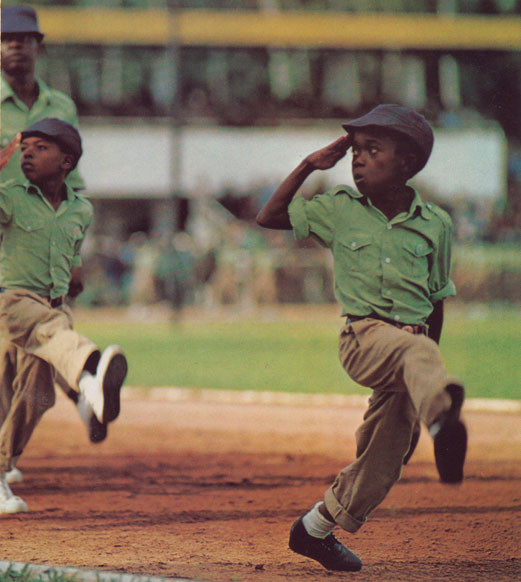
“Next
morning, here they come, the green shirts of the Youth League, or Green Guard,
and hundreds of blue-orange shirts imprinted with party slogan. They come at a
slow run, 40 abreast, clapping, shouting, with big banners: INDIAN OCEAN IS NOT
FOR U.S. MILITARY BASES! U.S. IMPERIALISTS GET OUT OF AFRICA, ASIA AND LATIN
AMERICA! They squeeze into narrowing streets and spill out into the American
Consulate. Next to me a little middle-aged lady leads the shouting. Should the
Americans be removed from the Indian Ocean? Ndiyo,
Ndiyo! Yes, Yes! Kwao, Kwao! Go Home! Go Home! A forest of fists flairs in
the air. I am pushed against the consulate building, and a police commander
points his swagger stick at me: ‘Don’t lean against the wall, you’ll make it
dirty! We haven’t come to quarrel, only to express our feelings’. At last a
green shirt with an electric bullhorn tells everybody to go back to work. It’s
over” (White, 1975, p. 503 Italics in the
original).
The capitalist message to the western
audience is clear: Tanzania is a country full of
resources that could be capitalized and exploited by the West, therefore the
west should not loose such an important ‘Cold War’ battle there.
THE WEARY
OR THE UN-WEARY SON OF HEMINGWAY?
“Forty years ago Ernest
Hemingway saw game-rich stretches of what is now Tanzania a ‘virgin country, an
unhunted pocket in the million miles of bloody Africa’” (White, 1975, p. 492)
It is clear that in 1975 the
representations of Tanzania and Tanzanians in the National Geographic Magazine
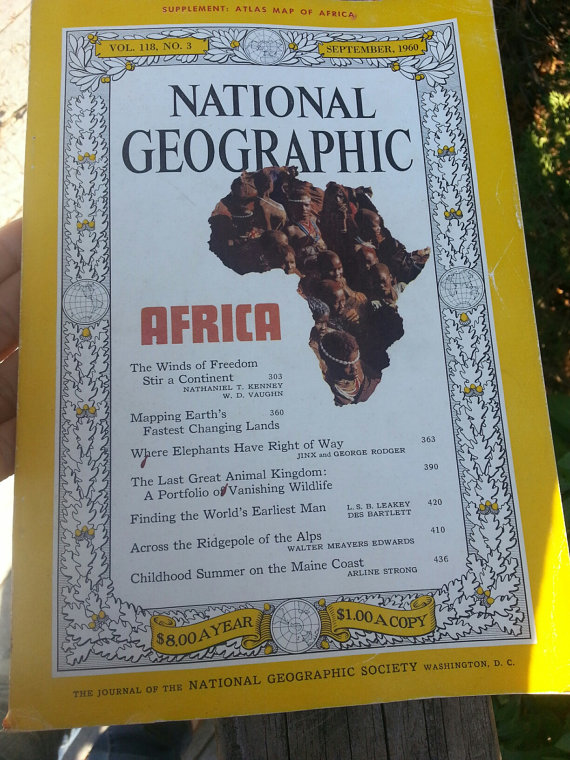
was tainted with the legacy of the Myth of the Dark Continent. Indeed, fifteen years
before, Louis and Mary Leakey, with the aid of National Geographic Society
grants, captured the attention of the world when they claimed to have found the
fossil of the earliest human being in Tanganyika/Tanzania. Their claim based on the theory
of evolution was well bought by the West and the National Geographic Magazine
published their findings as a cover article in their magazine. This, in the “Western Imagination” was a
confirmation that Africa in general, and Tanzania in particular is the
so-called “cradle of man” – place where humans originated from the
hominids.
This legitimizing story was to be perpetuated further in July 1983 when another article entitled “Tanzania’s Stone Age Art” and written by Mary Leakey came out as one of the cover stories. As a staff of the National Geographic, it is highly likely that White (1975) subscribed to this story for indeed page 488 and 489 of his travelogue are splashed with photographs of what he refers to as “some of the most intriguing fossils ever found” i.e. the fossils that the Louis family discovered. His charitable style of writing, which subtly attempts to self-detach him from the racist discourse of the “Western Imagination,” begs the question: who was Peter T. White? Was he just a neutral traveler who was just reporting what he saw in the land of Tanzanians? Was he a writer brought up and nursed on the shoulders and bosoms of the likes of Henry Morton Stanley and David Livingstone? Was he a weary or un-weary son of the likes of Ernest Hemingway and president Theodore Roosevelt who saw Africa as a vast game-lodge? Look at how he detaches himself from the Myths of the Dark Continent while strongly articulating some their inherent ideas:
“More than five million magnificent beasts abound
in its [Tanzania] National parks and game reserves, on which it spends a
considerably high proportion of its national budget than the United States
spends on national parks. Western
conservationists love it” (White, 1975, p. 478).
“Most visitors to Tanzania come to see the great
animals up north, and I can hardly wait to get there, to lake Manyara and
Ngorongoro Crater. Sure enough, the lions, elephants, hippos, giraffes, and
lesser quadrupeds are visible as advertised; the tourists in their minibuses and Land-Rovers are delighted. To
come so close to an uncaged elephant and not need to worry! If his ears stiffen
threateningly, the driver will step on the gas and pull out” (White, 1975, p.
488).
“In comfortable
lodges there’s animated conversation. ‘How’s your curried antelope?’ ‘Great, like veal.’ I hear talk of Impalas, zebras, buffaloes, of wildbeest (or
gnu); about the big cats, and how marvelous it is to see so many wild creatures
live so calmly together. ‘Such
innocence’, says a lady from Connecticut, ‘Garden of Eden, a paradise’”
(White, 1975, p. 488).
“And Ngorongoro Crater! This 1-by-13- mile saucer
with a 2,000-foot-high rim and all the wildlife in it has been called the
eighth wonder of the world. But look, encircling four dozing lioness stand six
vehicles – 27 cameras are clicking away. A lioness yawns. And suddenly it’s not so much like a paradise but more like a zoo”
(White, 1975, p. 488).
“Forty years ago Ernest Hemingway saw game-rich stretches of what is now
Tanzania as ‘virgin country, an unhunted pocket in the million miles of
bloody Africa’. Where he stalked
rhino and kudu, his son, Patrick, teaches conservation to aspiring game wardens
at the College of African Wildlife Management near Moshi” (White, 1975, p. 492).
“I fly to Lake Tanganyika, and at the little town
of Ujiji I see a monument where 104 years ago [Henry Morton] Stanley found
[David] Livingstone. In the Western
imagination this was then the heart of darkest Africa” (White, 1975, p.
504).
From the above statements, which are only concerned with the landscape of Tanzania and its animals at the
expense of the presence of Tanzanians, one can clearly see a number of myths,
practices and discourses articulating with each other and with the myth of the
Dark Continent long after Tanzania and many other African countries had gained
their independence: “the garden myth, the myth of the return to Eden and
innocence” (Coetzee, 1988, p. 2); game-lodges and colonialism – “Doesn’t the
game lodge represent the ultimate ‘leisuring’ of colonial history…. the game
lodge impedes the emergence of an image of Africa and its diverse culture as
transforming historical phenomena” (Ndebele, 1998); civilization and conquest
– with a modern car like a British Land-Rover one can fearlessly “participate
in the continuing enjoyment of the fruits of conquest” (Ndebele, 1998).
I glance at my sample of
other National Geographic magazine of the early 1970s and the message is the
same as I see Allan C. Fisher, Jr.’s (1975) “Rhodesia, A House Divided” lushly
illustrated with the Victoria falls, the great Zimbabwe ruins, the beautiful
waterbucks of the Zambezi and “canal lush fields “ of white settler and many
more; John J. Putman’s (1973) “Yesterday’s Congo, Today Zaire” with photographs
of precious diamonds, a huge elephant from Virunga national park, pygmy
hunters, the forests of the river Congo and many more. There is no much change
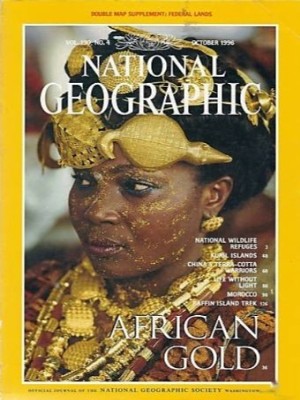
in the later 1990s and in the new millennium either: Carol Beckwith’s (1996)
“Royal Gold of the Asante Empire” with Africans heavily decked with “Africa
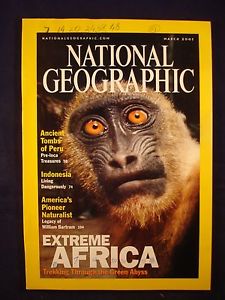
Gold”; Paul Theoroux’s (1997) “Down the Zambezi” with fighting elephants, the
beautiful untamed Victoria falls and the Zambezi’s “unspoiled reaches”.
Indeed the writers of National Geographic Magazine, like the 18th an 19th century travel writers, have been major producers of “Africa” to the western
audiences.
THE
PROPHET OF DOOM OR THE MESSENGER OF LIGHT?
“But I can’t keep my mind on animal problems. Will
Ujamaa survive? I am haunted by a conversation with a distinguished Tanzanian:
He thinks a crunch is coming…” (White, 1975, p. 505)
In a time when Nyerere (1978) and
Tanzania was wary of the U.S.A.’s economic support of the racial oppressive
regimes of Southern Africa and when Tanzanians were trying to foster unity and
a belief in Ujamaa, White (1975), with his subtle self-detaching charitable
writing style, decided to use an unnamed “ distinguished Tanzanian” to voice
his dissident and skeptical voice: “The conflict, he [the distinguished
Tanzanian] concluded, is between young revolutionary willing to use force to
further African socialism, and older bureaucrats opposed to Ujamaa. Some might
even welcome an army revolt to sobotage the programs in the name of national
salvation. Where it [Ujamaa] will end, no one knows. But the outcome will be of
great moment to Tanzania, to Africa, to the world” (White, 1975, p. 505).
Even
though I am a champion of academic freedom and freedom of speech, the context
of 1975 imply that this was a very dangerous statement given the fact that the Cold War meant that Tanzania was wary of the western intelligence such as C.I.A’s manoeuvres in the affairs of African countries. White must have been aware: “The region commissioner tells me
this is not for foreign consumption; I’d better stick to writing about coffee”
(White, 1975, p. 490); “I stumble into a symposium
[at the University of Dar-es-Salaam] on Ujamaa villages as seen through
the eyes of Lenin: Will Ujamaa villages breed capitalists? A gigantic bookstore
display paperbacks, a bulletin board announces Daniel Ellsberg coming to talk
about the Pentagon papers” (White, 1975, p. 486).
Did Ujamaa survive? Let us hear from the horse’s mouth: “The Arusha Declaration and
our democratic single-party system, together with our national language,
Kiswahili, and a highly politicized and disciplined army, transformed more than
126 different tribes into a cohesive and stable nation. However, despite this
achievement, they say we failed in Tanzania, that we floundered. But did we? We
must say no. We can’t deny everything we accomplished. There are some of my
friends who we did not allow to get rich; now they are getting rich and they
say ‘See, we are getting rich now, so you are wrong’. But what kind of answer
is that? The floundering of socialism has been global. This is what needs an
explanation, not just the Tanzanian part of it. George Bernard Shaw, who was an
atheist, said, ‘You cannot say Christianity has failed because it has never
been tried. ‘ It is the same with socialism: you cannot say it has failed
because it has never been tried” (Nyerere, 1999).
Some of the precepts of Ujamaa might have survived in Tanzania but now in 2003,
it is a common knowledge that Ujamaa as a policy has
not survived. This is end that White said will be a great moment to the
world – a moment which has been described as the triumph of capitalism and
global capitalism. Was White an innocent prophet of doom? Indeed, he was a
messenger of the so-called light of western modernity and civilization in
Tanzania – the light that has dawn in this so-called age of globalization and
free market. If it is true that Ujamaa in Tanzania did not survive because of
some internal and external pressure, then, I have to admit that little do I know
about the external impact of White’s travelogue on aiding the end of Ujamaa. As
I re-read again the following critical sentiments of his, I am constrained to
suspect that he was not just a prophet of doom, but also a self-fulfilling
history maker in the making of an end of Ujamaa: “But more and more I get wind
of less happy matters I cannot possible ignore, especially since official
voices and publications deal so bluntly with these issues bedevilling Tanzania
today”; “ Or consider the unhappiness of many a Ujamaa settler.” “Is the great
social experiment coming apart?” “Will Ujamaa survive?” (White, 1975, p. 505).
Surely, White knew that Ujamaa won’t survive and he himself was in the mission
of ensuring it does not survive, no wonder he even detached himself from his
own conclusion when he wrote, “ I remember a children’s program on color TV in
Zanzibar. A boy and a girl do homework but mother keeps tearing pages from the
girl’s notebook, for wrapping fish. Father sends the boy on an errand and takes
the lamp away. The boy comes back. He lights the candle. The message is, Don’t give up” (White, 1975, p. 509)
BY THE WAY OF CONCLUSION
“The message is, Don’t give up”
(White, 1975, p. 509)
Would I go, as far as
Achebe (1989) went when he claimed that Joseph Conrad was a racist, by claiming
that Peter T. White was a thoroughgoing racist? His diplomatic style of taking
a non-moral neutral stance and detaching himself from the language of
anti-racism and anti-struggle as the following quote indicates, indeed makes one
a racist by acquiescence: “Moreover, Zambia joins Tanzania in seeking to
eradicate ‘racist oppression’ in
southern Africa; thus the railroad has political as well as economic
significance. It’s been a shot in the arm of patriotic liberation movements –
for insurgency, depending on which side
you’re on” (White, 1975, p. 479). His subtle paternalistic othering of the
Chinese and their products raises serious questions on Orientalism. His wooing sympathetic description of Tanzanians and
especially Tanzanian children, coupled with his zoological metaphorical
description of their land and animals is ‘ontological disturbing’.
The strength
of his subtle racism lies in his ability to historicize and portray the events,
manners and customs of Tanzanians while simultaneously creating “a normalizing
discourse, whose work is to codify differences, to fix the Other in a timeless
present where all ‘his’ action and reactions are repetitions of ‘his’ normal
habits” (Pratt, 1986, p. 139). White is more than engaged in what Achebe (1989)
refers to as the inducing hypnotic stupor in his readers through bombardment of
emotive words and other forms of trickery. Like Joseph Conrad, White “chose his
subject well – one which was guaranteed not to put him in conflict with the
psychological predisposition of his [western] readers or raise the need for him
to contend with their resistance. He chose the role of the purveyor of
comforting myths” (Achebe, 1989, p. 5).
The above close reading of
White’s (1975) charitable yet subtle Euro-American centered travelogue on an
African country therefore constrains me to also conclude that indeed for
“reasons which can certainly use close psychological inquiry the West seems to
suffer deep anxieties about the precariousness of its civilization and to have
a need for constant reassurance by comparison with Africa. If Europe, advancing
in civilization, could cast a backward glance periodically at Africa trapped in
primordial barbarity it could say with faith and feeling: There go I but for
the grace of God. Africa is to Europe as the picture is to Dorian Gray – a
carrier on to whom the master unloads his physical and moral deformities so
that he may go ahead, erect and immaculate” (Achebe, 1989, p. 17). To the weary
champions of African discourse, these persisting negativizing Western images of
the African imply that the deconstructionist work is not yet over. “The message
is, Don’t give up.”
REFERENCES
Achebe, C. (1989). An Image of Africa: Racism in Conrad’s Heart of Darkness. In C. Achebe, Hope
and Impediments: Selected Essays (pp. 1-20). New York, USA: Doubleday
Brantlinger, P. (1988). The
Genealogy of the Myth of the Dark Continent. In P. Brantlinger, Rule of
Darkness: British Literature and Imperialism, 1830-1914 (pp. 173-197).
London, UK: Ithaka.
Coetzee, J. M. (1988). White
Writing: On the Culture of Letter in South Africa. Sandton, RSA: Radix
Irele, F. A. (2001). The
African Imagination: Literature In Africa and the Black Diaspora. Oxford,
UK: Oxford University Press.
Kamenier, B (1998). “Bodies,
Pedagogies and the Buddha. ”In http://www.aare.edu.au/98pap/kam98378.htm
Legum, C. (1999). Africa since Independence.
Bloomington, USA: Indiana University Press.
Mudimbe, V. (1994). The Idea
of Africa. Bloomington, USA: Indiana University Press.
Ndebele, N. (1998). Game lodges
and leisure colonialists. In H. Judin, I. Vladislavic (Eds.). Blank_Architecture,
apartheid and after. Cape Town, SA: David Philips.
Nyerere, J. K. (1978). Crusade
for Liberation. Dar-es-Salaam, Tanzania: Oxford University Press.
Nyerere (1999). The Heart of
Africa: Interview with Julius Nyerere on Anti-Colonialism (http://hartford-hwp.comarchives3049.html).
Pratt, M. L. (1986). Scratches on
the Face of the Country; Or, What Mr. Barrow Saw in the Land of the Bushmen. In
H. L. Gates (Ed.), “Race,” Writing, and Difference (pp. 138-162).
Chicago, USA: Chicago University Press.
Pratt, M. L. (1992). Imperial
Eyes: Travel Writing and Transculturation. London, UK: Routledge
White, P. T., (1975). Tanzania
Marches on its own Drum. National Geographic Magazine, 147,
474-509
The National Geographic Official
Website. http://www.nationalgeogaphic.com
Zeleza, P. T. (1997). Manufacturing
African Studies and Crises. Dakar, Senegal: CODESRIA.
ATTACHMENT

Asante mzee kwa pepa hii bomba kishenzi. Tunasubiri toleo la pili sasa kuhusiana na this thoroughgoing deconstruction of the African image of the White. Hapo ndipo mambo yatakapokuwa katika mizani, au siyo ?