
What does Digital Culture
have to do with Land Grabs?
Chambi Chachage
“We
are dealing with a massive loss of habitat” – Saskia Sassen
For the tenth time in a decade, global
champions of digital culture have conferenced in Berlin. Known as Re: Publica, the
conference “has grown from a cozy blogger meeting with 700
participants in 2007” into nearly 10 thousands. As a member of #AfricanBlogging interested
in land rights, one keynote was of particular interest.
How on earth, I
wondered, was Professor Saskia
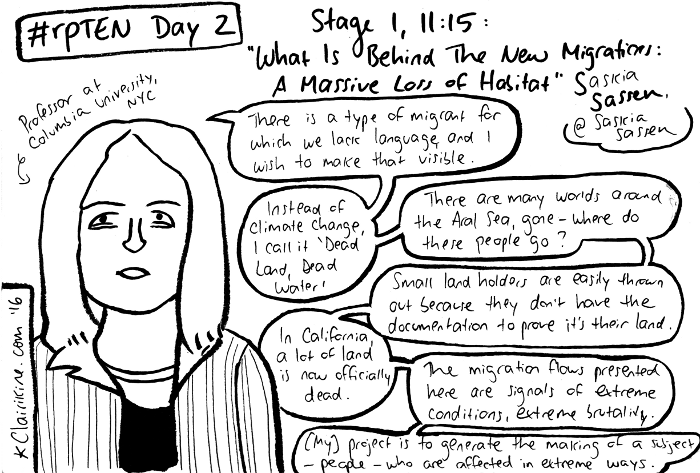
Sassen delivering a keynote on “What is behind the new
Migrations: A Massive Loss of Habitat” to a packed
audience full of ‘netizens’? What would they find so interesting about what
hardly affect their ‘cyberspace’? It was only after listening that I came to
realize why land as habitat should matter to anyone who inhabits any part of
our globalizing world.
After noting that
we are familiar with war refugees and migrants, she notes that there is third
type of migrating subjects. To make them visible one has ask the question: “Why
are they moving? There is no war where they are coming from.” One of the causes
for this, according to her research, is the “making” of “dead land, dead
water.”
This deadening goes hand in hand with the expansion
of mining, land grabs and cities to force people out of their habitat. For her,
the “pretty” language of climate change is not adequate to capture it. Unlike those who
claim that “land grab vocabulary, with its connotations of ‘illegality’,”
distorts “understanding of investment”, Sassen states:
“And we are talking of people who have been in that land for
centuries…but they don’t have the papers, they don’t have the instruments to
show that this is my land. So, they can be thrown out. The estimate is: Every
year, three million…. The main argument that I want to make is: They are invisible
to the eye of the law….”
Such ‘legal blind
spots’ enables us to look beyond the law. As
we noted in 2009, legal discourses on land have been used to render such
people “wavamizi”, a Swahili term that literarily means “invaders”, to justify
their eviction. We
also noted in 2010 that:
“It is tempting to conclude, alongside fellow strong critics of land
grab such as the Land Equity Movement in Uganda (LEMU) and ILC, that land grab
implies accumulation of land holdings through illegal and/or illegitimate means
or simply ‘means deliberately and illegally taking away someone else‘s land
rights’…. But this conclusion has to be qualified as there are incidences
whereby land acquisitions in the light of the domestic policy frameworks and
legal systems are sanctioned. As such there are at least two typologies of land
grabs, that is, illegal and legal – or more appropriately, legalized – land
grabs. In the case of Tanzania, land grabs, especially those of ‘village land’, are legally sanctioned
through procedures for land acquisition.”
By noting the ‘legality’ of land grabs,
Sassen thus helps us to see their subtle impact:
“Now land grabs have long
existed. The United States use a lot of land in Kenya, for instance, to raise
cattle because cattle is quite destructive, we know that. Kenya has vast
stretches of dead land thank you to the United States…using that to grow
cattle, same thing as Central America – lot of dead land. So, we have been
killing land for a while but there is so much of it. It is shrinking now…. Here
are some figures [From 2006 to 2010: 220 million hectares of land in Africa,
Latin America, Cambodia, Ukraine etc. bought/leased by rich government, firms,
financial firms]. The estimate now is that there are over 300 million hectares
of land that has been bought.”
In her words, such figures indicate that
the “land is now more valued than the people or activities on it.” Hence “what
we measure as development”, she argues, “is a massive expulsion.” It is “the
making of surplus population.” Sassen elaborates:
“There are about 100
firms…and about 15 governments that does include the United States but also
includes Saudi Arabia and China etcetera…who are buying land mostly…to develop
plantation agriculture…and you know plantation agriculture is a bit destructive
of land, right, it does not enable land to have earth, to have a long life.
Smallholder agriculture knows how to keep that land growing for millennia.
Plantations, no way – that is not the plot. It is pesticides and fertilizers,
you know, to get huge – to get it growing fast and it all has to look
beautiful…it is a lot of chemicals and stuff like that. Now what happens here
is that smallholders, and you know this, they don’t necessarily have documents
that says this is my land, I have been living here, my family has for centuries
…they are easily thrown out…”
Although she acknowledges that the
figures are the highest in Africa, Sassen also notes that they are also growing
elsewhere. What is so revealing is the way her examples captures the link
between the Global North and the Global North:
“This is about Europe now.
Land grabs in Europe…. The sons and daughters of former farmers in France,
given the bad job situation (this is something that happened 2 or 3 years ago),
decides that ‘maybe the best bet for me is to go back to the countryside and
buy some land and some very specialized farming….’ Guess what? No land for
sale. It has been mostly bought up by large corporates. Saudi Arabia has more
or less bought up – and the Qatari – Bosnia…. Last example… A nice Swedish
firm…. has bought a vast stretch of land in Northern England….”
For keen observer, such dynamics explains
why these Euro-American entities are public-private
partners of the Southern Agricultural Growth Corridor of Tanzania
(SAGCOT): Monsanto; Royal
Norwegian Embassy, SNV Netherlands Development Organisation; United States
Agency for International Development (USAID), Clinton Development Initiative, Stiching IDH Sustainable Trade Initiative,
Syngenta, Nestlé, International AG, UK’s
Department for International Development (DFID) etcetera.
In regard to
biofuel, Sassen argues that “growing crops that are not going to be for eating,
so, you have no constraints on the amount of pesticide…poisons…you are making
that land dead.” She thus decries the tendency of moving on to develop another
plantation after twenty years or so after degrading the previous one. As for
water grabs, she cites the cases of Nestlé and Coca Cola managing
to “exhaust two underground water tables in particular areas of India” thus
causing deprivation.
So, what does
digital culture have to do with all this? I think in this age of ‘Google Earth’
and ‘Big Data’, our champions of bridging the digital divide can be helpful in
providing empirical evidence on the scale of such grabs. Doing so will help
those who are not so visible to counter the
claim that “Land grab fears have been exaggerated.”
