

I recently watched a Kikeke DIGITAL video on YouTube titled “BENKI KUU TANZANIA BOT, HII LEO WAFUNGUKA”. [1] The exchange between the Bank of Tanzania (BoT) and representatives of Kariakoo’s business community brought an important question into focus: as Tanzania moves toward a digital economy, how do we ensure people using its systems receive fair value?
The exchange is encouraging because both sides recognise the benefits of digital payments. The traders describe the convenience of transacting without carrying cash or spending valuable business hours queuing at banks. The regulator acknowledges concerns about charges, explains its efforts to address them, and points to tools intended to give customers greater information and a stronger voice.
I welcome this engagement. Institutions earn confidence when they listen, explain their decisions, and make improvements that people can experience. Business communities contribute when they bring the practical realities of trade into policy discussions.
The Bank of Tanzania’s price comparison initiative deserves recognition in that spirit. BoT is Tanzania’s central bank and the regulator and supervisor of banks and financial institutions within its mandate. Its payment systems responsibilities extend to services offered by banks and non-bank institutions. Insurance and communications have their own regulators; financial consumer protection requires cooperation across these boundaries.[2]
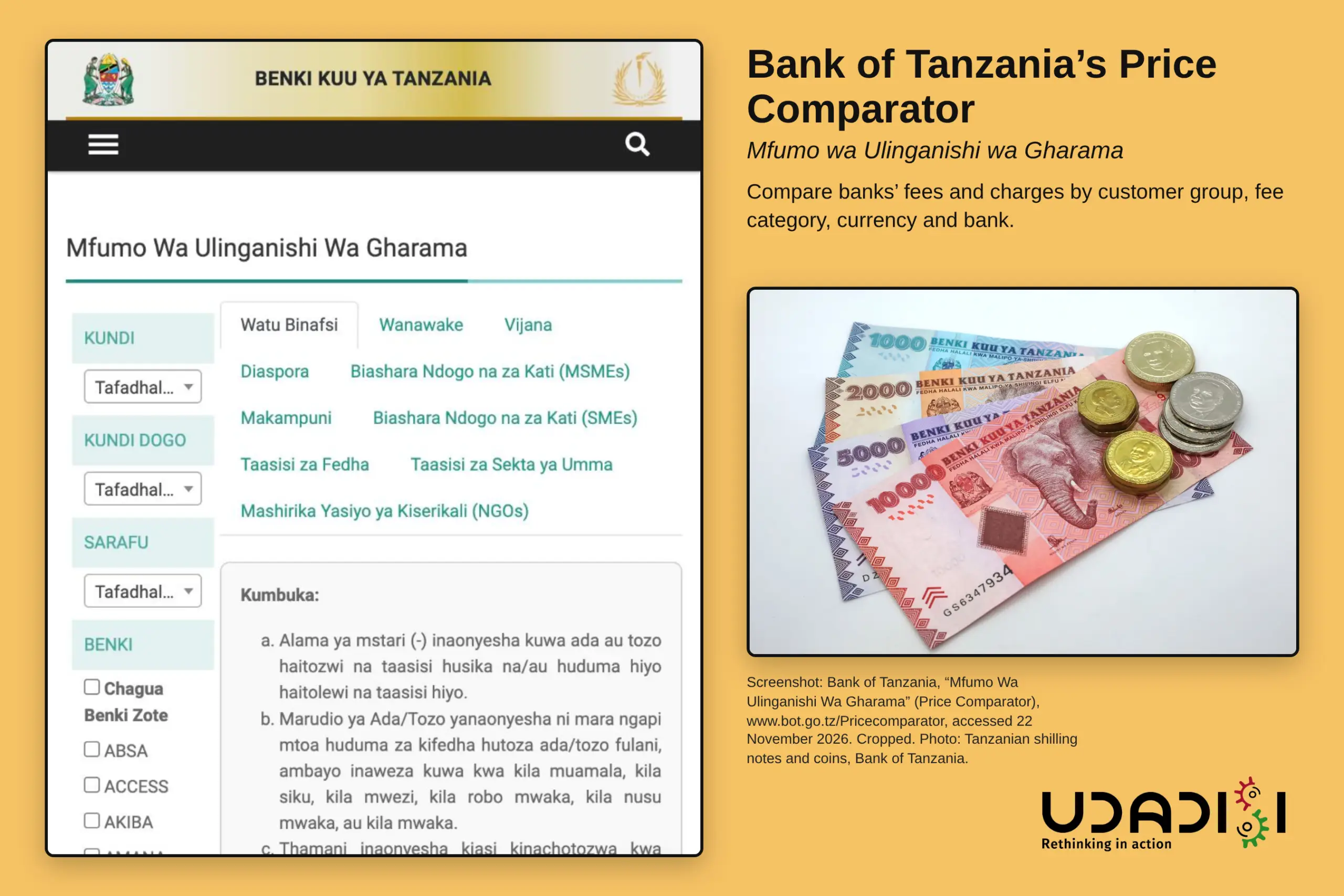
Its official website links to a Price Comparator, and the Bank has published a comparison of banking fees, charges and related requirements. Its published table includes account opening balances, maintenance charges, statement fees, lending fees and ATM withdrawals. That document identifies 4 September 2025 as its data update date—an important reminder that every comparison needs a clear indication of how current it is.[3][4]
This is a useful foundation. Its larger promise lies in what customers can do with the information, and how providers respond when their prices become easier to scrutinise.
For me, the question is whether these improvements will help a trader retain more working capital, a family manage its money more confidently, and an enterprise spend more time producing and selling.
The Kariakoo contribution speaks directly to this concern. As I understand the discussion, the traders welcome the convenience of digital transactions while questioning the accumulated deductions that come with them. They want payment services to support commerce at a reasonable cost.
That is a legitimate expectation.
A digital payment system requires investment. Banks and payment providers must maintain infrastructure, protect transactions, prevent fraud, support customers, and meet regulatory obligations. Commercial sustainability matters. A system that cannot finance its own reliability will eventually disappoint the people who depend on it.
Equally, customers deserve an explanation of what they are paying for and why. Greater use of a system should create opportunities to improve efficiency. I would expect regulators and providers to examine how those gains can reach customers through better service and more affordable pricing.
Consider a purely illustrative business.
Suppose a trader records TZS 1 million in sales and retains a margin of five per cent before certain operating expenses. That leaves TZS 50,000. If the combined payment costs associated with those sales were TZS 10,000, they would consume one-fifth of that margin.
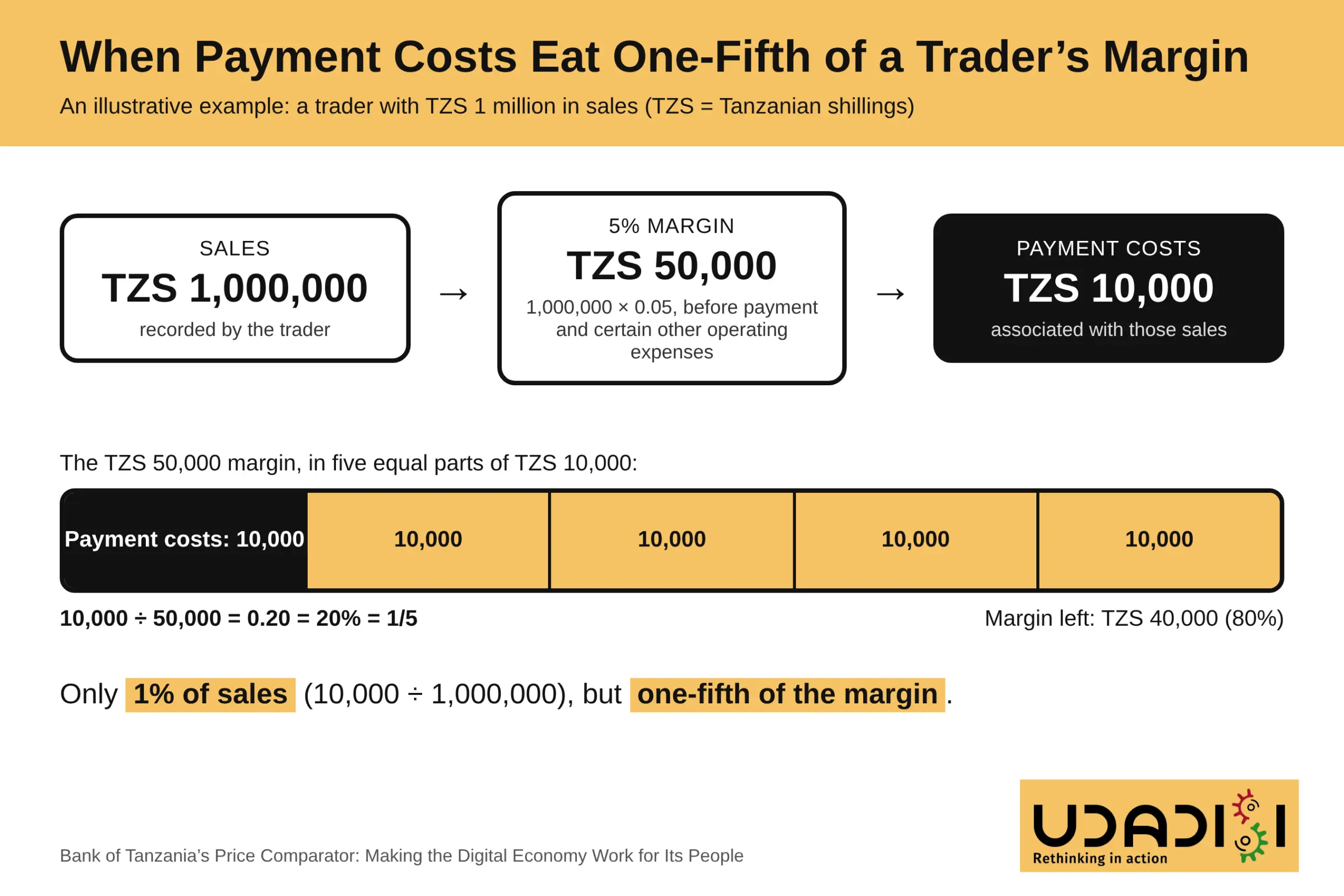
These are hypothetical figures, not a statement of any bank’s tariff. They demonstrate why a deduction that appears small against the value of a transaction can be significant against the income the transaction produces.
A serious affordability discussion should therefore examine customers’ circumstances, transaction sizes and frequency of use. An occasional payment by a salaried professional and repeated payments by a small trader can produce very different monthly burdens.
This is where the comparator could become particularly valuable.
A customer should be able to understand the total cost of using a service for their own purposes. A low account maintenance charge may be outweighed by withdrawal or transfer costs. A service that looks inexpensive in isolation may become costly when money passes through several stages before reaching its final use.
I would like to see comparisons built around recognisable patterns of activity: a household making regular transfers and bill payments; a trader receiving customer payments and paying suppliers; or a small enterprise handling wages and routine purchases.
Customers could enter the activities they expect to undertake and see an estimated monthly cost across comparable products. The assumptions, exclusions and effective dates should be visible. Where a charge depends on the amount transferred or the channel used, that should be explained.
This is a proposal for developing the initiative further. It should not be read as a claim that these functions are already available.
Accuracy in the language of comparison matters too. An opening balance is different from a fee. Money that remains available in the customer’s account should be clearly distinguished from money deducted for providing a service. Minimum balance conditions may still restrict access to funds, but they need their own explanation.
Likewise, a statement that a service is “free” should identify any conditions and the part of the transaction to which it applies. Customers should be able to understand the offer without becoming specialists in financial terminology.
There is also a question of responsibility that deserves greater public clarity.
When a customer sees several deductions, it may be difficult to distinguish a provider’s commercial fee from an applicable government tax or levy. The policy response depends on that distinction. A bank must answer for its own pricing. Government must answer for the fiscal measures it imposes. Where a payment involves several providers, the respective charges should be understandable.
The public discussion becomes more productive when each institution can account for the decisions within its control.
BoT has already issued Guidelines on Fees and Charges for Banks and Financial Institutions, effective from July 2024, with stated objectives that include fairness, competition, and financial inclusion.[5] The continuing task is to make such principles visible in everyday transactions.
That requires cooperation across the institutions responsible for financial regulation, taxation and payment services. If Tanzania encourages citizens to transact digitally, the combined cost of doing so should receive coordinated attention.
A government needs revenue to fund public services. It also needs productive businesses and public confidence. My concern is that excessive or poorly explained costs could weaken the willingness to use formal channels. This is a policy risk to investigate with evidence, rather than assume that every reduction in charges will automatically increase revenue.
We should examine which pricing arrangements encourage sustained use, what customers receive in return, and how the costs of delivering services can be reduced responsibly.
Transparency is essential to this work, but it needs practical support.
A customer may find a cheaper provider and still struggle to switch. A business might have to update supplier instructions, customer payment arrangements, or payroll processes. Someone in a rural area may have limited access to alternative branches or agents. A person who depends on assistance to use digital services may place considerable value on familiar support.
These realities should inform how we understand competition.
Publishing prices gives customers information. Making it reasonably straightforward to act on that information gives them greater bargaining power. I would therefore encourage attention to account opening and closure procedures, clear explanations of switching costs, and the ability to transact conveniently across providers.
Price also needs to be considered alongside service quality.
Imagine a supplier payment that fails while stock is waiting to be released, or a customer whose money is debited without reaching the intended recipient. Until the problem is resolved, that money may be unavailable for another urgent purpose.
For a small enterprise, the cost can include interrupted trading and time spent pursuing assistance. For a household, it can mean uncertainty over money needed for daily life.
I would like BoT and the industry to develop public service measures that help customers understand reliability as well as price. These could include payment success rates, the time taken to reverse failed transactions, and the speed and quality of complaint resolution. Definitions would need to be consistent so that comparisons remain fair.
This would also give providers recognition for delivering dependable service. Customers could make a more informed judgement about value, rather than relying on a tariff alone.
The establishment of Sema na BoT is another welcome development.
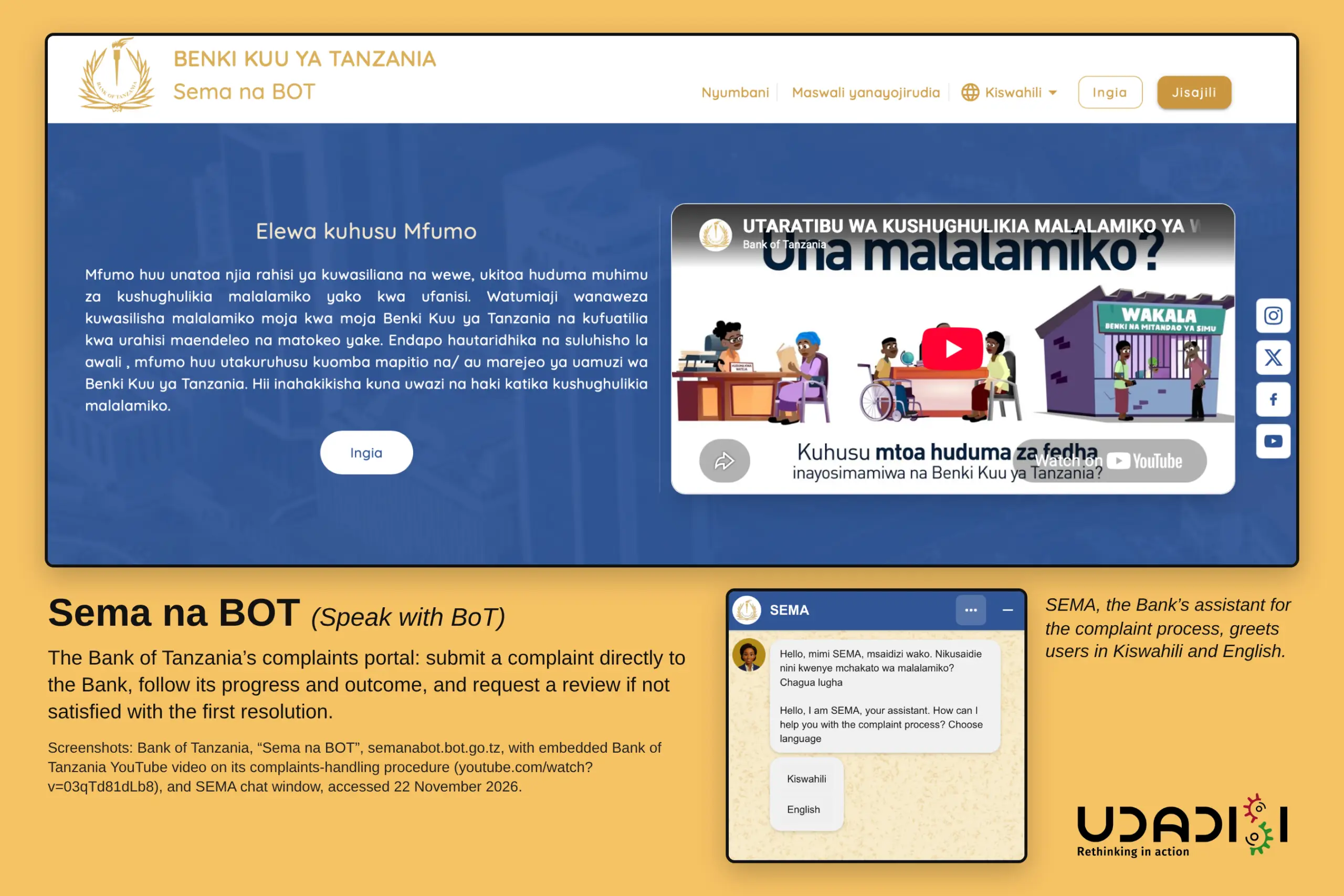
BoT describes it as a platform through which customers can submit complaints, track their progress and request a review of decisions. The Bank also states that its complaint resolution service is free.[6][7]
In the clip, the BoT representative encourages customers to raise concerns with their provider and bring unresolved matters to the regulator. That route should be made widely understood.
Its effectiveness will depend on the experience of the person using it. Can they submit their concern in clear Kiswahili or English? Do they receive a reference and understandable updates? Can someone with limited digital access obtain assistance? Does the response address the substance of the problem?
A complaints system should also help institutions learn. Where cases reveal a recurring weakness in transaction processing, communication, or pricing disclosure, the resulting improvement should reach other customers facing the same problem.
I would welcome publication of aggregate findings that protect personal information while showing what has changed. Citizens should be able to see that speaking up contributes to better services.
There is a wider issue of inclusion here.
We should be careful about treating account ownership or registration as sufficient proof of progress. The experience after registration deserves equal attention: whether a service is affordable to use regularly, whether customers understand it, and whether help is available when something goes wrong.
A comparator that serves only confident internet users would leave an important part of the public behind. Its information should reach people through channels they can use—mobile-friendly pages, accessible explanations, financial education, community organisations, and assistance from trained staff.
As the initiative develops, comparable transparency across banking and other payment services would also be valuable. Customers experience the movement of their money as one journey, even where several institutions are involved. Any expansion should be supported by accurate data and clear comparisons between genuinely comparable services.
Kariakoo’s traders can contribute directly to this work. So can market associations, small business organisations, rural users, and consumer groups.
They can explain the payment patterns that matter, the charges they find difficult to interpret, and the points at which a failed service disrupts their lives. Involving them in testing would help turn a technically sound tool into a useful public service.
This connects with the concern running through my writing on Tanzania’s development and ethical business: progress must be assessed through its effect on people’s ability to participate and prosper.
Ethics has a practical place in financial services and in every essential service on which enterprise and household life depend. It is present when prices are understandable, when customers can give informed consent, when complaints receive fair attention, and when an institution corrects a recurring failure.
Responsible profit supports investment and continuity. Responsible regulation supports a market in which that profit can be earned through useful, reliable services. Both depend on public trust.
BoT’s example should now prompt a wider question about how our regulated markets serve the public.
Banking charges sit alongside the cost of communication, electricity, and insurance in the household budget and the operating costs of an enterprise. Improving one while ignoring the others leaves much of the burden untouched.
I would like Tanzania to adopt a common expectation across regulated services: every provider should publish accurate, understandable prices and material conditions in a standard format, and the responsible regulator should make meaningful comparisons readily available. Existing disclosure obligations should be enforced; gaps should be addressed through the proper legal process. Updates should be required whenever a material price or condition changes, with effective dates and an accessible history.
This should become a public service standard. Providers should submit comparable data electronically, customers should be able to check it without paying, and the regulator should verify it against actual bills and transactions. Common data standards could support several sector tools through a single public access point, while leaving technical responsibility with the relevant regulator. We do not need an expensive new institution to duplicate work that existing institutions can coordinate.
The Tanzania Communications Regulatory Authority (TCRA) is an obvious place to extend this approach.
TCRA already has rules covering bundle tariffs, promotions and special offers, alongside sector competition regulations.[8] Building on that foundation, I propose a comprehensive, continuously updated consumer comparison service covering all licensed providers and relevant retail offers.
For mobile services, the comparison should explain data, voice and messaging allowances, validity periods, restrictions, automatic renewals, and out-of-bundle costs. A household comparing home internet needs installation and equipment costs, contract length, and service availability at its address. Advertised speeds should be distinguished from measured service performance. A cheap package is of little use where the connection cannot support the customer’s work.
The boundary between connectivity and payments also needs to be clear. TCRA should address communications services, while BoT handles payment services within its mandate. A customer using a mobile money service should see where network costs end, and payment charges begin. Coordination should make the transaction easier to understand, with an agreed route for complaints that cross institutional boundaries.

The same principle applies to insurance.
The Tanzania Insurance Regulatory Authority (TIRA) identifies protection of policyholders and beneficiaries, market supervision, and market development among its responsibilities.[9] A regulator-supported comparison framework should help people understand what they are buying across authorised insurers and products.
A premium on its own is an inadequate comparison. Coverage limits, exclusions, waiting periods, deductibles or excesses, payment conditions, and relevant service networks can determine the value of a policy. Comparable product summaries should be accompanied by appropriately contextualised information about claims handling and complaints. A low price should never conceal a protection gap. Personalised quotations would still require the relevant risk information; published examples must state their assumptions.
These arrangements need a strong competition dimension.
I would like the Fair Competition Commission (FCC) to work closely with sector regulators on market studies, misleading pricing, barriers to switching, and potentially anti-competitive behaviour, with findings made public where appropriate. FCC’s consumer and competition functions provide a foundation for that contribution.[10]
This requires a legally clear working arrangement. Sector regulators have their own competition powers, and the relationship with the Fair Competition Act is governed by law.[8][10] My proposal is for coordinated scrutiny across the economy, using the powers each institution lawfully holds, and a review of gaps where those powers prove insufficient. The working arrangement should respect these statutory roles and make responsibility for enforcement explicit.
An agreed referral process, shared evidence, and a public record of unresolved market barriers would help prevent a customer’s problem from disappearing between institutions. Where legislation needs changing, the case should be presented openly. The public should know who is responsible for acting and how the result will be assessed.
Electricity requires particularly careful attention.
Reliable, affordable power influences what a manufacturer can produce, how a workshop operates and whether a small business can invest with confidence. Tanzania’s electricity industry is dominated by the Tanzania Electric Supply Company Limited (TANESCO), which the Energy and Water Utilities Regulatory Authority (EWURA) describes as a vertically integrated, government-owned utility. Private participation and a licensing framework already exist, providing foundations on which reform can build.[11]
Nevertheless, TANESCO’s dominant position warrants a serious examination of how competition, investment, and accountability could improve service. I support an independent options assessment that includes public-private partnerships (PPP), selective concessions, and partial privatisation where a demonstrable public benefit can be established.
NMB Bank provides a Tanzanian example worth studying. Its own history records partial privatisation in 2005 and a subsequent public offering in 2008. Its company profile describes a listed bank with both private and government shareholding.[12] This demonstrates that public participation and private capital can coexist. It does not establish that a banking ownership model can simply be transferred to electricity, or that selling shares automatically creates competition.
A PPP contract and an equity sale are different decisions, with different obligations. Both need scrutiny of asset value, investment commitments, governance, procurement, and the allocation of financial risk. Citizens should understand what the state would retain, what an investor would control, and who would bear the cost if a project underperformed.
The electricity market also has distinct parts. Generation can accommodate competing projects under suitable arrangements. Transmission and much of distribution involve shared networks where duplicating infrastructure may be inefficient. Opening participation therefore requires fair rules for network access, transparent charges for using the grid, credible procurement, and dependable payment arrangements. A privately owned monopoly could otherwise reproduce the problems reform was intended to solve.
EWURA’s technical and economic regulatory responsibilities should anchor the process, with competition expertise from the FCC and specialist engineering, financial, and legal input. EWURA already identifies competition, consumer protection, and the financial viability of efficient suppliers among its duties.[11] The government’s role as policymaker and shareholder should be clearly distinguished from independent regulatory decisions.
Price transparency should develop alongside these reforms. Where customers can actually choose between suppliers or service arrangements, comparisons should show the full delivered cost, including network and connection charges, contract conditions, and any backup requirements. Where a household has only one lawful network supplier, a comparison should explain its tariff and benchmark the provider’s cost and performance. It should not imply a switching option that does not exist.
Any pilot should protect existing users, rural access and essential services. The assessment must address the cost of maintaining the network, service to less profitable communities, public liabilities, environmental obligations, and workforce transition. The public case for reform must rest on better outcomes and sustainable investment, rather than an assumption that a change of ownership is sufficient.
There is a further opportunity linking these reforms to employment: making Tanzania’s skilled technicians easier to find, verify and engage.
I would like every appropriately trained and certified Vocational Education and Training Authority (VETA) graduate, and every practitioner with an equivalent recognised qualification, to have a straightforward route into a public register of competent tradespeople. Customers should be able to search by trade and location, verify qualifications and see the categories of work a person is authorised to undertake. Basic verification should be free, with only necessary professional information made public and personal data protected.
This needs to build on existing arrangements. VETA already operates Recognition of Prior Learning (RPL) through which people who acquired skills outside formal education can be assessed and certified. Its published information also sets eligibility conditions, including experience and age requirements.[13] EWURA already has electrical installation licensing rules, including the 2025 rules.[14] We should connect and improve these systems instead of adding another disconnected register or permit.
A qualification confirms assessed skills; a licence, where required, authorises a defined category of practice. The register should reflect both. Each competent authority should retain its proper licensing role, with authorisation matched to the work a practitioner is qualified to perform. Relevant professional, contractor and sector requirements must remain clear, with unnecessary duplication removed.
Registration should be available through a simple digital application and assisted local services. Institutions should verify qualifications directly rather than repeatedly asking applicants to carry the same papers between offices. Fees should be modest, published and justified by the cost of providing the service. Renewal and refresher requirements should be proportionate to the work and its risks.
Experienced fundis who lack certificates must receive a fair opportunity to demonstrate their competence. Assessment should recognise skills learned through apprenticeship and work, identify gaps and provide accessible bridging or refresher training. Eligibility conditions that unnecessarily exclude capable practitioners, including older workers, deserve review. Mobile assessment teams, evening provision and targeted financial support could help people qualify without abandoning their livelihoods.
Once that route is accessible, funded, and widely publicised, I support a clearly announced transition towards prohibiting independent provision of specified skilled services without the required certification or licence. Implementation should be phased by trade and risk, with firm enforcement for safety-critical work and simplified requirements for lower-risk services. Existing safety duties must continue throughout. Apprentices should have a recognised route to work under competent supervision while they learn.
The preparation matters. Announcing a ban before providing assessment capacity would turn a potentially useful reform into exclusion. The state should publish the timetable, available places, costs, support, and appeal arrangements well before new restrictions take effect. Assessment must test competence fairly, and decisions must be open to review.
Certification alone cannot create demand. Its contribution to jobs would come through connecting trusted technicians with households, firms, and public maintenance work. Procurement packages small enough for local enterprises, fair payment terms, apprenticeships and access to suitable tools could make registration economically useful. Service records could demonstrate experience and help a practitioner progress to larger contracts.
Digital payments would complete an important part of this arrangement. A registered technician should be able to issue a clear quotation and receipt, accept payment through an affordable account or merchant service, and keep useful business records. Customers should retain accessible payment options while adoption grows. Mandatory use of an expensive channel would undermine the purpose of the reform.
BoT’s comparison initiative has a direct role here. Removing unjustified or duplicative charges, improving reliability, and making total payment costs understandable could encourage more practitioners and customers to deposit and transact through formal services. That is a proposition to test. We should measure sustained use, balances, customer experience, and business outcomes, rather than assume that registration automatically produces financial inclusion or access to credit.

These proposals connect to specific parts of Dira 2050.
The first pillar of Dira 2050 [Vision 2050], Strong, Inclusive and Competitive Economy, links to fair markets, enterprise and investment. Human Capabilities and Social Development connects the technicians’ pathway to skills and productive work. Environmental Integrity and Climate Change Resilience connects electricity reform to cleaner investment and long-term resilience. Energy and digital transformation are also identified as drivers, while the implementation framework calls for phased delivery and evidence-based accountability.[15]
The connections are practical. Lower and clearer transaction costs can support trade. Reliable electricity can make investment productive. Verified skills can reduce uncertainty for employers and customers. Better insurance information can help households and enterprises understand protection. Together, these contribute to the Vision, rather than claiming that any single reform will deliver its ambitions.
How should we proceed?
I would propose an initial 12-to-18-month programme for comparison tools and the technician pathway, subject to funding and institutional readiness. Electricity ownership or market restructuring should follow its own feasibility, consultation, and lawful approval process; irreversible decisions should not be rushed to match a software pilot.
During the first three months, the responsible institutions could establish the baseline, map existing systems and legal powers, consult users and agree on costs and responsibilities. The design should include rural users, women, people with disabilities, informal practitioners, and smaller providers. The proposed reforms should use existing institutional capacity wherever possible, with a named lead for each workstream.
During the next six months, selected pilots could test standardised banking and telecom comparisons, comparable insurance summaries, and the practical registration of technicians in a few contrasting locations. An electricity workstream could assess reform options and test suitable service or investment arrangements only where legally and technically ready. Pilot participation should not suspend safety or consumer protection requirements.
The remaining period should allow independent evaluation, correction, and a published decision on expansion. Specialists should agree the measures before implementation, so that success cannot be redefined after results arrive. Where feasible, comparison groups or phased introduction would help distinguish the reform’s effect from wider economic changes.
The measures should include customers’ total costs and time spent resolving problems; the accuracy and use of comparisons; successful payments and reversal times; and sustained use of financial services. For technicians, we should track time and cost to certification, verified work obtained, net earnings, apprenticeships, repeat business, and safety outcomes. New registrations must be distinguished from genuinely additional jobs. Electricity options should be judged against reliability, connection times, investment, total delivered costs and public financial exposure.
Funding should support delivery, assessment capacity, and independent evaluation, with procurement and expenditure open to scrutiny. Public comparison results should not be sold to the highest bidder or influenced by commissions. If published prices appear to converge in ways that weaken competition, regulators should investigate; transparency tools themselves need monitoring and careful design.
Professional leadership is essential. I want engineers to lead engineering analysis, economists to assess competition and affordability, vocational specialists to define competence, and qualified financial and legal experts to examine investment and obligations. User organisations must help test whether the arrangements work in practice. Appointments should be based on competence, with conflicts of interest declared.
Political leadership should establish the public purpose, authorise lawful reform and remain accountable through public institutions. Day-to-day decisions on tariffs, licences, assessments, procurement, and technical findings should be protected from partisan interference and favours. Expert leadership must remain transparent and answerable; professional independence is compatible with parliamentary scrutiny, consumer participation and lawful appeal.
Finally, regulators should be evaluated primarily on the quality, safety, accessibility, and fairness of the markets they oversee. Necessary fees can finance competent regulation, but rising collections and penalties should not become the principal measure of achievement. Annual reports should show what improved for users and providers, what obstacles were removed and which problems remain. This is the service orientation I would like BoT’s example to encourage across our institutions.
For the next phase, I would encourage a clear set of public commitments: current and verified comparison data; understandable estimates of total usage costs; transparent identification of deductions; dependable transaction handling; and evidence that complaints lead to corrective action.
The industry and regulator could establish a baseline and report progress against it. That would allow citizens to judge improvement over time and give policymakers better evidence for further decisions.
The Bank of Tanzania has taken a constructive step.
The business community has responded with appreciation and a practical challenge. TCRA, EWURA, TIRA, FCC, VETA and the other institutions concerned can build on this example through a coordinated programme of practical improvements. Some foundations already exist; others require new decisions. Each deserves a fair test.
As we pursue Dira 2050, we should take these everyday systems seriously. A payment made successfully, at a fair and clearly explained cost, helps someone complete a sale, pay a supplier, or support a family. Repeated across the economy, those experiences shape confidence in the institutions carrying our development ambitions.
I welcome BoT’s price comparator and its efforts to strengthen consumer redress. I want that example to travel further: into communication services, electricity, insurance, and the opportunities available to skilled Tanzanians. Businesses and citizens should help shape, test, and assess these reforms, with findings guiding what we change and what we expand.
The promise of a digital economy becomes meaningful when the people who keep the economy moving can afford to participate, rely on its services, and obtain a fair hearing when they are let down.
Sources and references
- Kikeke DIGITAL on YouTube — BENKI KUU TANZANIA BOT, HII LEO WAFUNGUKA. The author watched the discussion, and it prompted this article on this channel.
- BoT Financial Sector Supervision and Payment Systems Overview.
- Bank of Tanzania Price Comparator, linked from the official BoT website.
- BoT Detailed Comparison of Banking Institutions Fees and Charges and Related Costs. The document identifies 4 September 2025 as its data update date; its figures are not presented here as current tariffs.
- BoT Guidelines on Fees and Charges for Banks and Financial Institutions 2024.
- BoT account describing Sema na BoT and the Sema na BoT portal.
- BoT Procedure for Resolving Complaints from Users of Formal Financial Services.
- TCRA regulatory rules, including bundle tariffs, promotions, and special offers, and the Electronic and Postal Communications Competition Regulations 2018.
- TIRA functions and responsibilities.
- FCC consumer information; SIDO explanation of FCC functions; Fair Competition Act 2003, including section 96, WIPO Lex. Any implementation requires review against the laws and sector rules then in force.
- EWURA Electricity Infrastructure, Licensing and Registration, and regulatory functions. The electricity proposals concern Tanzania Mainland, where EWURA exercises these responsibilities; extension to Zanzibar would require its own competent authorities and legal arrangements.
- NMB history and company profile.
- VETA Recognition of Prior Learning.
- EWURA Electricity (Electrical Installation Services) Rules 2025.
- United Republic of Tanzania Development Vision 2050, National Planning Commission, 2025. Relevant provisions include sections 4.1, 4.2 and 4.3; energy and digital transformation in sections 5.2 and 5.5; and implementation in sections 7.2–7.5. The proposed programme and its expected contributions are the author’s interpretation and recommendations.

Leave A Comment